
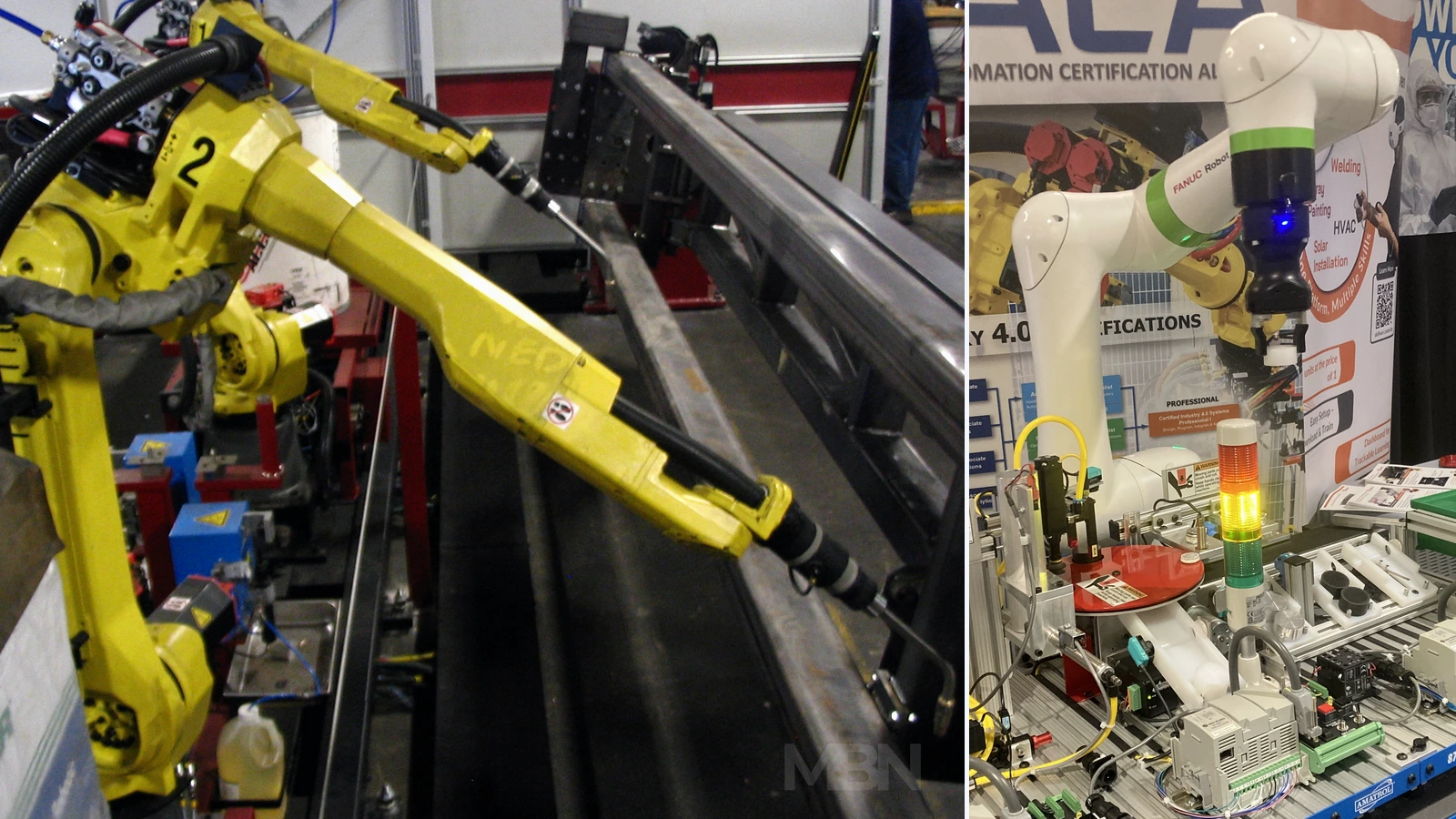
FANUC America and Palladyne AI have announced a collaboration to make industrial robots easier to deploy and adapt to changing tasks, targeting manufacturers and warehouse operators for whom programming and setup remain barriers to automation.
The September 8 announcement pairs FANUC’s robots with Palladyne IQ, software designed to help machines respond to changes around them.
The announcement gives no contract value, customer orders, commercial launch date, or measured savings from the collaboration. Its commercial case rests on reducing the work required to turn a robot into a reliable part of a production process.
Changing the task can change the economics
Buying a robot arm is only part of an automation project. The machine must be programmed, connected to equipment, and configured for the objects and movements involved in the job.
The International Federation of Robotics has identified programming as a substantial part of adoption costs. In an earlier analysis, it described how software tied to individual robot manufacturers made it difficult to reuse an application on another machine.
That creates a problem for factories producing small batches of different products. A process that pays for itself when repeated thousands of times may be harder to justify if engineers must frequently reconfigure it.
The federation has described several ways to reduce that work, including reusable programming blocks and teaching a robot by guiding its arm through a movement. Such approaches can make automation more accessible to production staff, although demanding tasks still require specialist expertise.
Palladyne and FANUC’s planned work includes motion planning, which determines how a robot moves through a task, and human-assisted learning. They also intend to use simulation to train and test systems, and teleoperation, in which a person controls a machine remotely.
The partners will work on repeatable setup procedures for customers and system integrators, the businesses that combine robots, software, and other equipment into a functioning installation.
Palladyne has already tested software on FANUC hardware
The companies’ technologies have appeared together before. In a June 2025 company announcement, Palladyne said it had demonstrated autonomous surface treatment using its IQ software on a FANUC M710 robot under a US Air Force project.
The task involved directing abrasive material at aircraft components, a process known as media blasting. Palladyne said the system controlled factors including the distance from the surface, the angle, and the speed of movement.
It also reported sanding work using a Universal Robots UR10e. These were company-reported project milestones involving particular tasks and equipment. They provide background for the new collaboration, but do not establish its future performance across factories and warehouses.
For customers, reducing programming effort would address one expense. The investment still has to deliver acceptable output, product quality, and operating reliability. A robot that needs frequent intervention can consume some of the staff time it was intended to save.
Our recent coverage of why hands-on jobs remain less exposed to AI examined the difficulty of moving from software assistance to physical work. Factory applications offer a more defined setting, but each installation still has to deal with real objects and the surrounding production process.
FANUC is pursuing several routes into AI
The Palladyne collaboration sits alongside other FANUC initiatives. In March, FANUC announced work with NVIDIA on AI computing and simulation, including links between FANUC’s ROBOGUIDE software and NVIDIA’s Isaac Sim.
Simulation lets engineers build a digital representation of equipment and test a process before installing it. FANUC says the approach can reduce commissioning time, the period spent checking and preparing equipment for operation.
In its September 3 preview of IMTS 2026, the manufacturing technology exhibition, FANUC outlined planned demonstrations of robots responding to handwritten instructions and generating programs from verbal commands.
The Palladyne announcement leaves customer validation and standardized deployment procedures among the work still to be completed, with no timetable for either.
