

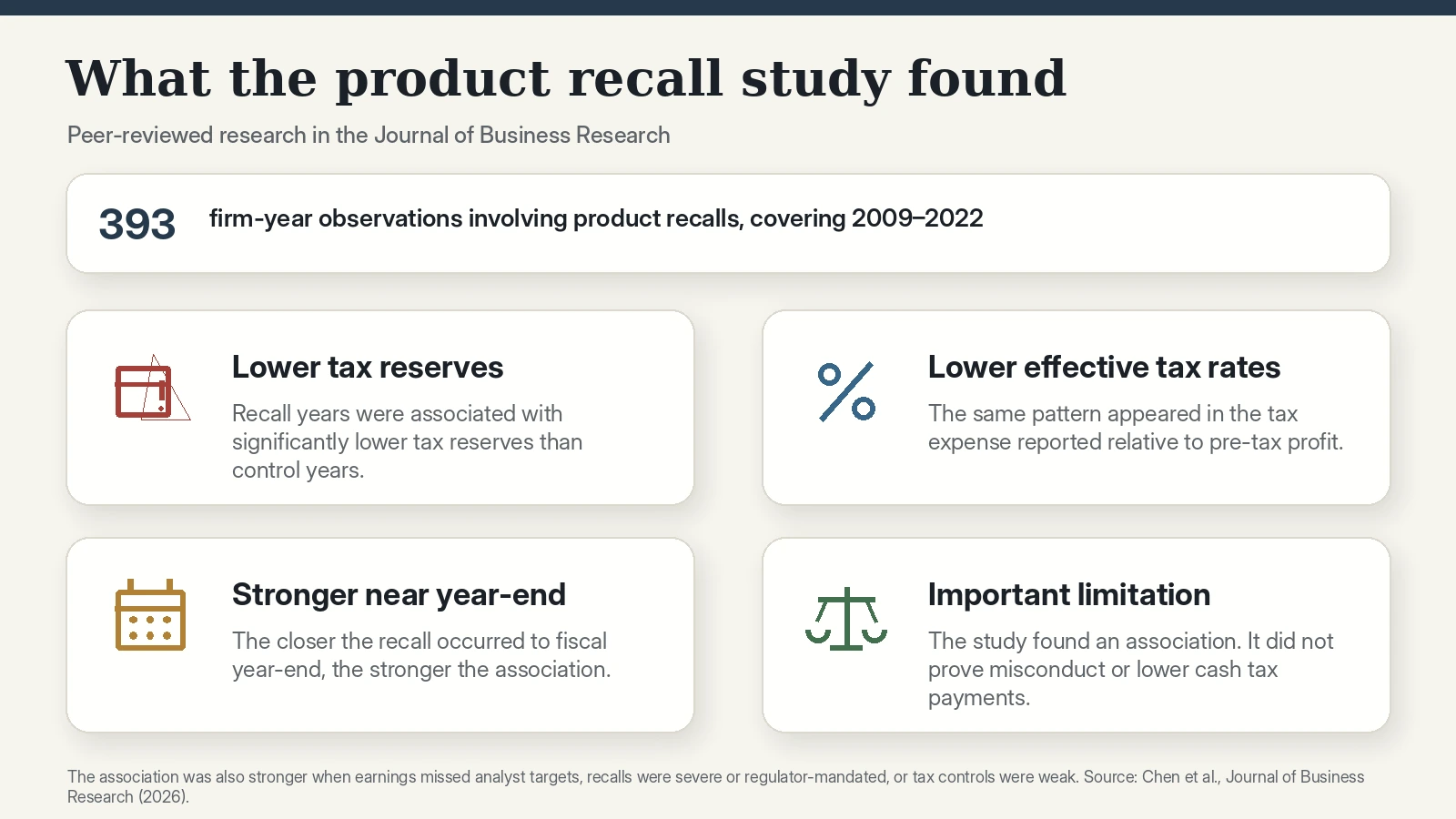
A study of 393 firm-year observations found that companies affected by product recalls reported lower tax reserves and effective tax rates than control firms. The pattern was stronger when recalls happened close to the end of the financial year.
Product recalls usually bring visible costs. Companies may have to collect or repair products, refund customers, stop production, dispose of stock and deal with legal claims.
New research suggests investors may also need to examine a less obvious part of the accounts: the income tax line.
The peer-reviewed study, published in the Journal of Business Research, found that company-years involving product recalls were associated with lower tax reserves and lower effective tax rates than control company-years.
The link was stronger when the recall happened closer to the company’s financial year-end.
The finding does not prove that companies deliberately changed their tax reporting because of a recall. It does, however, point to a part of recall accounting that can easily be missed when attention is focused on repair bills and lost sales.
What the researchers examined
The study was conducted by Yifei Chen, Dan Palmon, An Qin and Dan Ding.
Its sample contained 393 firm-year observations involving product recalls between 2009 and 2022.
A firm-year means one company observed during one financial year. The figure should not be read as 393 separate companies or 393 individual recall announcements.
The researchers collected recall information from three US regulators: the Consumer Product Safety Commission, the Food and Drug Administration, and the National Highway Traffic Safety Administration.
They then compared the tax reporting of company-years involving recalls with control company-years used in the analysis.
On average, the recall observations showed significant reductions in both tax reserves and effective tax rates.
This was a pattern across the sample. It does not provide a fixed amount by which a recall should be expected to reduce a particular company’s tax expense.
How the tax line can affect final profit
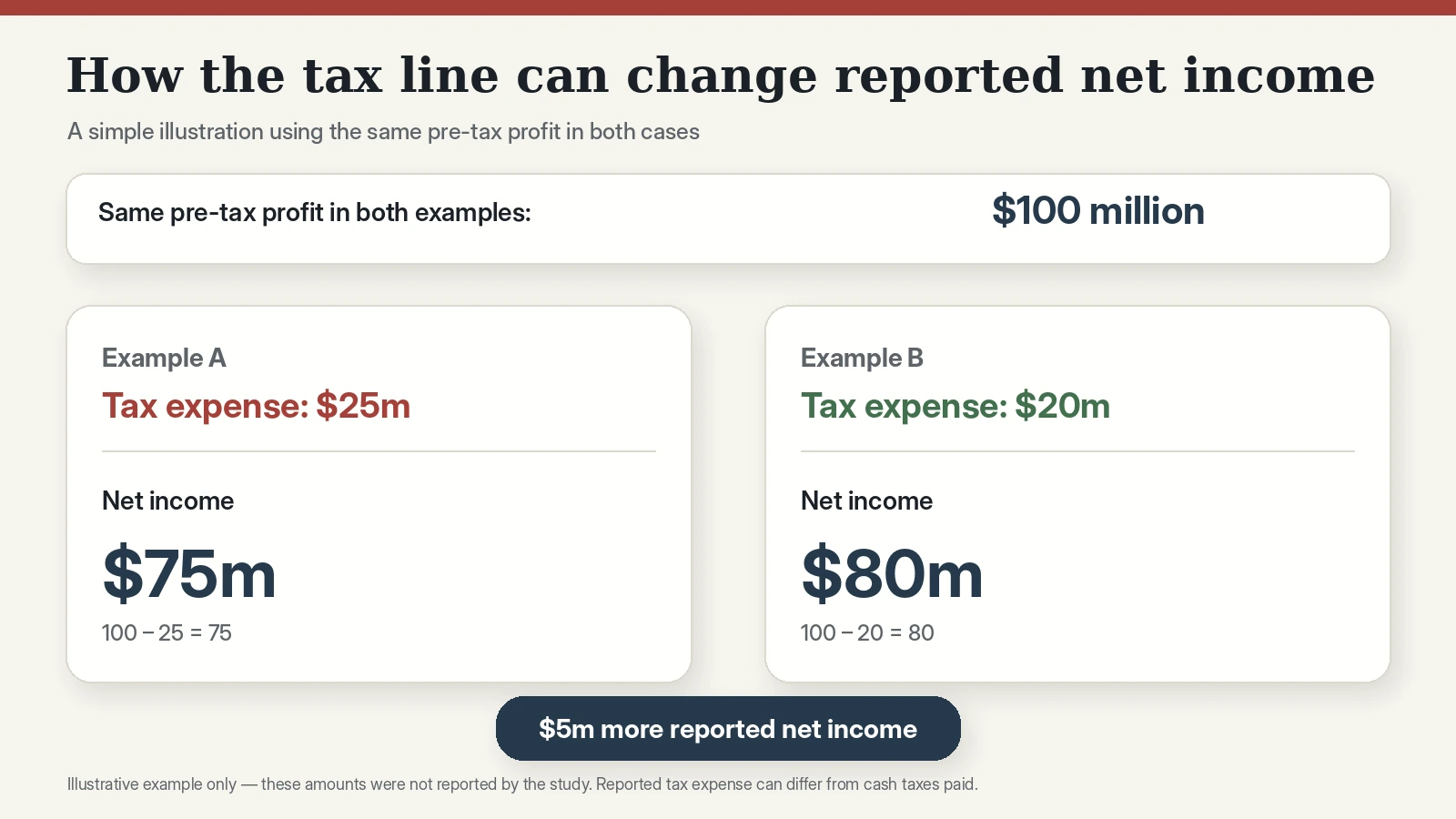
A company first calculates its profit before tax. It then records income tax expense to arrive at its final net income.
Consider a simplified example.
A company with $100 million in pre-tax profit and $25 million in tax expense would report net income of $75 million.
If the reported tax expense fell to $20 million, net income would rise to $80 million. The company would appear to have earned $5 million more, even though its sales and operating profit had not changed.
This example is only an illustration. It is not a result taken from the study.
Accounting researchers have previously described year-end tax expense as a possible “last-chance” way to influence reported earnings. The reason is that the tax calculation is made after much of the company’s pre-tax performance is already known.
The new study uses the same idea to explain why the timing of a recall may matter.
If a serious recall happens late in the year, management has little time to recover lost sales, reduce operating costs or change production. The tax calculation may be one of the remaining areas containing estimates that can affect the final profit figure.
The researchers describe their findings as consistent with companies using tax reporting as a “last-chance earnings management” tool. The word “consistent” is important: the statistical result does not establish the intention of any individual manager.
What a tax reserve actually is
A tax reserve is not normally a separate pot of cash kept for a future tax bill.
In this context, it is an accounting liability connected to a tax position whose final outcome is uncertain.
A company may claim a deduction, credit or other tax benefit on its tax return. It must then decide how much of that benefit it can recognise in its financial statements if the position is examined by a tax authority.
The Internal Revenue Service refers to these amounts as liabilities for unrecognised tax benefits. US accounting guidance sets rules for recognising and measuring such uncertain tax positions.
A company may later reduce a reserve if new information makes the tax position appear more likely to succeed.
Reserves can also change after a settlement with a tax authority, the end of a legal time limit for an examination, a court decision or a reassessment of the available evidence.
Depending on the circumstances, releasing part of a tax reserve can reduce reported tax expense and increase net income.
These adjustments can be entirely legitimate. A lower tax reserve is not, by itself, evidence of misleading accounts or illegal tax avoidance.
The pattern was stronger under greater financial pressure
The researchers found that the link between recalls and lower tax reserves was stronger when earnings calculated before the tax adjustment were below analysts’ forecasts.
It was also stronger when:
- The recall was more severe
- The recall had been required by a regulator
- The company had weaknesses in its tax-related internal controls
- The company’s auditor was handling a heavier workload
- Managers had stronger equity-based incentives linked to risk
By contrast, the association became weaker when companies faced greater concern about their reputation or more public scrutiny.
That result is consistent with close attention from investors, customers, regulators and the media limiting the room for aggressive estimates. The study does not prove that this was the reason for the weaker association.
It also does not show that busy auditors or weak controls directly caused inappropriate tax adjustments. These were conditions under which the statistical relationship was stronger.
Reported tax expense is different from cash tax paid
An effective tax rate shows how reported income tax expense compares with pre-tax profit.
In simple terms, a company reporting $20 million in tax expense on $100 million in pre-tax profit would have an effective tax rate of 20%.
That figure can change for many reasons, including:
- The countries or states in which the company earned its profit
- Tax credits and deductions
- Settlements with tax authorities
- Changes in tax law
- Changes in the expected use of past tax losses
- Reassessments of uncertain tax positions
A lower effective tax rate does not necessarily mean that the company paid less cash to tax authorities during the same year.
Accounting tax expense and cash tax payments can differ because payments, deductions and benefits may be recognised at different times.
The study should therefore not be reported as evidence that companies stop paying tax after product recalls. It examined how tax costs were reported in the financial statements.
What investors can check after a recall
A company’s annual Form 10-K contains financial statements and detailed notes explaining important accounting figures.
After a major recall, investors can examine several parts of the report:
- Pre-tax profit and net income: Did final net income hold up better than operating performance?
- The effective tax rate: Did the rate fall sharply compared with previous years?
- The tax-rate reconciliation: What reasons did the company give for the change?
- Unrecognised tax benefits: Did the company release a large part of an existing tax reserve?
- Cash taxes paid: Did actual payments move in the same direction as reported tax expense?
A falling tax rate is not automatically a warning sign. The useful question is whether the company provides a clear explanation that matches the change shown in its accounts.
Investors can also compare the tax benefit with the cost of the recall. A tax adjustment that materially protects net income may deserve closer attention when the company’s underlying operations have weakened.
What the study does not prove
The research identified an association. It did not prove that product recalls caused companies to reduce their tax reserves or effective tax rates.
It also did not prove that managers at the companies studied acted dishonestly, broke tax law or deliberately misled investors.
The results describe an average pattern within a sample of 393 firm-year observations from 2009 to 2022. They cannot establish the intentions behind a tax adjustment made by a particular company.
Other factors may have affected both the recalls and the tax figures, even though the researchers used control observations and additional tests to examine the relationship.
The study also focused on recalls recorded by US regulators. Its results should not automatically be applied to every country, industry or type of corporate crisis.
Why the finding is useful
A product recall is usually treated as an operational, legal and public-relations problem.
The study suggests that it may also create pressure around financial estimates, particularly when the recall arrives late in the reporting year and earnings are already below expectations.
For boards and audit committees, that provides a reason to give tax estimates and internal controls additional attention during a product crisis.
For investors, the practical point is simpler. The cost of a recall may appear near the top of the income statement through lost sales and added expenses. Part of the response may appear much further down, where the tax calculation affects the profit finally reported to shareholders.
