
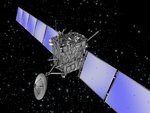
The Rosetta probe, which is orbiting Comet 67P/Churyumov-Gerasimenko, is helping scientists understand how comets were formed. New photographs of the icy object show it has a lumpy texture in places that researchers believe may have been the comet’s original building blocks.
The international team of scientists is calling them goosebumps, which sounds apt given that the object looks a bit like a duck.
If the team is right – that the lumpy texture can tell us about comet formation – it represents a major milestone in space research.
The scientists wrote in the journal Science (citation below) that the comet’s coma (atmosphere) is not as homogeneous as expected. Over time, its outgassing varies considerably.
Lead author in one of the articles published in Science this week, Dr. Myrtha Hässig, a postdoctoral researcher at Southwest Research Institute (SwRI) in San Antonio, Texas, said:
“If we would have just seen a steady increase of gases as we closed in on the comet, there would be no question about heterogeneity of the nucleus. Instead we saw spikes in water readings, and a few hours later, a spike in carbon dioxide readings. This variation could be a temperature effect or a seasonal effect, or it could point to the possibility of comet migrations in the early solar system.”
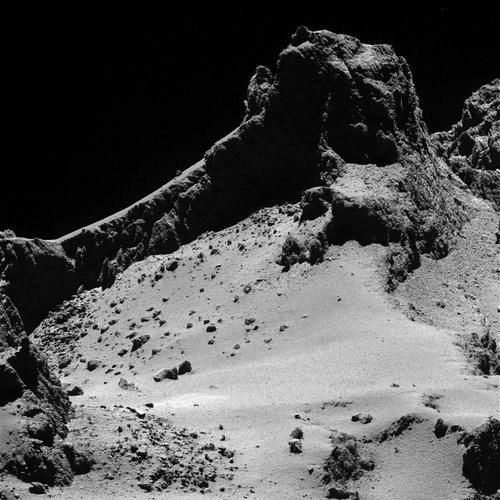
The Rosetta probe has taken some spectacular photographs of comet P67. (Image: European Space Agency)
Colleague Dr. Hunter Waite, a program director and planetary scientist, said:
“Our whole concept of the variability of volatile release at comets will change based on this paper, which will have significant impact on our understanding of comet formation and evolution.”
Comets are cosmic balls made of frozen gases, rock and dust that orbit the Sun. As they get closer to the Sun they heat up and outgas, displaying visible atmospheres. They typically have tails.
Comets contain data on our solar system’s history
Astronomers say comets contain some of the best-preserved material from the formation of our solar system, offering important clues about the physical and chemical conditions that existed soon after our planetary system was born.
After reaching 67P in August 2014, the European Space Agency Rosetta spacecraft made history by landing a space probe on the comet’s surface in November. Even though the lander is now in hibernation, Rosetta continues performing 11 experiments that will help us understand comets better as it approaches the Sun.
Dr. Stephen Fuselier, a director in the SwRI Space Science and Engineering Division, said:
“From a telescope, images of a comet’s atmosphere suggest that the coma is uniform and does not vary over short periods of hours or days. That’s what we were expecting as we approached the comet. It was certainly a surprise when we saw time variations from 200 km away.”
“More surprising was that the composition of the coma was also varying by very large amounts. We’re taught that comets are made mostly of water ice. For this comet, the coma sometimes contains much more carbon dioxide than water vapor.”
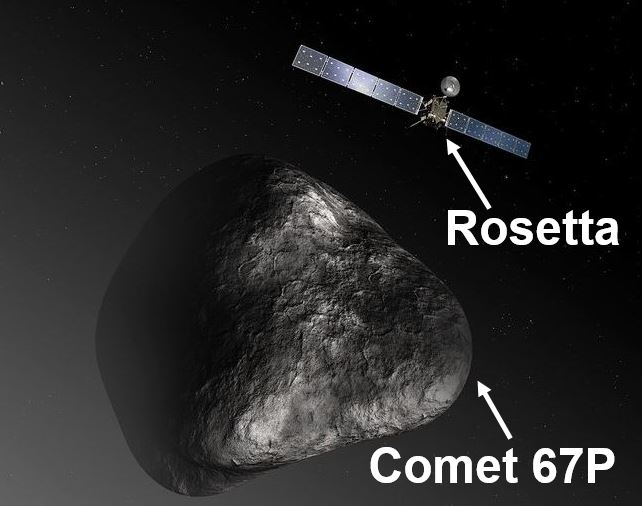
The Rosetta probe will continue orbiting Comet 67P as it approaches the Sun. (Image source: European Space Agency)
The Rosetta mission provides astrophysicists and other scientists an opportunity for long-term study of a comet during its sunward-approaching phase of its orbit. The data being discussed are from the first two months since the probe’s rendezvous with 67P.
According to in situ measurements of the coma, ROSINA (Rosetta Orbiter Spectrometer for Ion and Neutral Analysis) data indicate that the H2O (water) signal is strongest overall. However, levels of CO and CO2 sometimes rival that of H2O.
Dr. Hässig said:
“These large fluctuations in composition in a heterogeneous coma indicate diurnal or day-night and possibly seasonal variations in the major outgassing species.”
“When I first saw this behavior, I thought something may have been wrong, but after triple-checking the data, we believe 67P has a complex coma-nucleus relationship, with seasonal variations possibly driven by temperature differences just below the comet surface.”
Comet 67P’s nucleus consists of two different sized lobes, connected by a neck region. This complex, duck-like shape probably plays a key role in this variation, as different portions of the nucleus face the sun during the comet’s diurnal rotation cycle of 12 hours.
Variations in the coma’s composition suggest that the nucleus might have formed by collision of smaller bodies that originated from very different regions of the early solar system, the authors say.
Rosetta scientists say they will be studying seasonal variations as well as the comet continues its 6.5-year orbit around the Sun.
Rosetta is a European Space Agency mission with contributions from EU-member states and NASA. The Rosetta spacecraft was built by Airbus Defense and Space.
Citation: “Catching a comet.” This special issue of the journal Science contains the first published scientific results from Rosetta at comet 67P.
Video – Rosetta’s 12-year journey through space
