
The global market for wearable technology is expected to more than triple between 2016 and 2022 to reach US$51.60 billion at an annual compound growth rate of 15.5 percent.
So concludes a new Markets and Markets report that cites rising consumer demand for hi-tech gadgets, increasing availability of new display technology, and the advent of greater connectivity via the Internet of Things (IoT) as the key drivers of wearable technology.
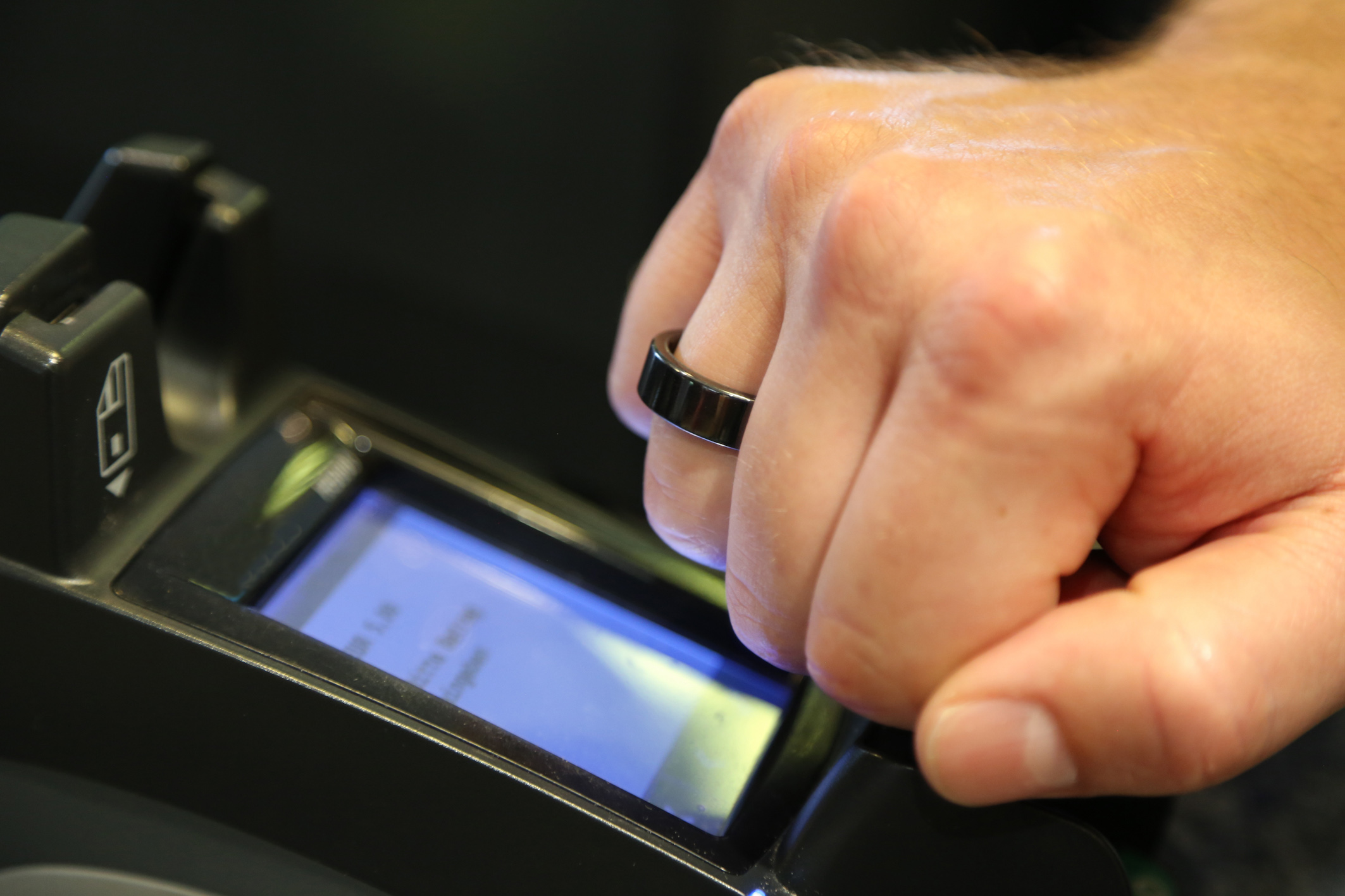
 The world’s first smart payment ring incorporates a chip that allows it to be used like a contactless payment card using NFC technology. Credit: Infineon Technologies AG
In some respects, the idea of “wearable technology” is not new and has been around for centuries – take for example the tiny but fully workable Chinese abacus ring.
But nowadays, what we mean by wearable technology is more akin to the contactless payment ring, that allows the wearer to make contactless payments thanks to near field communication (NFC) technology.
Wearable “electronic intelligence”
Essentially, “wearable technology” is any form of electronic “intelligence” that can be worn on the body, either as a device or as material used in clothing.
However, what is making wearable technology increasingly interesting and more widespread, is its capacity to connect wirelessly to the Internet, and send and receive data in real time.
Thus, the humble pedometer that was hailed as the ultimate fitness device less than a decade ago evolved into a sophisticated wrist band or smartwatch app that not only counts steps but measures lots of other activity (or inactivity), analyses it for you, and also allows you to share the results with friends or your fitness trainer in real time.
Leaving the smartphone behind
Now, the evolution is entering another step – thanks to increased connectivity left right and centre – for instance to the Internet of Things (IoT).
One example of where this is leading is that the smartphone does not have to be in your hand all the time to use it.
This is the “always-on connectivity” that wearable tech companies like Qualcomm are promoting.
We can get a taste of this in the growing number of things we can do with a smartwatch – such as using the apps on your smartphone, whether it is in your pocket or miles away, as long as the two devices are connected in some way, such as via Bluetooth or over the Internet.
Thanks to platforms such as Android Wear Apps, smartwatches are taking on the role that used belong to smartphones, such as getting map directions, messaging, making phone calls, playing music, booking flights, checking the weather, reading the headlines, and ordering pizza.
So far, by means of illustration, this article has confined itself mainly to one part of the wearable technology market – namely some devices in the consumer electronics segment. There is also a whole other area that is emerging thanks to smart textiles or e-textiles, for which a set of slides from the National Physical Laboratory in the United Kingdom provides a concise overview.
But the market is expanding in all kinds of other directions as well, which the new report explores in detail and segments in different ways.
Structure of the report
The report segments the wearable technology market not only in terms of the wearable products themselves but also in terms of the supply chains and technologies involved in bringing them to market. For example, it breaks down the market by:
– Types: such as smart textile or devices
– Products: such as wristwear, headwear, eyewear, neckwear, bodywear, footwear
– Technologies: including computing, display, networking, sensor, and positioning
– Components: such as to make power, sensing, control, memory, and interface modules
– Software and services: such as operating, network, security, wireless, cloud, and data systems
– Applications: for instance healthcare, consumer electronics, and industrial
It also maps this breakdown onto four main regions (Americas, Europe, Asia-Pacific, and Rest of the World), giving the main countries in each case.
The report describes the “ecosystem” of the wearable technology market as including: “research and development associations, component manufacturers and suppliers, wearables product manufacturers, software solution providers, and end users.”
The report also lists many of the major players in the wearable technology market, including: Fitbit, Apple, Xiaomi, Garmin, Samsung, BBK, Misfit, Alphabet, LG, Qualcomm, Adidas, Sony, Jawbone, and Lifesense.
