
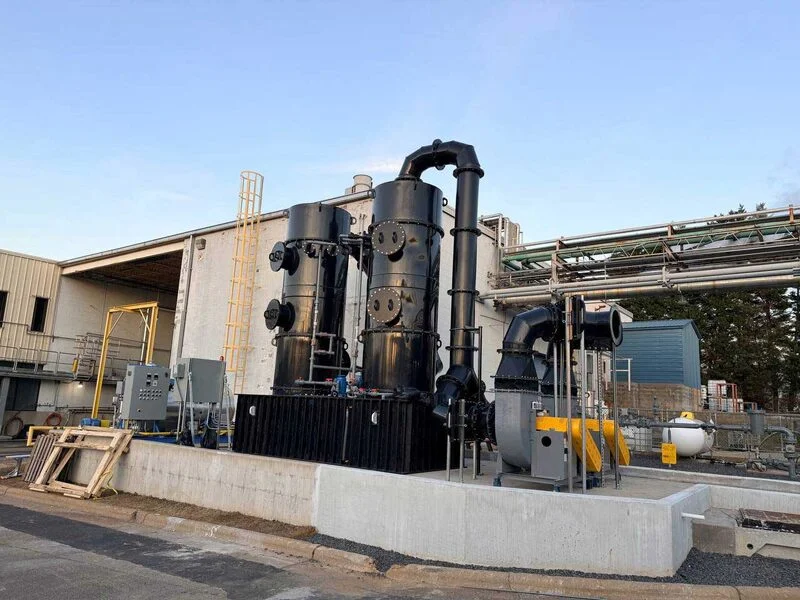
Bromine-containing gas streams require carefully engineered treatment because bromine is highly reactive, volatile, and corrosive. In industrial manufacturing, a properly designed bromine absorption tower provides an effective gas-liquid contact zone where bromine vapour can be transferred from a contaminated gas stream into a circulating liquid and, when appropriate, chemically converted into a more stable form.
For engineers and plant operators, understanding the change in bromine vapour in an absorption tower is essential for selecting the correct tower configuration, packing, absorbent, materials of construction, and operating conditions.
What Is a Bromine Absorption Tower?
A bromine absorption tower is an industrial wet-scrubbing system designed to remove bromine from a gas stream through contact with a liquid absorbent. The tower commonly operates in counter-current flow: contaminated gas enters from the lower section while the absorbing liquid is distributed from the top.
Inside the tower:
● Bromine vapour contacts the wetted packing or liquid droplets.
● Bromine transfers from the gas phase into the liquid phase.
● A suitable chemical absorbent can react with dissolved bromine.
● The treated gas leaves through the upper section.
● The bromine-containing liquid is collected for recirculation, treatment, recovery, or disposal.
This approach is particularly relevant to chemical processing and other industrial operations in which bromine vapour may be generated during bromine recovery, handling, reaction, or related manufacturing processes.
What Happens to Bromine in an Absorption Tower?
The answer depends strongly on the composition of the circulating liquid. Bromine can first dissolve into the liquid film and then participate in a chemical reaction.
When a reactive absorbent is used, chemical absorption can greatly improve the overall capture process. For example, alkaline solutions can convert bromine into bromide and bromate species, while reducing solutions can convert bromine into hydrobromic acid and other products.
This is why a bromine scrubber is more than a simple liquid filter. The system combines:
1. Gas-liquid mass transfer
2. Dissolution of bromine
3. Chemical reaction where applicable
4. Liquid circulation and reagent management
5. Removal of residual droplets before gas discharge
The chemical reaction helps maintain a concentration gradient that encourages additional bromine to move from the gas phase into the liquid.
Change in Bromine Vapour in Absorption Tower Operation
The change in bromine vapour in absorption tower service can be understood by following the gas stream from the inlet to the outlet.
At the tower inlet, the gas may contain a relatively high concentration of bromine vapour. As the gas travels through the contact zone, it repeatedly encounters fresh or partially regenerated absorbing liquid.
The concentration generally decreases progressively through the tower.
1. Bromine enters the contact zone
The contaminated gas enters the lower portion of a counter-current tower. Its bromine content provides the driving force for mass transfer toward the liquid.
2. Bromine contacts the liquid
Packing creates a large wetted surface area. The liquid forms a film over the packing while the gas travels through the available void space.
This arrangement increases the interface between the two phases and promotes bromine transfer. Packed towers are widely used for gas absorption because packing substantially increases gas-liquid contact area.
3. Bromine dissolves and reacts
Once bromine reaches the liquid phase, the selected absorbent determines what happens next. Chemical absorption can bind bromine into less volatile compounds, reducing its tendency to return to the gas phase.
4. Residual bromine leaves at a much lower concentration
By the time the gas reaches the upper section, most of the targeted bromine has been transferred to the liquid, provided that the tower has been correctly sized and operated.
Bromine Absorption Tower Diagram: Understanding the Flow
A typical bromine absorption tower diagram can be represented conceptually as follows:
Bromine-containing gas → Gas inlet → Packed/contact zone → Mist eliminator → Treated gas outlet
At the same time:
Absorbent → Liquid distributor → Wetted packing → Collection sump → Recirculation pump/cooler → Liquid distributor
The counter-current arrangement allows the cleanest absorbing liquid to contact gas that has already passed through much of the tower. This can help maintain the mass-transfer driving force along the column.
Industrial absorption systems may also incorporate liquid recirculation, cooling, fresh reagent addition, bleed-off, and multiple absorber stages depending on the required removal performance.
Why Tower Design Matters for Bromine Vapour
Bromine service places demanding requirements on equipment design. The tower must provide sufficient gas-liquid contact while also resisting the corrosive environment.
Important design considerations include:
● Gas flow rate and operating velocity
● Bromine concentration at the inlet
● Required outlet concentration
● Absorbent chemistry
● Liquid circulation rate
● Packing type and surface area
● Pressure drop
● Operating temperature
● Mist eliminator performance
● Materials compatibility
● Reagent concentration and control
● Required number of absorption stages
Tower capacity and packing dimensions should be calculated from the actual gas flow, inlet and outlet concentrations, physical properties, liquid rate, and selected contact technology rather than relying on generic dimensions.
Bromine Vapour in Absorption Tower: The Role of Temperature
Temperature is another important variable when treating bromine vapour.
Bromine is volatile, so increasing temperature can make gas-phase retention more difficult. For this reason, industrial systems may incorporate liquid cooling or other heat-management measures when required by the process.
Maintaining appropriate liquid temperature can help sustain absorption performance and reduce the tendency of captured bromine to return to the gas phase. Torch-Air’s technical discussion of bromine absorption specifically identifies cooling and reaction-heat management as important considerations in this service.
Choosing Packing and Materials
The internal construction of a bromine absorption tower must be selected with chemical resistance in mind.
Packed towers can use different types of random or structured packing to create the required contact area. The choice depends on gas velocity, pressure-drop requirements, fouling potential, chemical compatibility, and the desired mass-transfer performance.
Materials are equally important. Bromine-containing wet environments can be extremely corrosive, so materials such as suitable fluoropolymers, ceramics, glass, glass-lined construction, or appropriately selected corrosion-resistant composite systems may be considered for different components and conditions.
Operating and Monitoring Considerations
Consistent performance depends on more than the tower itself. Operators should monitor the conditions that directly influence absorption.
Key parameters include:
● Absorbent temperature
● Liquid circulation rate
● Gas flow rate
● Tower pressure drop
● Absorbent pH or other relevant chemical-control parameter
● Reagent concentration
● Inlet and outlet bromine concentration
● Packing condition
● Mist eliminator performance
A rising pressure drop can indicate fouling, salt accumulation, or other restrictions in the contact zone. Monitoring these trends helps identify deterioration before it becomes a major operating problem.
Industrial Applications of Bromine Absorption Technology
Bromine absorption systems can be incorporated into industrial gas-cleaning arrangements where bromine-containing emissions need to be captured or recovered.
Potential applications include:
● Bromine recovery processes
● Chemical manufacturing
● Halogen handling operations
● Processes involving bromine-containing reaction gases
● Industrial emission-control systems
● Gas treatment and recovery operations
The appropriate configuration depends on the process chemistry and the concentration, temperature, humidity, and flow rate of the contaminated gas.
Conclusion
Understanding what happens to bromine in an absorption tower starts with the gas-liquid interface. Bromine vapour moves from the contaminated gas into the circulating liquid, where an appropriately selected absorbent can dissolve and chemically bind the bromine. Counter-current operation, effective packing, controlled liquid circulation, suitable temperature, and corrosion-resistant construction all contribute to reliable performance.
For industrial facilities dealing with bromine vapour, the tower should be engineered around the actual process rather than treated as a generic scrubber. Correct calculations and selection of the contact technology are essential for achieving the desired removal efficiency, pressure drop, operating stability, and equipment service life.
