
Keysight Technologies recorded more than $2 billion in quarterly orders for the second consecutive quarter, helped by demand for tools used to design and test high-speed networks.
Orders reached $2.091 billion in the fiscal third quarter ended 31 July 2026, up 56% from a year earlier. Revenue increased 36% to $1.846 billion, according to the company’s Form 8-K filed with the US Securities and Exchange Commission.
Most of the increase came from the existing business. Core orders, which exclude currency movements and recent acquisitions and divestitures, rose 52%. Core revenue grew 31%.
“Keysight’s record Q3 results and outlook reflect the growing relevance of our strategy and portfolio,” chief executive Satish Dhanasekaran said.
Communications demand drives orders
An order is a customer commitment to buy, while revenue is normally recorded after the product or service has been delivered. Keysight took in $245 million more in orders than it recognised as revenue during the quarter.
That gives the company a book-to-bill ratio of about 1.13. A figure above 1 means new orders exceeded current sales. Keysight also reported record backlog, meaning orders still waiting to be fulfilled, although it did not disclose the amount. Orders can still be delayed or cancelled.
The result follows $2.051 billion of orders in the previous quarter, according to Keysight’s second-quarter presentation.
The Communications Solutions Group generated $1.345 billion of revenue, up 43% as reported and 36% on a core basis. Within the division, commercial communications revenue rose 56% to a record $1.006 billion.
Keysight said in its prepared remarks that wireline orders more than doubled. Here, wireline refers to the fixed electrical and optical connections inside data centres and communications equipment, not household telephone lines.
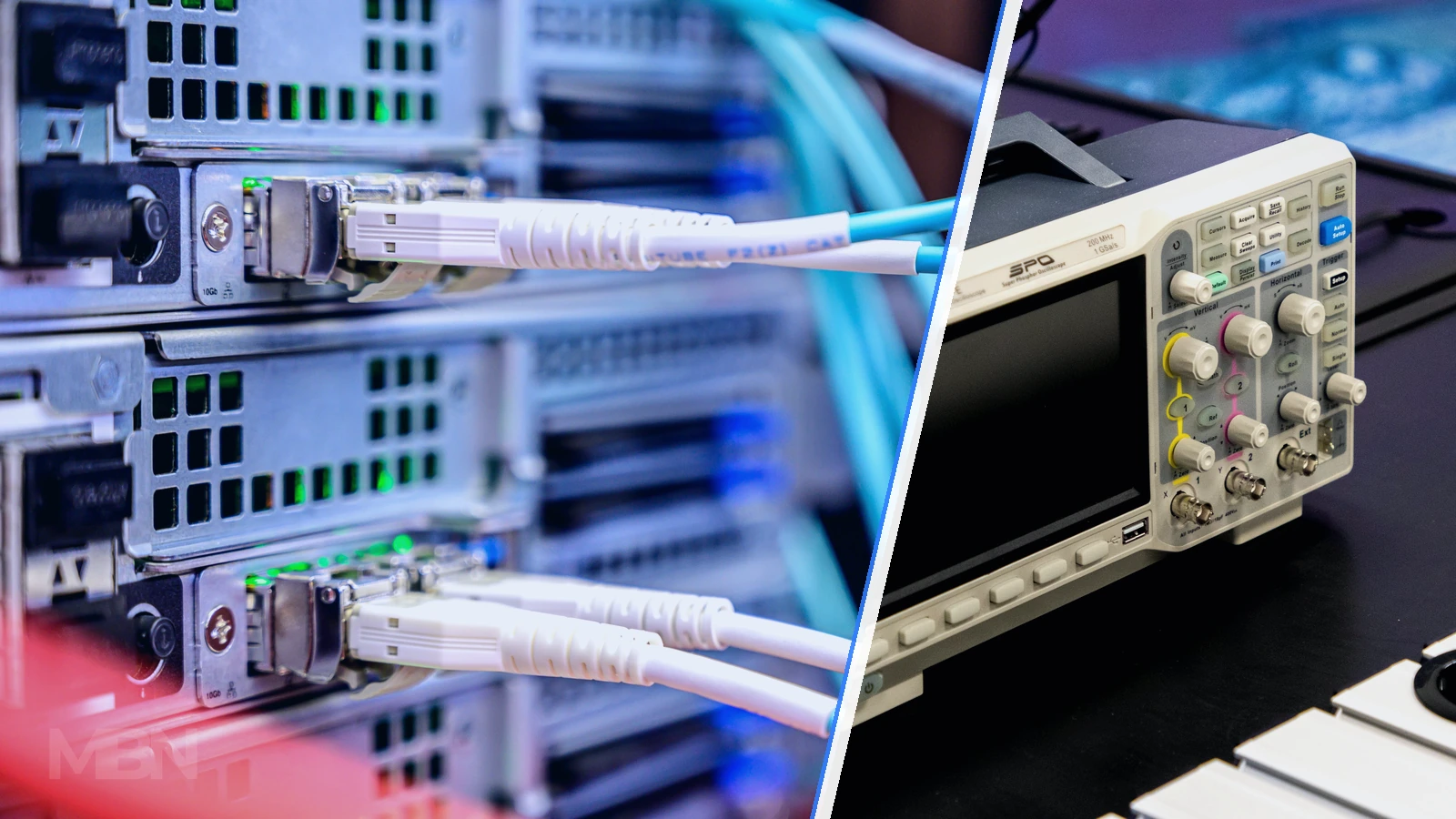
Keysight sells instruments, software and emulation systems that engineers use to test chips, network switches and optical links. This allows the company to benefit when data-centre operators move to faster connections, even though Keysight does not manufacture the processors or operate the facilities.
One example is the move towards 1.6T optical modules, which can carry an aggregate 1.6 terabits of data per second. Keysight introduced new testing products for 1.6T networks in March.
Growth extends beyond communications
The Electronic Industrial Solutions Group increased revenue 21% to $501 million, or 18% on a core basis. Keysight cited demand from semiconductor manufacturing, high-bandwidth memory, silicon photonics, software-defined vehicles and energy systems.
Aerospace, defence and government revenue rose 14% to $339 million. These markets give Keysight some protection from swings in data-centre spending, although communications supplied nearly three-quarters of total quarterly revenue.
Keysight completed its acquisition of Spirent Communications in October 2025. Spirent added network automation, satellite emulation, positioning and assurance products.
Acquisitions and divestitures contributed $84 million to third-quarter revenue, while currency movements reduced it by $6 million. Core revenue increased by $416 million from a year earlier. On Keysight’s definition, the existing business therefore supplied most of the $494 million rise in reported revenue.
The company said the Spirent integration was largely complete, one quarter ahead of schedule. It expects to reach 80% to 90% of its planned $100 million in cost savings on a run-rate basis by the end of the fourth quarter. Run-rate is the annualised level of savings at that point, not the amount saved during the quarter.
Profit, cash flow and outlook improve
Net income under standard US accounting rules more than doubled to $397 million from $191 million. Diluted earnings rose to $2.30 per share from $1.10, while operating margin increased to 24.9% from 17.3%.
Adjusted earnings were $3.07 per share and adjusted operating margin reached 33.2%. These figures exclude items including acquisition-related amortisation, integration costs, restructuring and share-based compensation.
Operating cash flow rose to $437 million. After $34 million of capital expenditure, free cash flow was $403 million, up from $291 million a year earlier.
For the fourth quarter, Keysight forecasts revenue of $1.93 billion to $1.95 billion and adjusted earnings of $3.34 to $3.40 per share. Its latest investor presentation implies full-year revenue of $7.103 billion, 32% above fiscal 2025.
The forecast depends on the current backlog converting into completed sales. For now, orders above revenue, strong core growth and wider margins show that the improvement was not simply the result of adding Spirent.
