
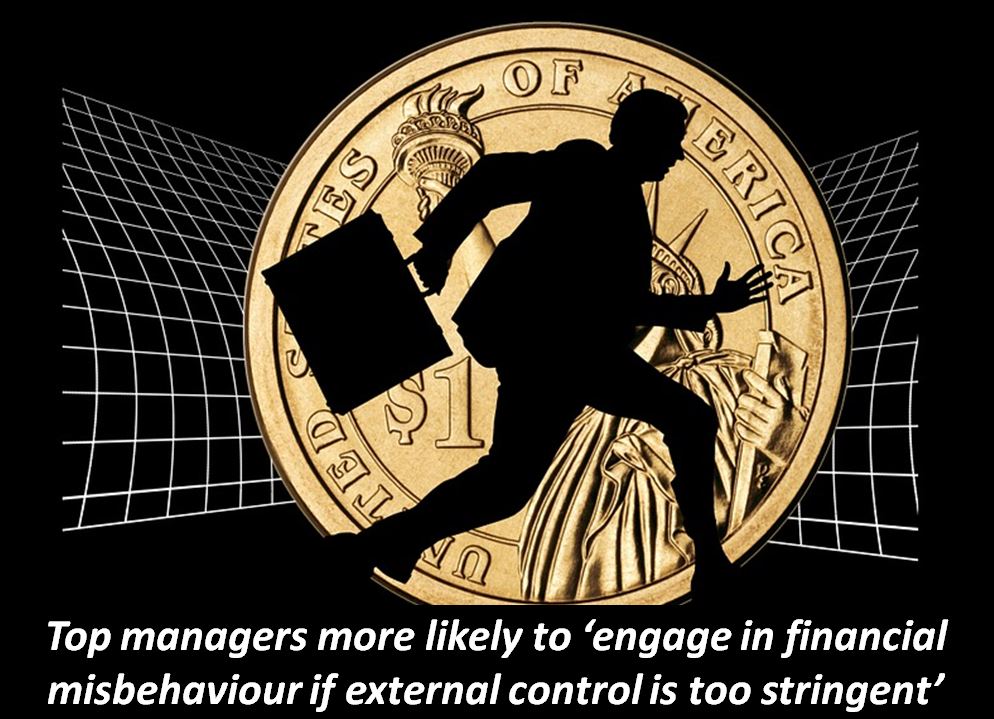
Often, the reaction that companies and regulatory bodies have when top managers are discovered cooking the books or committing financial fraud is to impose stricter controls and stiffen external governance.
However, in a research paper published recently in the Strategic Management Journal, experts suggest such actions could backfire. They may well increase the likelihood of financial cheating by top managers because it robs them of their own motivation to do the right thing.
Co-author Robert Hoskisson, professor of management at Rice University, Houston, TX, and colleagues discuss a theory called cognitive evaluation that supports the idea too much external control takes away one’s intrinsic motivation for behaving appropriately. They note:
“We find this to be the case. When top managers face more stringent external control mechanisms, in the form of activist shareholders, the threat of a takeover, or zealous securities analysts, they are actually more likely to engage in financial misbehaviour.”
 Management experts suggest if external control on a company is overly stringent, it is more – not less – likely to make top managers commit financial fraud.
Cognitive evaluation theory
The cognitive evaluation theory explanation is that humans need to feel a certain level of autonomy and self-determination. The theory centres on the difference between intrinsic and extrinsic motivation.
Intrinsic motivation is when we want do things because we find them inherently interesting and fulfilling. Extrinsic motivation is when we do things because we are seeking a reward or recognition from others. It is thought that intrinsic motivation enhances persistence, wellbeing, and creativity much more so than extrinsic motivation.
Originally, the suggestion was the two forms of motivation were additive and complemented each other – that is, an increase in either would result in more of the same behaviour.
However, studies have been done that show certain extrinsic motivators such as deadlines and surveillance tend to curb intrinsic motivation and reduce the behaviour.
Thus, say Prof. Hoskisson and colleagues, under cognitive evaluation theory, the imposition of external controls “crowds out” the individual’s own intrinsic motivation.
Counter to this argument is another concept called agency theory that proposes people are primarily driven by self-interest. Under agency theory, managers would be less likely to be found cooking the books if external governance and controls are stricter because they would not wish to get caught.
Researchers studied three forms of external governance
To test how well cognitive evaluation theory might apply to top managers, the researchers looked at institutional and regulatory data from 1999-2012 covering companies in the S&P 1500 index.
For extrinsic motivators they focused on three mechanisms of external governance: surveillance by dedicated institutional investors, the threat of corporate takeover, and the pressure from ratings agencies.
Dedicated institutional investors follow senior management actions very closely and hold stock much longer than the average investor. Agency theory would predict managers under such a level of scrutiny would commit less financial fraud.
But the researchers found the opposite pattern in the data. Higher levels of dedicated institutional investment was linked to higher levels of cooking the books by managers.
Their statistical analysis found the chance of financial fraud went up by 36 percent when dedicated institutional investment increased by one standard deviation from 4.5 percent (the mean) to 11.2 percent.
Next, the researchers looked at the threat of takeover. One of the ways companies react to hostile takeovers is by “shielding” their senior managers. These defensive mechanisms include staggered board appointments, “golden parachutes,” and poison pills;” this last being where the target company stock is made prohibitively expensive or unattractive to the unwanted buyer.
Again, agency theory would say financial fraud would increase as takeover defences increased – because this would be in the managers’ self-interest, to be shielded from hostile takeover. But the researchers found the chance of fraud went down 37 percent when the number of takeover defences went up from zero to one.
They found a similar pattern when they looked at the pressure exerted by rating agencies on firms. Rating agencies act like a second pair of eyes on firms and their reviews have profound effects on stock prices. Agency theory would suggest more scrutiny from ratings agencies would lead to less financial fraud, but, again, the researchers found the opposite.
They found the chance of financial fraud rose 82 percent when the extent to which rating agencies issued recommendations to buy and sell rose by one standard deviation from an average of 56 percent (the mean) to 78.5 percent.
Paradox for policymakers
In summing up their findings, the researchers note that “policymakers may face a paradox in regulating corporate governance.” Too much external surveillance can decrease top managers’ intrinsic motivation – so they lose sight of their internal values and begin cooking the books.
On the other hand, giving them too much freedom from outside pressure to perform could lead some to extract personal gain at the expense of stockholders. The researchers conclude:
“Perhaps managers can ‘earn the right’ to autonomy over time as they demonstrate that they consistently act in the best interest of shareholders, despite who may or may not be looking over their shoulders.”
