

Nearly two-thirds of European Union enterprises with at least 10 workers used social media in 2025, with adoption much more common among large businesses than smaller ones, according to Eurostat.
The EU statistics office reported that 63.6% of covered enterprises used some form of social media, up from 61.1% in 2023. That is an increase of 2.5 percentage points, not 2.5% growth.
The 2026 Eurostat release provides a snapshot of adoption rather than a measure of whether social media increased sales or profit.
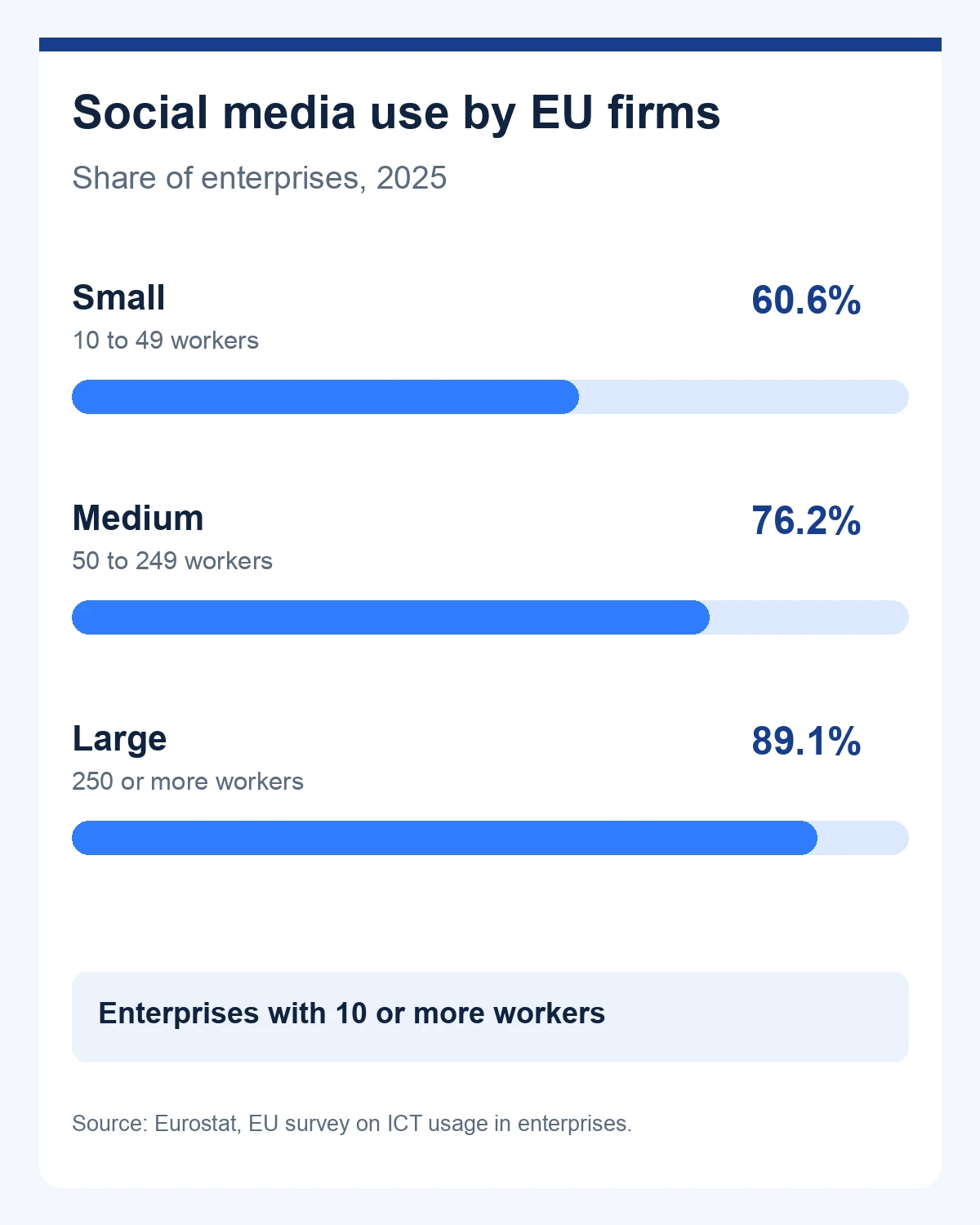
Large companies were more likely to use social media
Among small enterprises with 10 to 49 workers, 60.6% used social media. The share was 76.2% among medium enterprises with 50 to 249 workers and 89.1% among large enterprises with at least 250 workers.
These figures do not include microbusinesses with fewer than 10 workers. They also cover the economic activities defined in the survey, so they should not be described as the share of every business in Europe.
Use can mean different things. A company may maintain a profile, share updates, communicate with customers or use social platforms for collaboration. The figures do not say how often each business posts, how much it spends or whether it achieves its goals.
Differences between countries
Malta recorded the highest share among covered enterprises at 88.2%, followed by Finland at 87.6% and Denmark at 86.1%. The lowest reported shares were Bulgaria at 41.5%, Croatia at 46.0% and Hungary at 47.3%.
Country comparisons describe adoption, not the quality or profitability of individual campaigns. Industry composition, customer behavior and business resources may differ, but the Eurostat release does not identify the causes of the gap.
What a smaller business can do
The numbers do not mean a business needs to join every platform. A useful starting point is to identify the customers it wants to reach, choose a channel those customers actually use and decide who will respond to questions.
Set a measurable purpose for the account, such as handling service requests or generating qualified inquiries. Track the time and cost involved alongside meaningful outcomes. A large audience or many likes may be useful signals, but they do not by themselves establish sales or customer satisfaction.
A business should also make its contact information, opening hours and links consistent with its own website. Customers need a clear route to ask questions or buy without guessing whether a profile is current.
For a related measurement issue, our reporting on ad appeal and recall explains why a positive response to an image is not the same as remembering the ad.
Eurostat’s survey indicates that social media is now common among the enterprises it covers. The practical question for each business is whether the channels it maintains help customers and justify the resources spent on them.
