

featured-image-standard-abstract-lines-dots-nodes-connecting

Facebook losing popularity among US teenagers, Pew research reveals

Written by Joseph Nordqvist

Published: 08:56, June 3, 2018

According to new research from the Pew Research Center, the percentage of teenagers using Facebook has plunged over the past few years.

Only 51% of Americans aged 13 to 17 who took part of Pew’s latest survey said they use Facebook, a 20% drop from the 71% of teens who said they used Facebook in Pew’s previous survey in 2015.

Facebook is no longer the dominant online platform for teenagers. Facebook use was “notably lower” than the percentage of teens who said they used Youtube (85%), Instagram (72%), or Snapchat (69%).
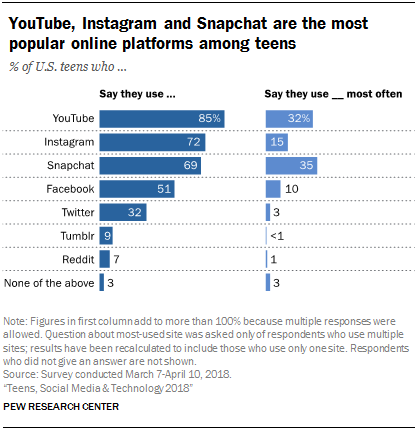
YouTube, Instagram and Snapchat are the most popular online platforms among teens

Use of social media platforms was, for the most part, similar across different demographic profiles. However, Pew found that lower-income teens are more likely to gravitate toward Facebook than teens from higher-income households.

Facebook use among teens living in households earning less than $30,000 was at 70%, while just 36% of teens in households whose annual income was $75,000 or higher said they use Facebook.

The survey also revealed that 95% of teens either own a smartphone or have access to one, while almost half (45%) said that they were online “almost constantly”.

“The social media environment among teens is quite different from what it was just three years ago,” said Pew researcher Monica Anderson, the lead author of the report.

“Back then, teens’ social media use mostly revolved around Facebook. Today, their habits revolve less around a single platform. At the same time we’ve seen this shift, teens are more digitally connected than ever.”

Facebook is the biggest social network in the world, with over two billion users. However, surveys are showing that the platform is becoming less popular among younger users.

A survey earlier this year by eMarketer found that there was a 9.9% decline in Facebook use among Americans aged 12-17. The company predicts that Facebook will lose 2.1 million American users under 25 this year.


Joseph Nordqvist Avatar

Other News

Why the weather can affect ratings of cold-weather gear

Nov 15, 2026

Seeing a purchase as part of a collection can change the shopping experience

Nov 15, 2026

Retail app ads may influence what customers do after installation

Nov 15, 2026

A bank tested AI customer twins for marketing, with mixed lessons for businesses

Nov 15, 2026

What makes a product vintage, and why the distinction matters to retailers

Nov 15, 2026

EU business social media use rises, but a gap remains by company size

Nov 15, 2026

Why startups may benefit from testing locally before expanding abroad

Nov 14, 2026

Novel product ideas can be harder to try but more rewarding afterward

Nov 14, 2026

What is in an online cart can influence whether shoppers check out

Nov 14, 2026

Subscription plans can miss customers who would save money, Lyft research finds

Nov 14, 2026

Workers with worse shifts than their colleagues were more likely to leave, restaurant study finds

Nov 14, 2026

More product options do not always reach more customers, cosmetics study finds

Nov 14, 2026

EU household spending grew in 2025 as communication purchases led gains

Nov 13, 2026

Ad experiments can help predict which campaigns drive additional sales

Nov 13, 2026

Browser choice screens lifted Firefox usage in Europe, researchers find

Nov 13, 2026

Online product rankings can cut shipping costs without reducing sales, experiment finds

Nov 13, 2026

Large companies lead EU service exports, but smaller firms dominate in some markets

Nov 13, 2026

Cart reminder timing is linked to different shopper responses

Nov 12, 2026

AI labels changed how consumers judged food images in three experiments

Nov 12, 2026

Shared AI tools were linked to higher sales for small online sellers

Nov 12, 2026