
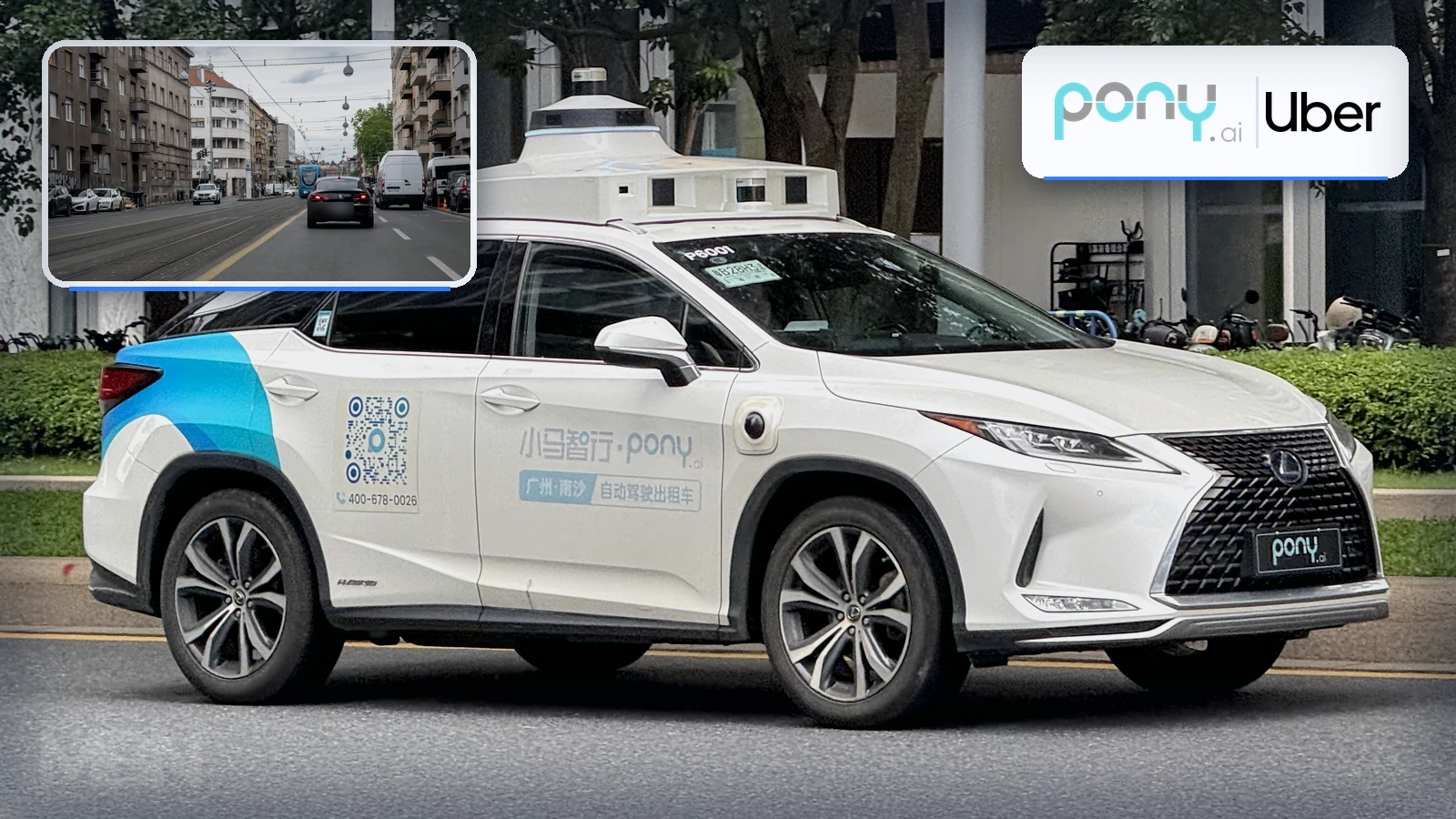
Pony.ai and Uber plan to deploy more than 2,000 robotaxis across five European cities, expanding a partnership that already supports a paid service in Zagreb, Croatia. The companies did not name the four additional cities or give a timetable for putting the vehicles on the road.
The expansion was announced on August 14, 2026, in a statement filed by Pony.ai with the US Securities and Exchange Commission.
The figure covers Zagreb and four future markets. It should not be read as 2,000 active vehicles, approved vehicles or firm orders from Uber. The announcement did not disclose financial terms, identify the vehicle models or say how the planned fleet would be divided among the five cities.
Three partners can divide the cost and the work
Pony.ai will provide its Level 4 autonomous-driving technology, rider experience and operating expertise. Uber will provide access to customers, booking and payments, as well as customer service. Local fleet partners may handle day-to-day operations.
Level 4 systems are designed to drive without a human within defined operating conditions. They are not intended to operate autonomously on every road or in all weather.
The partners said vehicle financing and ownership could vary by market. A local operator might own the cars in one city, while another funding arrangement could be used elsewhere.
That structure is central to the business case. Pony.ai can supply the driving system without necessarily financing every vehicle, while Uber can add autonomous cars to its platform without developing the complete driving technology itself. A local partner can contribute depots, maintenance staff and knowledge of city rules.
It also leaves important questions unanswered. The companies have not said which party will carry most of the capital cost, who will bear operating losses during the early stages or whether the planned fleet is covered by binding purchase commitments.
Zagreb provides the starting point
Pony.ai, Uber and Verne, a company within the Rimac Group, announced their Zagreb partnership in March. Pony.ai said paid service began on April 8, with rides booked through the Verne app.
The company initially described a service area of approximately 90 square kilometres, including Zagreb Airport, and operating hours from 7 a.m. to 9 p.m. Verne is responsible for the local fleet and regulatory work. Availability through the Uber app was still described as coming soon in the August announcement.
The service has been introduced gradually and should not yet be described as fully driverless. AFP reported in early May that Verne was operating 10 vehicles for selected users, with a human operator temporarily sitting behind the wheel in case intervention was needed.
The Zagreb operation therefore gives the partners a real commercial test, but it is still much smaller than the proposed five-city network. The next challenge is moving from a limited, supervised service to fleets that can run reliably and economically at a much larger scale.
The European plan is large compared with Pony.ai’s current fleet
The planned European total alone exceeds the 1,776 robotaxis Pony.ai said it had produced as of May 24. That comparison does not indicate when the European fleet will arrive, because the companies have not provided a deployment deadline and Pony.ai continues to manufacture more vehicles.
Pony.ai expects its worldwide fleet to exceed 3,500 vehicles in more than 20 cities by the end of 2026. That is a company forecast covering all markets, not a schedule for the European partnership.
The company is growing quickly, but it is still loss-making. First-quarter revenue increased 145% from a year earlier to $34.3 million. Robotaxi service revenue rose from $1.7 million to $8.6 million, while the net loss widened to $53.5 million from $37.4 million.
Those figures show why fleet structure matters. Higher ride volume can increase revenue, but owning, maintaining and supporting thousands of sensor-equipped vehicles requires substantial capital. Splitting those responsibilities among a technology supplier, a booking platform and local operators may reduce the amount any one participant has to fund.
Uber is spreading its robotaxi bets
The Pony.ai agreement is one part of a wider autonomous-vehicle network being assembled by Uber. The company is also working with WeRide on planned robotaxi services in Madrid and Zurich. Both launches are expected later in 2026 and remain subject to milestones or regulatory approval.
Uber’s approach does not depend on a single autonomous-driving supplier. Instead, it is seeking to become the customer, distribution and operating layer used by several vehicle and software partners.
In February, Uber introduced a package of services for autonomous-vehicle companies that includes mapping, regulatory support, fleet financing, customer assistance and fleet-management tools. The strategy gives Uber several chances to secure autonomous supply, although it must still integrate vehicles built around different driving systems.
Approvals will remain a city-by-city issue
The European Union has a technical approval framework for automated-driving systems, but that does not amount to one operating licence covering the bloc. EU rules preserve national authority over road circulation and local transport services.
Each proposed city may therefore require its own testing, permits, operating conditions and local fleet arrangements. The four new cities have not been identified, and the companies have not said that approvals have been secured.
The 2,000-vehicle target is a statement of scale rather than a completed rollout plan. The first useful milestones will be the names of the additional cities, the funding structure in each market, a timetable for deployment and evidence that the Zagreb service can move beyond its supervised phase.
