

Unusual ingredients were associated with fewer people trying recipes but higher ratings from those who did, according to research examining more than 57,000 recipes on Allrecipes.
The finding points to a practical problem for businesses introducing unfamiliar products. A feature that makes an idea appealing after customers experience it may also make them hesitate before the first purchase.
In the Journal of Marketing study, Sibel Sozuer, Oded Netzer and Kriste Krstovski distinguished novelty from coherence, or how well the components of an idea fit together.
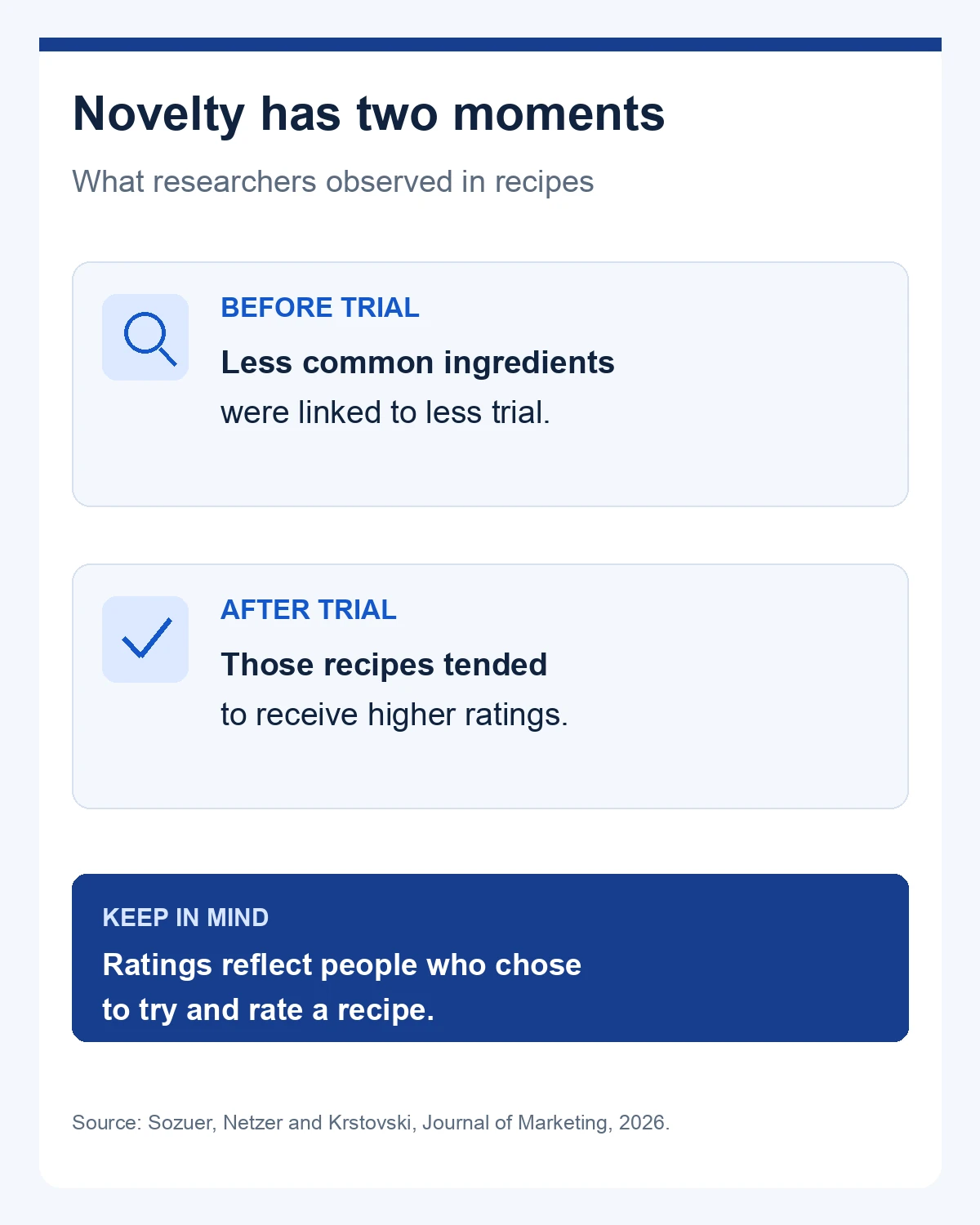
Trial and satisfaction are different measures
The researchers analyzed recipes and the ingredients used to make them, as well as measures of trial and ratings. They found that recipes with less common ingredients tended to receive less trial but higher ratings among people who tried them. Combinations whose ingredients fit together were associated with better trial and evaluation.
The data are observational. They do not prove that an unusual ingredient caused a change in behavior, and ratings come from people who chose to try and rate a recipe. Those customers may differ from people who never tried it.
The research also examined 1,057 ideas for a health app. The two settings helped the authors study whether their method for measuring the fit between components could be useful beyond recipes, but they do not establish that the same pattern applies to every industry.
What businesses can test
A company launching a new snack, software feature or service can look separately at the number of people willing to try it and the experience of those who do. High satisfaction among early adopters does not automatically mean that a wider audience understands the offer.
For example, a food brand could explain an unfamiliar ingredient through a familiar flavor combination. A software company could show how an unusual feature helps with an existing task. Those are possible tests, not interventions proven by the recipe study.
Teams should compare like-for-like groups when possible and track both the first decision and what happens afterward. Depending on the product, useful measures could include qualified trial, repeat purchase, returns and customer feedback. A high initial click rate alone says little about whether the product met expectations.
Fit does not mean avoiding new ideas
The researchers used a computational model to measure how ingredients appeared in combinations across recipes. The resulting measure helps describe whether an idea’s parts are consistent with one another, rather than simply counting how frequently individual ingredients appear.
That distinction matters when evaluating a product with several features. An unexpected component can be valuable if customers understand what it contributes. Adding more features without a clear connection can make an offer harder to grasp.
For a related question about how the presentation of ingredients can affect shoppers, see our reporting on how ingredient descriptions affect interest. The practical lesson from the new study is to test the journey from first impression to actual use, rather than treating those stages as the same decision.
