
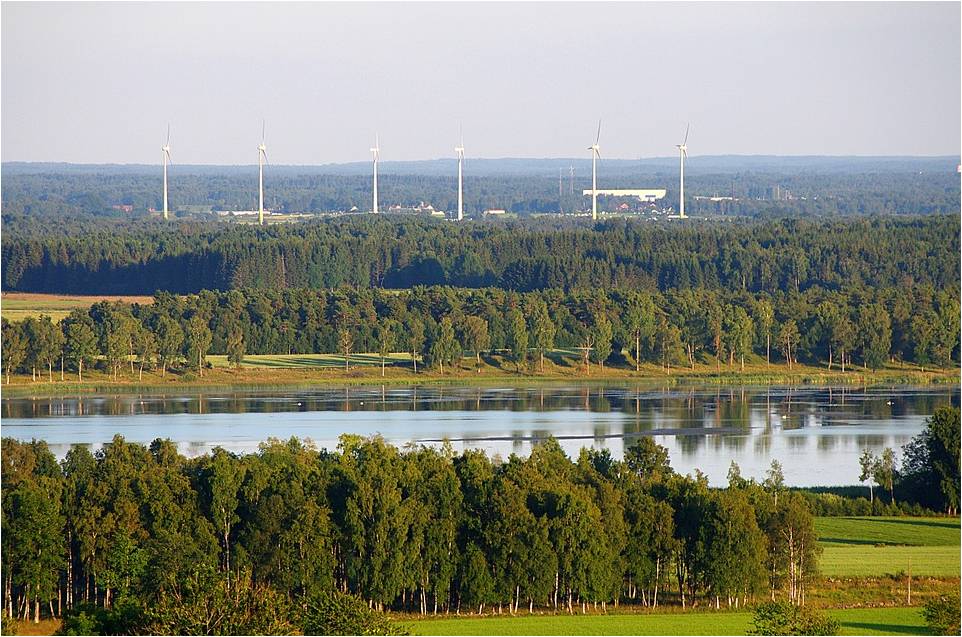
Sweden is on target to produce 100 percent of its electricity from renewable energy sources by 2040, says the country’s energy market inspector.
Earlier this year, the Swedish government and three opposition parties agreed a long-term energy policy.
The agreement sets a target for Sweden’s electricity to be produced entirely from renewable energy sources by 2040.
 Wind energy now accounts for 10 percent of Sweden’s overall energy production. Image: pixabay
Few countries consume more energy per person than Sweden’s 9.6 million people, yet carbon emissions in the Scandinavian nation are low compared with those of other countries.
The latest statistics estimate that the average person in Sweden releases 4.25 tonnes of carbon dioxide (CO2) into the atmosphere. This compares with a European Union average of 6.91 tonnes and a United States average of 16.15 tonnes.
This was not always the case.
In 1970, Sweden was heavily dependent on fossil fuels – they supplied three quarters of the country’s energy needs. Then, following the oil crisis in the early 1970s, Sweden invested heavily in searching for alternatives.
The result is that today, Swedish reliance on fossil fuels has dropped to 20 percent, mainly due to reduced use of oil for residential heating.
Push towards green electricity
In 2003, to promote renewable energy use, Sweden introduced green electricity certification. Under the scheme, power generators receive certification for producing electricity from renewable energy sources such as wind, solar, geothermal, wave power, biofuels, or small-scale hydroelectric plants. And electricity companies are required buy a proportion of “green electricity” as part of their normal supply.
Through this and other schemes, Sweden managed to reach its goal of 50 percent electricity produced from renewable sources in 2012, which is 8 years earlier than the government’s 2020 target.
The latest figures show that 52 percent of the country’s energy needs – including electricity, heating, and fuel – are met by renewables. This is the highest of any EU country.
Last year, around 57 percent of Sweden’s electricity came from hydro and wind energy, Anne Vadasz Nilsson, Director General of the Swedish Energy Markets Inspectorate, commented to Reuters at an international energy meeting on Monday.
The other 43 percent of electricity comes mainly from nuclear energy.
Lack of clarity on Sweden’s plans for nuclear energy
However, while the new cross-party deal commits to an ambitious goal of producing 100 percent of its electricity from renewables by 2040, there appears to be no deadline for the phase-out of nuclear power.
The deal seems to take a step backwards in that it commits to the phasing out of an extra tax on nuclear energy over the next few years. However, it also increases penalties tied to nuclear waste.
Nonetheless, Nilsson says four of Sweden’s 10 nuclear reactors are being phased out and the country has no plans to subsidize more nuclear energy.
Following Japan’s Fukushima nuclear plant disaster, countries are keeping a close eye on nuclear power. Attention is focusing on the costs of dismantling the nuclear plant, which was damaged in the March 2011 Tohoku earthquake and tsunami.
The Japanese government recently announced that they believe the clean-up costs have been massively under-estimated.
A government study released on Tuesday estimates the decommissioning costs of the Fukushima Daiichi nuclear plant may rise to several billion dollars a year, from less than US$800 million now.
Nilsson says nuclear is also an expensive way to produce energy because of safety concerns and the costs involved in long-term management of nuclear waste.
Wind power accounts for 10 percent of Sweden’s energy production
Renewables, on the other hand – which in the case of Sweden mostly refers to large-scale wind – are getting cheaper and cheaper to commission and operate, says Nilsson.
“This together with low wholesale prices will make it less likely that new nuclear power plants will replace the remaining ones when they are phased out due to old age,” she adds.
Sweden is an ideal country for generating electricity from wind energy. It is not densely populated, and the geography lends itself to land-based, large-scaled wind farms.
In 2014, Sweden’s wind farms totalled over 3,000 wind turbines and produced 11.5 TWh of its electrical energy from wind.
Wind energy now accounts for 10 percent of the country’s overall energy production, says Nilsson.
