

There are too many “social mobility cold spots” in the UK, neighbourhoods where young adults and children have little opportunity to climb the socioeconomic ladder, says Alan Milburn in the “Bridging the Social Divide Report“, published on 28th February by the Social Mobility and Child Poverty Commission.
Children born after the global financial crisis of 2008 may be the first generation in the UK in several decades to see their prospects deteriorating.
Mr. Milburn said the United Kingdom is at serious risk of becoming a “permanently divided nation,” despite an improving economy, unless there is a concerted cross-party effort to level the playing field.

In the last 25 years, the proportion of families with children living in the private renting sector has increased nearly fourfold. (Source: Social Mobility & Child Poverty Commission)
Commission Chair Alan Milburn, and Deputy Chair Baroness Gillian Shephard, said:
“British politicians have agreed for decades that boosting social mobility and reducing child poverty are essential. Counter to today’s prevailing anti-politics mood, that this consensus has produced real results on some of the most intractable social problems of our age, is testament to the ability of our political system to deliver.”
“Nonetheless, it is obvious that the progress made so far has been too limited and too slow. This is not a criticism of what current or previous Governments have done, but instead an exhortation to all the political parties to continue to bend to the wheel. Urgent action and renewed energy is needed now if the challenges of the fiscal deficit and deep-seated changes in the labour and housing markets are not to result in Britain becoming a permanently divided nation.”
Social mobility today driven by postcode
The report pointed out that people’s life opportunities are being driven by where they live as much as their family’s socioeconomic and academic status.
In several areas across England, including the “affluent” neighbourhoods of the south and east, social mobility has come to a standstill, the report informs.
While several areas enjoy low unemployment, they also have higher-than-average concentrations of low-paying and low-skilled jobs, plus poor school attainment.
While London is today a social mobility “hotspot”, after a push to improve schools in deprived areas of the city, other towns such as Folkestone, Portsmouth, Gosport, Norwich and Peterborough have become “cold spots”.
According to the report, the gap between the haves and have-nots is widening “That gulf is not just between rich and poor or young and old but between one part of Britain and another. There is a postcode lottery in opportunity and in outcome,” the authors wrote.
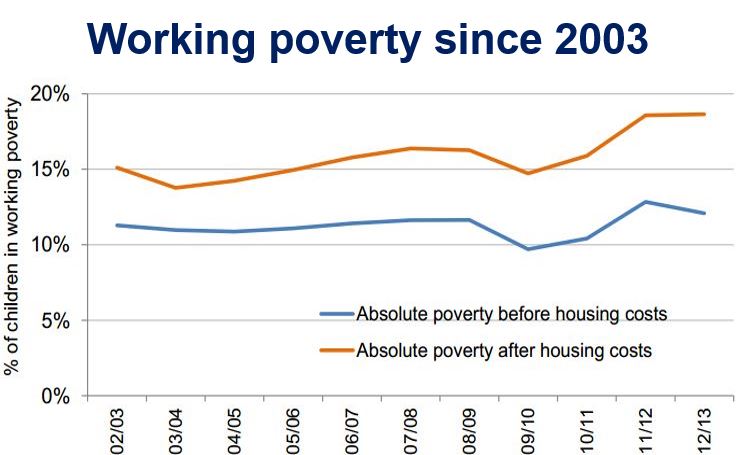
The Institute for Fiscal Studies forecasts that 3.5m children (1 in 4) will be in absolute poverty by the end of the next Parliament, 50% more than a decade earlier. (Source: Social Mobility & Child Poverty Commission)
Mr. Milburn added:
“So far the 2015 election campaign has seen politicians of all parties ducking the challenge of setting out in detail how they would avoid these pitfalls in an age of austerity. The economy and health have dominated, with mobility and poverty issues being treated as a sideshow.”
“Too little debate now means potentially lots of bad decisions later, and the real risk that whoever is in 10 Downing Street in May will consign progress on mobility and poverty to the ‘too difficult’ pile. It would be all too easy for each of the political parties to take refuge in simple policy solutions and treat them as easy answers to the problem of high levels of child poverty and low levels of social mobility.”
Great Britain will not become a high-mobility, low-poverty nation if the Government relies totally on GDP growth, a higher minimum wage, or raising the tax-free threshold. What is needed is a concerted and “holistic plan of action,” Mr. Milburn emphasized.
