

jobs

US job creation slowed in May to weakest pace of growth in over five years

Written by Joseph Nordqvist

Published: 22:47, June 3, 2016

US job creation slowed in May to its weakest pace of growth in over five years as manufacturing and construction employment fell sharply.

According to the US Labor Bureau, only 38,000 jobs were created in the US last month, down from 123,000 jobs created in April – representing the smallest monthly gain since September 2010.

The figures were much worse than what economists had forecast of approximately 164,000 new “non-farm” jobs.

Employment change by industry, May 2016, seasonally adjusted:
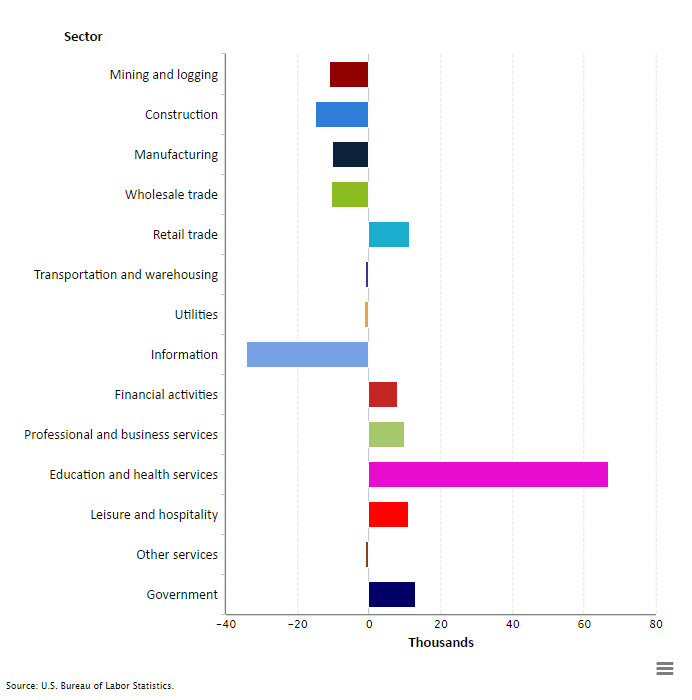
Employment change by industry, May 2016, seasonally adjusted
Source: U.S. Bureau of Labor Statistics | Division of Labor Force Statistics

Health care added 46,000 jobs last month, while employment in professional and business services only increased by 10,000 after rising a 55,000 rise in April.

Within manufacturing, employment in durable goods declined by 18,000 in May, with job losses of 7,000 in machinery and 3,000 in furniture and related products. Mining employment dropped by 10,000.

The unemployment rate fell from 5 percent down to 4.7 percent, however, this was mainly due to the fact almost half a million people dropped out of the labor force – not because of robust hiring.

Friday’s weak job data has clouded the outlook of another interest rate hike by the Federal Reserve this summer – the US central bank will likely wait for a cleaner read on payrolls before hiking rates again.

“This is a smack in the face for the US economy,” Diane Swonk of DS Economics told The Financial Times.

“They [the Fed] need to see a much better June number to keep July on the table . . . When you are losing momentum going into the meeting, that is not when you raise rates.”


“For the Fed, these data present a dilemma. The unemployment rate tells them unambiguously that policy needs to be tightened, but if they choose to believe the slowdown in payrolls will persist, they will expect unemployment to rise again even if rates are left unchanged,” Ian Shepherdson of Pantheon Macroeconomics told The Wall Street Journal.

“Their response will be the usual: They’ll wait.”

Joseph Nordqvist Avatar

Other News

Cart reminder timing is linked to different shopper responses

Nov 12, 2026

AI labels changed how consumers judged food images in three experiments

Nov 12, 2026

Shared AI tools were linked to higher sales for small online sellers

Nov 12, 2026

An image ad people like may not be the one they remember

Nov 12, 2026

Upfront rental prices changed competition as nightly rates rose in a study

Nov 12, 2026

Showing payment options earlier can influence online purchase decisions

Nov 11, 2026

Cash-back offers for positive reviews brought more responses but fewer repeat purchases

Nov 11, 2026

Turning a free business service into a paid one is harder than changing the price

Nov 11, 2026

Small businesses that sought customer feedback reported higher revenue in Rwanda experiment

Nov 11, 2026

Checkbox coupons were less effective than direct discounts in an online shopping experiment

Nov 11, 2026

The way online reviews are organized can make them more useful to shoppers

Nov 11, 2026

AI feedback helped some customer service agents in a workplace study

Nov 11, 2026

In-store screens can increase purchases of advertised products, retail study finds

Nov 11, 2026

A loyalty campaign can lose sales when stores struggle to carry it out

Nov 10, 2026

Offering a choice of discounts can sometimes reduce purchases, study finds

Nov 10, 2026

A fee to place a bid can lift a seller’s profit, but the effect may fade

Nov 10, 2026

Experiences can make loyalty rewards more engaging, retail research finds

Nov 10, 2026

Most emerging-market firms in an IFC survey use AI, but few have embedded it across core operations

Nov 10, 2026

Startups given examples of AI workflows found more uses for the technology

Nov 9, 2026

Showing product costs can change how shoppers judge a brand’s motives

Nov 9, 2026