

The US March trade deficit declined to $40.4 billion, compared to $41.9 billion in February. Exports in March totaled $193.9 billion, the second highest month ever and the biggest gain in nine months, said the Bureau of Economic Analysis, part of the US Department of Commerce.
Exports improved from a 5-month-low February, adding evidence that heading into the second quarter US economic growth is accelerating after a slowdown at the start of the year. There are also signs imports will increase as confidence in households and businesses rise and the labor market improves.
The exports surge was driven by bumper overseas sales of food and drink, automobiles and aircraft. March exports to Germany, South Korea and Canada hit a new record.
Imports increased by 1.1% as demand grew for machinery, clothes and mobile phones. The majority of economists are predicting a declining trade deficit for 2014 as exports grow more rapidly than imports.
Exports in March were $3.9 billion greater than February’s $190 billion, while imports increased by $2.5 billion in comparison to February’s $231.8 billion.

In comparison to March 2013, the goods and services deficit grew by $3.8 billion – an increase of 5% in exports (+$9.2 billion) and 5.9% in imports (+$13 billion).
The March improvements represent a recovery after disruptions this winter caused by abnormally harsh winter weather. The US economy barely expanded in the first quarter of 2014.
The Wall Street Journal quoted Yelena Shulyatyeva, a BNP Paribas economist, who said”
“Typically, when weather disrupts trade, it affects exports more than imports, as trucks find it difficult to get to ports while ships keep coming in,” she said in a note to clients. “This is what we saw on the trade front in February with a subsequent rebound in March, and we expect further strengthening in exports” in the second quarter.”
US exports of goods – March vs. Feb
March increase in exports of goods in comparison to February were as follows:
- Capital goods: +$2.1 billion.
- Industrial supplies and materials: +$0.9 billion.
- Automotive vehicles, parts, and engines: +$0.6 billion.
- Other goods: +$0.3 billion.
- Foods, feeds and beverages: +$0.1 billion.
Exports of consumer goods declined by $0.3 billion.
US imports of goods – March vs. Feb
The following goods saw greatest increases in March compared to February:
- Consumer goods: +$1.2 billion.
- Foods, feeds, and beverages: +$1.0 billion.
- Capital goods: +$0.9 billion.
- Other goods: +$0.8 billion.
The following goods registered smaller imports over the same period:
- Industrial supplies and materials: -$0.5 billion.
Automotive vehicles, parts, and engines: virtually no change.
US exports of goods increase – March ’13 to March ’14
- Capital goods: +$2.8 billion.
- Consumer goods: +$1.5 billion.
- Foods, feeds and beverages: +$1.5 billion.
- Automotive vehicles, parts and engines: +$0.6 billion.
Falls occurred in industrial supplies and materials by $0.6 billion and other goods by $0.2 billion.
US imports of goods increase – March ’13 to March ’14
- Consumer goods: +$4.1 billion.
- Capital goods: +$3.2 billion.
- Automotive vehicles, parts and engines: +$1.6 billion.
- Foods, feeds, and beverages: +$1.0 billion.
- Industrial supplies and materials: +$0.8 billion.
- Other goods: +$0.1 billion.
US trade in services
Services exports increased by $0.2 billion in March compared to February. Imports of services declined by $0.7 billion.
Over a one-year period to March, services exports increased by $3.3 billion or 6%, while imports rose by $1.8 billion or 4.8%.
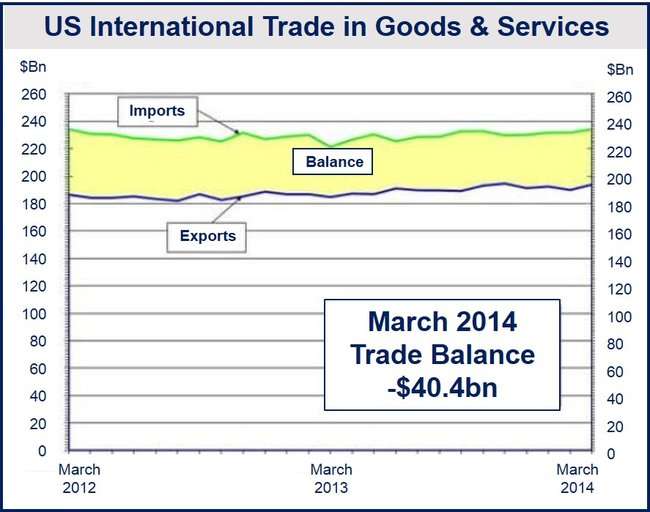
(Source: Bureau of Economic Analysis)
In an interview with Bloomberg Businessweek, Paul Edelstein, director of financial economics at IHS Global Insight Inc. in Lexington, Massachusetts, said:
“Exports rebounded after a few weaker months, and that’s good to see. Imports were also up, and that’s a good sign because it suggests that business and consumer spending are back on track. In general, this is a pretty good report.”
Edelstein had forecast that the trade deficit in March would shrink to $40.5 billion.
