

A 2-D camera that can capture events at the incredible speed of 100 billion frames per second has been developed by a team of biomedical engineers at Washington University in St. Louis.
Lihong Wang, PhD, the Gene K. Beare Distinguished Professor of Biomedical Engineering and team used a technique called compressed ultrafast photography (CUP), which was developed at the School of Engineering & Applied Science.
The researchers have made movies of images they took with single laser shots of 4 physical phenomena: refraction, laser pulse reflection, faster-than light propagation of what is called non-information, and photon racing in two media.
Wang and colleagues say the images are awe-inspiring, entertaining and represent the beginning of new vistas of scientific exploration.
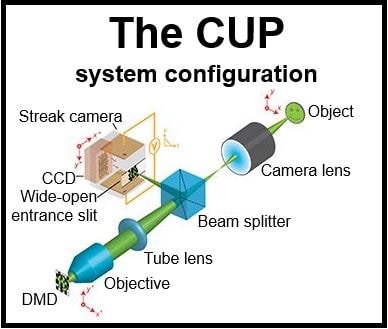
Photo from Washington University in St. Louis.
Watch a ray of light as it travels
Dr. Wang said:
“For the first time, humans can see light pulses on the fly. Because this technique advances the imaging frame rate by orders of magnitude, we now enter a new regime to open up new visions.”
“Each new technique, especially one of a quantum leap forward, is always followed a number of new discoveries. It’s our hope that CUP will enable new discoveries in science – ones that we can’t even anticipate yet.”
Although it is a camera, it does not look like one. It is a collection of devices designed to work with high-powered telescopes and microscopes to capture moving natural and physical phenomena. After gathering the raw data, the actual images are formed on a PC (personal computer). The technology is called computational imaging.
Funding for the development of the technology came from two National Institutes of Health (NIH) grants.
Richard Conroy, PhD, program director of optical imaging at the National Institute of Biomedical Imaging and Bioengineering, part of the NIH, said:
“This is an exciting advance and the type of groundbreaking work that these high-risk NIH awards are designed to support. These ultra-fast cameras have the potential to greatly enhance our understanding of very fast biological interactions and chemical processes and allow us to build better models of complex, dynamical systems.”
The application can be used to detect diseases or reflect cellular environmental conditions such as pH or oxygen pressure.

Dr. Lihong Wang (Photo: Washington University in St. Louis)
Potential for usage in astronomy and forensics
Wang believes this the technology could also be used in forensics and astronomy, where the ultra-rapid frame rate could analyze temporal activities of a supernova that occurred many light years away.
The CUP could be used for reproducing the pathways of bullets, “which could once again open up the Kennedy assassination conspiracy theories and revive a more accurate analysis of the strange physics of the ‘magic bullet’,” the University wrote.
Wang and team essentially added components and used algorithms to a technology that is already in existence – streak camera – which measures the intensity variation in a pulse of light with time.
Although a streak camera is super-fast, it can only provide a 1-D view, which “is not intuitive – much analogous to watching a horse race through the distant vertical slit. We expanded the view into 2-D space, more like what we see in the real world,” Dr. Wang said.
According to Washington University “Wang’s work with CUP pushes the dimensional limits of fundamental physics and also pushes the limits of deep imaging of biological tissues, one of Wang’s research specialties.”
Dr. Wang said:
“Fluorescence is an important aspect of biological technologies,” he said. “We can use CUP to image the lifetimes of various fluorophores, including fluorescent proteins, at light speed.”
He believes the CUP can be a game-changer in the astronomy world. “Combine CUP imaging with the Hubble Telescope, and we will have both the sharpest spatial resolution of the Hubble and the highest temporal solution with CUP. That combination is bound to discover new science,” he said.
Citation: “Single-shot compressed ultrafast photography at one hundred billion frames per second,” Liang Gao, Jinyang Liang, Chiye Li & Lihong V. Wang. Nature 516, 74-77 (04 December 2014) doi:10.1038/nature14005.
