
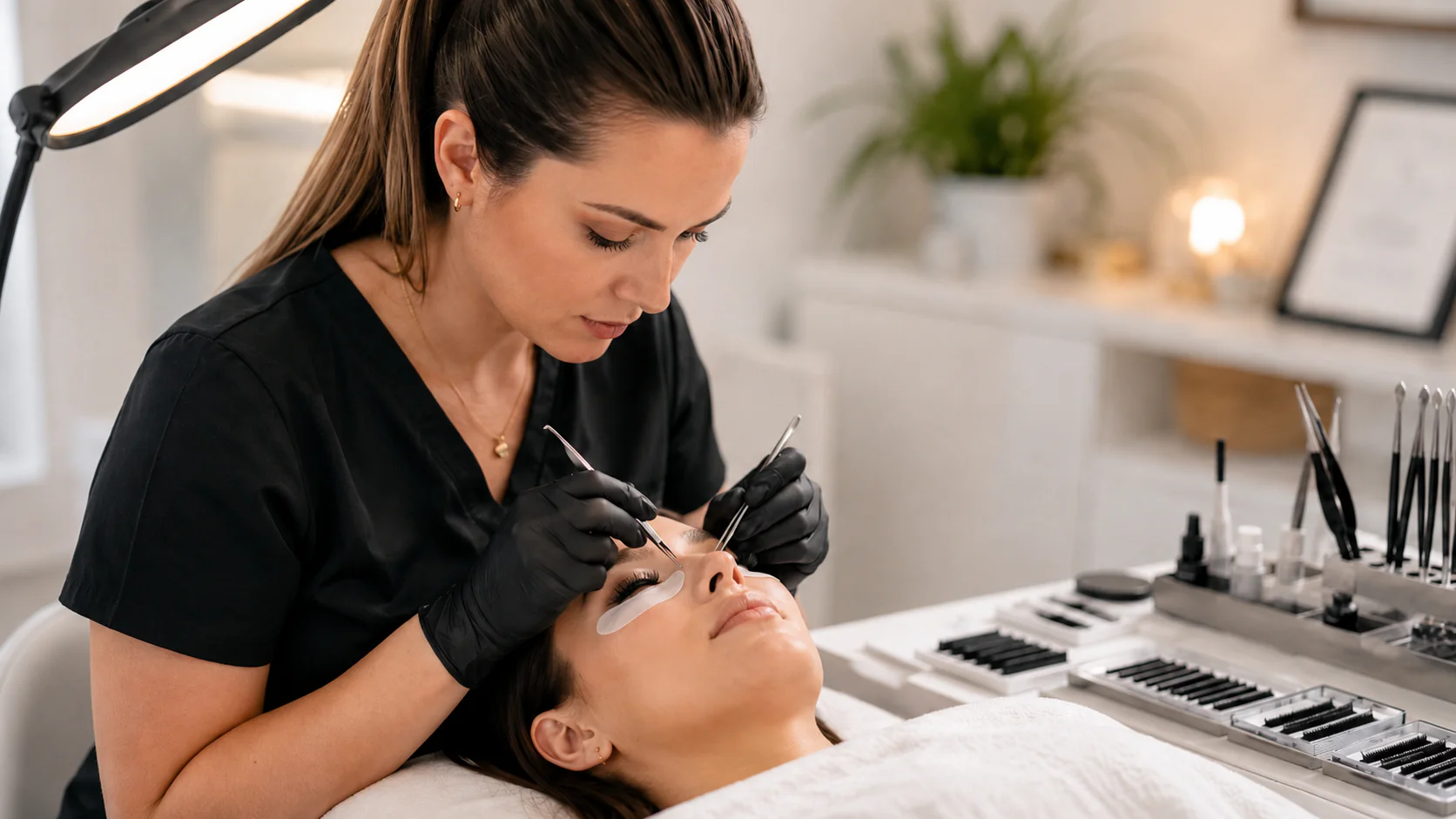
Advanced lash training can help an artist move beyond basic classic sets into services such as hybrid, Russian Volume, Mega Volume, and more customized styling.
However, readiness should not be judged solely by how long you have worked, how quickly you can finish a set, or how many clients you have. A better question is whether you can produce consistent work safely, recognize the limits of your current knowledge, and explain how additional training would benefit both your clients and your business.
The UK’s National Occupational Standard for advanced semi-permanent eyelash extensions emphasizes consultation, informed consent, hygiene, lash assessment, suitable weight selection, safe application, monitoring, aftercare, and appropriate action when an adverse reaction occurs.
Those areas provide a more useful way to judge whether you are ready for the next stage of training.
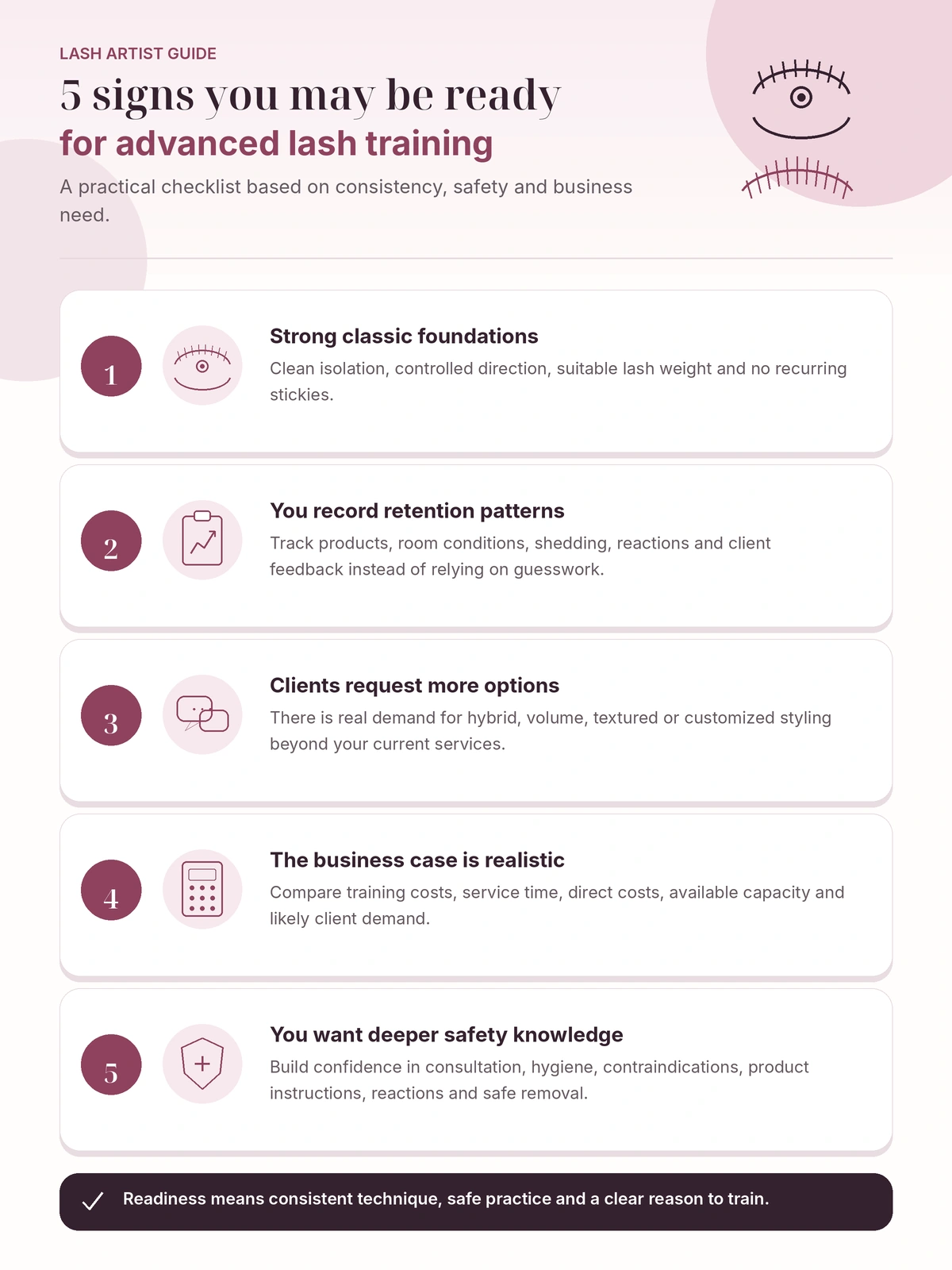
1. Your classic work is consistently safe and clean
Advanced techniques rely on the same foundational skills used in classic extensions. Isolation, attachment, direction, adhesive control, client positioning, and safe removal all need to be reliable before more complex fan-making and styling techniques are introduced.
There is no universally recognized rule stating that a lash artist must complete a classic set in under 90 minutes before progressing. Speed matters in a commercial setting, but it should develop without sacrificing isolation, comfort, or the health of the natural lashes.
You may be ready to progress when you can consistently:
- Isolate individual natural lashes without leaving lashes bonded together
- Apply extensions in a controlled direction with suitable spacing from the eyelid
- Select lengths, curls, and weights that suit the client’s natural lashes
- Identify and correct stickies before the client leaves
- Maintain and remove extensions without unnecessarily pulling the natural lashes
- Keep accurate consultation, treatment, and aftercare records
- Complete the service within a realistic time while preserving quality
If recurring stickies, discomfort, inconsistent direction, or difficult removals are still common, additional coaching in classic application may provide more value than moving immediately into Mega Volume or another advanced technique.
2. You track retention instead of relying on guesswork
Retention matters, but there is no single percentage or refill interval that proves an artist has mastered adhesive use.
The number of extensions remaining at a refill can be affected by the client’s natural lash cycle, treatment history, home care, attachment quality, product selection, room conditions, and the timing of the appointment. The advanced National Occupational Standard specifically includes lash condition, growth patterns, treatment history, product selection, manufacturer instructions, and the effect of humidity among the factors an artist should understand.
A more useful approach is to keep consistent records. These may include:
- The date of the original set and each refill
- The condition of the natural lashes before treatment
- The products and adhesive batch used
- Room temperature and humidity where relevant
- Areas where early shedding occurred
- Any discomfort, irritation, or unusual reaction reported by the client
- Aftercare advice provided
- Changes made at the next appointment
This information can help distinguish a recurring technical problem from normal shedding or a client-specific issue.
Retention should never be improved by using excessive adhesive, overloading natural lashes, or bonding several natural lashes together. A set that remains in place for longer is not successful if it causes discomfort or places unnecessary stress on the client’s lashes.
3. Clients are asking for results outside your current skill set
Client demand can be a strong reason to consider advanced lash training. Regular clients may begin asking for fuller sets, textured styling, wispy effects, stronger lift, or a look that cannot be created effectively with classic extensions alone.
This does not mean an artist should experiment on paying clients without suitable training. Advanced volume work involves more than attaching additional extensions. It requires an understanding of fan construction, diameter, combined weight, symmetry, attachment, eye shape, natural lash tolerance, and the intended finished effect.
A suitable course should explain how to:
- Create and control different fan shapes
- Choose appropriate diameters and fan sizes
- Consider the condition and tolerance of the natural lashes
- Adapt mapping to different eye shapes and facial features
- Create texture without losing balance or direction
- Recognize when a requested look is unsuitable for a particular client
- Practice and demonstrate competence before adding the service to a menu
The goal is not simply to create a more dramatic set. It is to achieve the requested appearance within the limits of the client’s natural lashes and the artist’s professional competence.
4. You can make a realistic business case for the training
Advanced training may allow a lash business to introduce new services or revise its pricing, but additional income is not guaranteed.
Before enrolling, calculate the full cost of the decision. This may include:
- The course fee
- A practice kit and replacement products
- Time away from paid appointments
- Model sessions and discounted practice sets
- Changes to insurance cover
- Marketing, photography, and booking-system updates
- Any licensing or premises requirements
Then calculate the contribution produced by each advanced appointment:
Contribution per appointment = service price minus products, payment fees, and other direct costs
To estimate how many appointments would be needed to recover the investment, use:
Break-even appointments = total training-related cost divided by contribution per advanced appointment
For example, if training and related setup costs total £800 and each advanced appointment contributes an additional £20 after direct costs, the business would need 40 such appointments to recover the initial investment. This is only an illustrative calculation. The actual result will depend on local pricing, demand, appointment duration, refill requirements, and operating costs.
A higher menu price does not automatically produce a higher hourly profit. An advanced set may take longer, require more expensive materials, or involve more practice before it can be offered efficiently.
Review existing client requests, local competitor pricing, appointment times, and available booking capacity before assuming a new qualification will increase income.
5. You want a deeper understanding of safety and product use
Advanced training should develop safety knowledge as well as artistic technique.
The US Food and Drug Administration classifies eyelash extensions and their adhesives as cosmetic products. It warns that the eyelids are delicate and that adhesives may cause allergic reactions, irritation, or other injuries around the eye.
A peer-reviewed study of 107 patients treated for problems associated with eyelash extensions reported conditions including keratoconjunctivitis, allergic blepharitis, conjunctival erosion, and subconjunctival hemorrhage.
This does not mean that every extension treatment is unsafe. It does mean that professional training should cover risk reduction and an appropriate response when a problem occurs.
A strong safety curriculum should include:
- Client consultation and informed consent
- Conditions that require postponing or refusing a treatment
- Manufacturer instructions for adhesives, removers, eye pads, and other products
- Ingredient information and safety data where applicable
- Hygiene and contamination controls
- Suitable ventilation and safe product storage
- Testing procedures required by the manufacturer or insurer
- Recognition of irritation and other adverse reactions
- Safe removal and emergency procedures
- When to stop a service and recommend medical attention
The UK Health and Safety Executive notes that some ingredients in beauty products can irritate the skin or contribute to allergies and recommends controls such as suitable ventilation, good working techniques, and reduced contact with potentially harmful substances.
A lash artist should not diagnose an eye or skin condition. If a client experiences significant pain, swelling, vision changes, persistent redness, or another concerning reaction, the service should stop and the client should be advised to contact an appropriate healthcare professional.
What to look for in an advanced lash training course
Course titles alone reveal very little. Two programs described as “advanced” may differ significantly in their content, assessment, support, and professional recognition.
Before enrolling, examine the following areas.
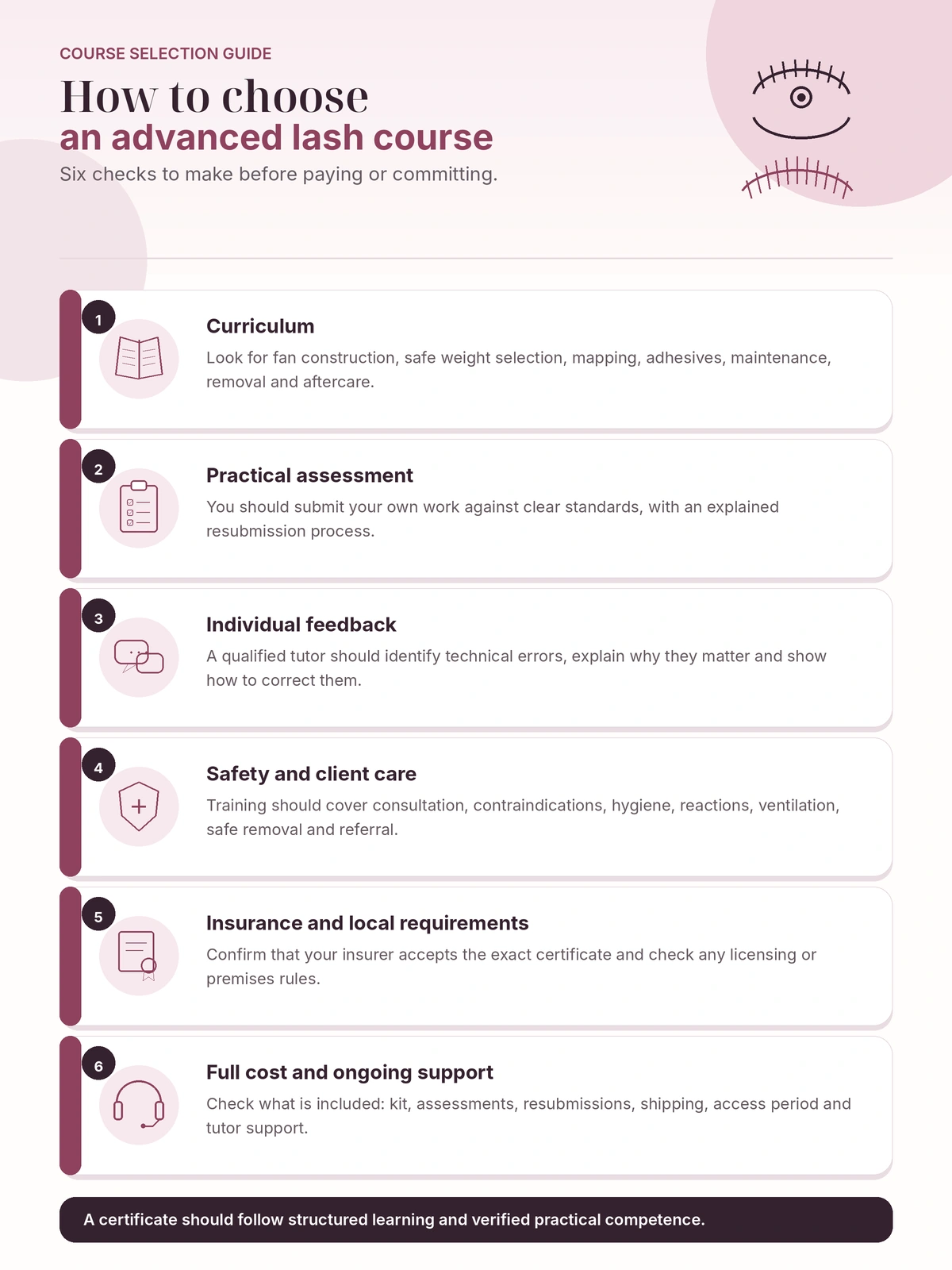
A clear curriculum
The provider should explain exactly what will be taught. A credible advanced curriculum may include volume fan construction, combined weight, attachment, mapping, styling, adhesive behavior, environmental conditions, maintenance, removal, consultation, adverse reactions, hygiene, aftercare, and treatment records.
Compare the curriculum with the National Occupational Standard for advanced eyelash extensions. A course does not need to copy the standard word for word, but major safety and competency areas should not be missing.
Practical assessment
Watching demonstrations is not enough to establish practical competence. The program should require students to submit evidence of their own work and should explain how that work is assessed.
Ask the provider:
- How many practical submissions are required?
- Must work be completed on a mannequin, model, or both?
- What evidence must be submitted?
- What are the pass criteria?
- Will the assessor identify specific technical errors?
- Can work be resubmitted after feedback?
Allowing resubmissions can support learning, but the standard required to pass should remain clear and consistent.
Individual feedback
Advanced techniques involve small differences in pickup, fan geometry, adhesive control, and placement. General prerecorded advice may not explain why one student’s fans are closing, leaning, or creating inconsistent bases.
Look for access to a qualified tutor who can review close-up photographs or videos, explain what needs correcting, and show how to make the correction.
Safety and client-management content
A course should not focus entirely on producing attractive photographs. It should also cover consultation, consent, contraindications, hygiene, product instructions, recordkeeping, aftercare, adverse reactions, and professional referral.
These subjects protect both the client and the artist and are central to accepted occupational standards.
Accreditation, regulation, and insurance
“Accredited” and “regulated” are not automatically interchangeable terms.
An industry body may accredit a course, while a regulated qualification is listed through an officially recognized awarding organization. Students in England and Northern Ireland can use the government’s Register of Regulated Qualifications to check whether a particular qualification is officially regulated.
Private accreditation may still be accepted by beauty insurers, but acceptance varies. Before paying for a course, ask an insurer in writing whether it will cover the exact treatments you intend to provide after completing the qualification.
Also confirm:
- Whether the certificate covers Classic, Hybrid, Russian Volume, and Mega Volume separately
- Whether model work is required before insurance begins
- Whether there are age, location, or experience restrictions
- Whether treatment and public liability cover are included
- Whether the insurer accepts fully online training
Local business requirements
A certificate does not automatically satisfy every legal or local requirement.
Rules can vary according to country, council area, treatment, and premises. UK learners can use the GOV.UK licence finder and contact their local council before opening a home studio, renting a salon space, or adding a new treatment.
Artists working elsewhere should check the licensing, cosmetology, insurance, and premises rules that apply in their own state, province, or country.
The complete cost and support period
Confirm what the advertised price includes. Ask whether the following involve additional charges:
- Practice products and replacement adhesive
- Assessment or certification
- Assessment resubmissions
- Tutor calls
- Shipping
- Insurance
- Access after qualification
- Advanced modules or future updates
It is also useful to know how long tutor support continues and whether students can ask questions after receiving their certificate.
Can advanced lash techniques be learned online?
Online training offers flexibility and allows students to replay detailed demonstrations. Its value, however, depends on the quality of the assessment and feedback.
A useful online program should provide clear close-up demonstrations, structured theory, practical assignments, individual correction, and an opportunity to repeat work that does not yet meet the required standard.
Before enrolling, ask to see a course preview, sample lesson, assessment instructions, and example of the feedback students receive. This provides more useful information than promotional photographs or a certificate image alone.
How Training Beauty & Beyond approaches lash training
According to Training Beauty & Beyond, its online eyelash extension course combines foundation and advanced content rather than serving only experienced artists.
The advertised curriculum covers Classic, Hybrid, Russian, and Mega Volume lashes. It includes lessons on the lash growth cycle, contraindications and infections, adhesives, curls and thicknesses, client consultation, mapping, isolation, stickies, volume-fan weights, fan construction, refills, removal, and aftercare.
The provider also states that students complete multiple-choice and practical assessments and can arrange private one-to-one video sessions with an assigned tutor. A customized kit and ongoing access to the course are listed among the included features.
Training Beauty & Beyond says the qualification is accredited by IPHM Beauty and the CPD Group. Its accreditation and insurance information also acknowledges that insurance acceptance can vary according to the insurer, treatment, and training completed.
Prospective students should still confirm that the certificate is suitable for their experience level, location, insurer, and intended services before enrolling.
Questions to ask before enrolling
- Does the course require previous classic-lash experience?
- Which techniques and lash styles are included?
- How is practical competence assessed?
- How many model or practical submissions are required?
- Will a tutor provide individual feedback on my work?
- Does the course cover lash weight, client suitability, and adverse reactions?
- Who accredits or regulates the qualification?
- Will my intended insurer accept the certificate?
- Do local licensing or premises rules apply?
- How long will I have access to lessons and tutor support?
- What is the total cost after products, assessments, insurance, and other expenses?
- What evidence will I need to submit before receiving the certificate?
Readiness is about consistency, not perfection
You do not need to know every advanced technique before enrolling in further training. That is the purpose of the course. You should, however, have an honest understanding of your present skills and the areas that still require work.
The strongest signs of readiness are consistent foundations, careful recordkeeping, genuine client demand, a realistic financial plan, and a willingness to develop deeper safety knowledge.
A certificate should mark the completion of structured learning and assessment. Continued practice, feedback, and reflection are what turn that learning into dependable professional skill.
