

Accounts payable, or AP, covers the process of receiving, checking, approving, recording, and paying supplier invoices.
For a small business handling only a few invoices, this may be manageable with email, spreadsheets, and basic accounting software. Problems tend to emerge as invoice volume increases, more managers become involved in approvals, or the business expands across several departments or locations.
Invoices can be overlooked in crowded inboxes. Managers may approve them late. Employees may enter the same information into more than one system. Resolving a duplicate invoice, incorrect amount, or missing purchase order can also take considerably longer than processing an invoice correctly the first time.
Accounts payable software is designed to centralize these tasks and automate the parts of the process that do not require human judgment.
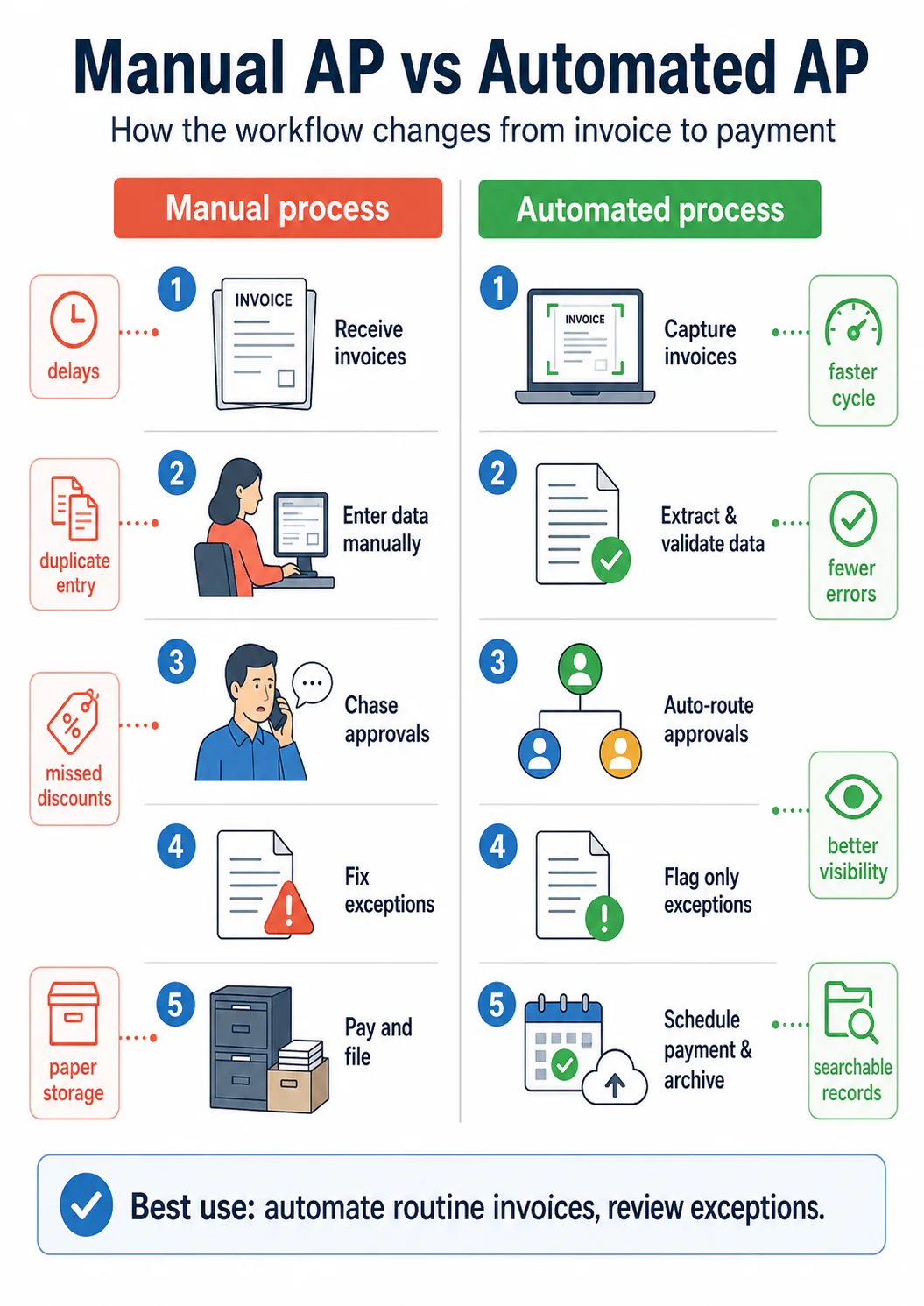
The real cost of manual invoice processing
The cost of processing an invoice includes more than the time spent entering its details into accounting software. Employees may also need to find the correct approver, check the invoice against a purchase order, investigate discrepancies, correct coding errors, answer supplier questions, and retrieve records during an audit.
According to APQC’s cross-industry benchmarking data, the median total cost of processing an accounts payable invoice is $6. The benchmark is based on 4,821 companies and includes personnel, systems, overhead, outsourcing, and other costs.
That figure should be treated as a benchmark rather than a universal estimate. A company’s actual cost will depend on its labor expenses, invoice volume, approval structure, error rate, and the number of invoices that require additional investigation.
Businesses should therefore calculate their own cost by considering:
- Time spent entering and checking invoice information
- Time spent finding and reminding approvers
- Work required to resolve missing or incorrect information
- Late fees and duplicate payments
- Missed early-payment discounts
- Paper, printing, postage, and physical storage
- Time spent finding documents for audits or supplier inquiries
What AP automation actually does
A typical automated system receives invoices through email, file uploads, scans, supplier portals, or other approved channels. It then extracts information such as the supplier name, invoice number, payment terms, line items, and total amount.
The software may compare the invoice with a purchase order and receiving record. When the information matches the company’s predefined rules, the invoice can move to the next stage automatically. When something is missing or inconsistent, it can be directed to an employee for review.
According to its product information, Yooz’s automated invoice processing platform supports AI-based data extraction, invoice validation, purchase-order matching, approval routing, and integration with accounting or enterprise resource planning systems.
This does not mean that every invoice should be approved without human involvement. A more practical goal is to automate predictable, lower-risk invoices while directing exceptions and unusual transactions to the appropriate employee.
Faster approvals with clearer oversight
Invoices often remain unpaid because the correct manager has not reviewed them. An automated workflow can route an invoice according to its department, amount, supplier, cost center, or other business rules.
Approvers may then review the invoice through a dashboard or mobile device instead of waiting to return to the office. Automated reminders and escalation rules can also reduce the need for AP staff to repeatedly follow up with managers.
Faster routing does not have to mean weaker oversight. A company can still require additional approval for large invoices, unusual suppliers, changes to payment details, or transactions that exceed an employee’s authorization limit.
Strengthening financial controls
Small businesses may be particularly exposed to fraud because they often have fewer employees and less separation between financial duties. The Association of Certified Fraud Examiners reported in 2026 that small organizations often face heightened vulnerability and that strong internal controls can materially reduce risk.
Depending on the software and how it is configured, digital AP controls may include:
- Role-based access to invoices and payment information
- Separation between invoice entry, approval, and payment duties
- Checks for duplicate invoice numbers and amounts
- Purchase-order and receiving-record matching
- Alerts when supplier banking details change
- Records showing who reviewed or approved an invoice
- Approval limits based on an employee’s role
These measures can strengthen and standardize internal controls, but they cannot make fraud impossible. Access permissions must be configured correctly, supplier records must be maintained, and employees still need procedures for independently verifying unusual payment requests.
Paying suppliers on time
A more predictable AP process can help a business pay suppliers by the agreed due date. This may reduce late fees, prevent avoidable disputes, and give suppliers a clearer idea of when they will receive payment.
Some suppliers also offer early-payment discounts. One example is “2/10 net 30,” which allows a buyer to deduct 2% when paying within ten days. Otherwise, the full invoice is due within 30 days. This type of trade-credit arrangement is explained in more detail by OpenStax’s Principles of Finance.
With a system like Yooz, the speed of processing makes capturing these discounts a standard part of the financial routine rather than a rare occurrence.
The value of this benefit will depend on how many suppliers offer discounts, the value of the eligible invoices, and whether the business has enough available cash to pay early. A company should not weaken its cash position simply to obtain a small discount.
Improving visibility into upcoming payments
When invoices are captured and categorized promptly, managers can obtain a more timely view of the company’s financial obligations.
Instead of waiting until the end of the month to determine how much the business owes, they may be able to review invoices awaiting approval, scheduled payments, disputed amounts, and spending by supplier or department.
This information can support cash-flow planning and make unusual changes easier to identify. For example, a business may discover that several departments are buying the same service separately or that a recurring supplier charge has increased unexpectedly.
However, AP software should not be described as making financial records automatically or permanently accurate. The quality of its reports still depends on timely invoice submission, correct coding, reliable integrations, and well-maintained supplier data.
Supporting growth without making unrealistic staffing promises
As a business grows, the number of supplier invoices often increases. In a manual process, that growth can lead to larger backlogs and eventually require additional administrative staff.
Automation can help an existing team process more invoices by reducing data entry, approval chasing, and document retrieval. It may also allow employees to spend more time investigating exceptions, reviewing supplier contracts, or planning cash requirements.
The size of the improvement will vary considerably. It depends on invoice formats, purchasing procedures, the number of exceptions, the complexity of approvals, and the quality of the implementation.
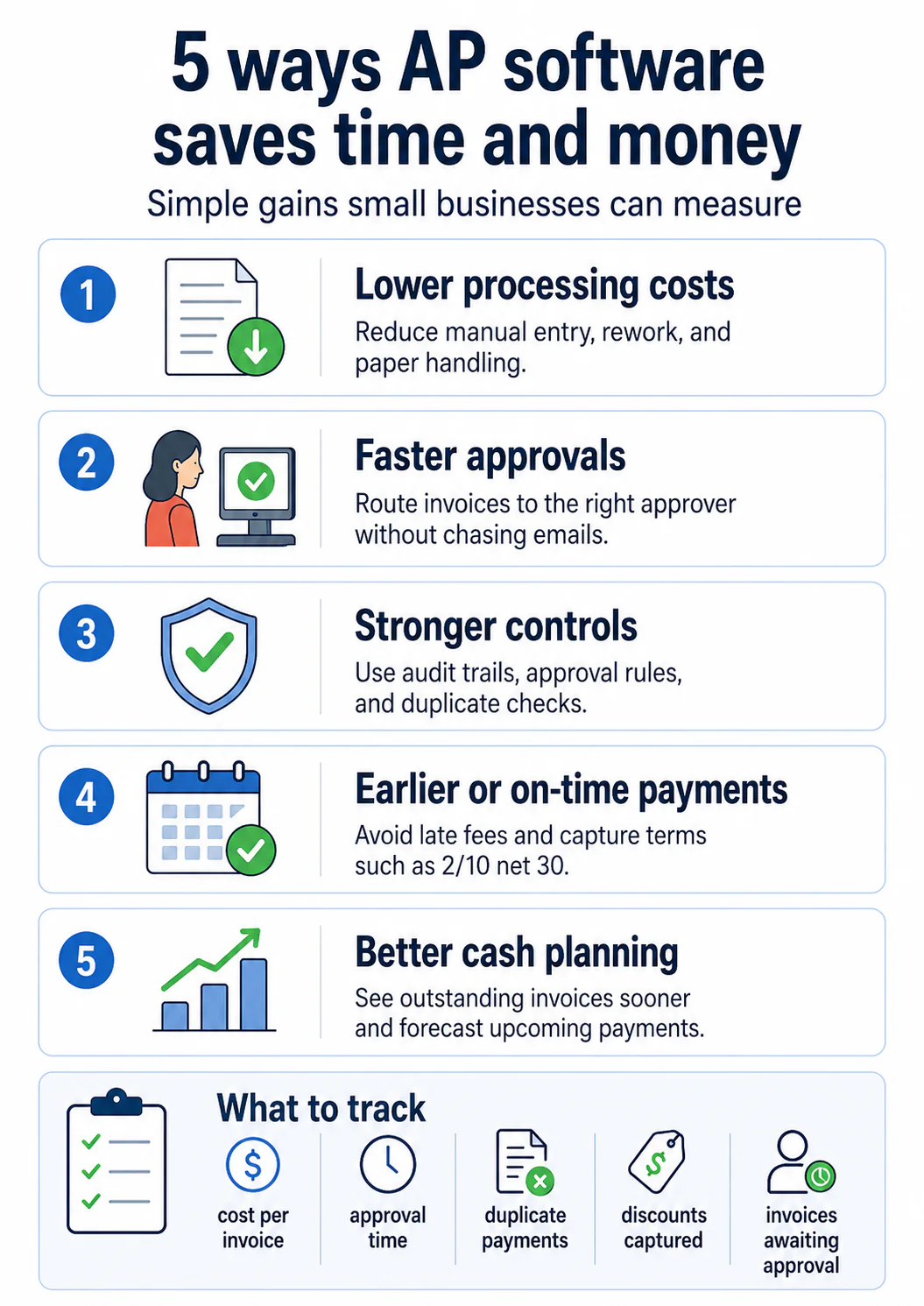
Rather than relying on a generic productivity promise, businesses should measure results using indicators such as:
- Average cost per invoice
- Time from invoice receipt to approval
- Percentage of invoices requiring manual intervention
- Number of late or duplicate payments
- Early-payment discounts captured
- Time spent responding to supplier inquiries
- Number of invoices processed per AP employee
Reducing paper and improving document retrieval
Digital invoices can reduce the need for printing, filing cabinets, and boxes of archived documents. Searchable records may also make it easier to retrieve an invoice during an audit, internal review, or supplier dispute.
Going paperless does not eliminate every record-management risk. Businesses still need suitable access controls, backup procedures, retention policies, and plans for responding to system outages or cyber incidents.
When dedicated AP software makes sense
A company processing a small number of straightforward invoices may not need a separate AP platform. Basic accounting software and clearly documented approval procedures may be sufficient.
Dedicated AP software becomes more relevant when the business has:
- A growing volume of supplier invoices
- Several departments or approval levels
- Multiple business entities or locations
- Purchase-order matching requirements
- Recurring problems with late or duplicate invoices
- Limited visibility into outstanding obligations
- A need for stronger approval records and access controls
Before selecting a system, the business should examine the full cost of implementation, including subscription fees, configuration, integrations, training, and ongoing administration. It should also confirm that the software works with its existing accounting system and supports its approval and reporting requirements.
A limited pilot involving one department or a small group of suppliers can help establish whether the expected savings are realistic before the system is introduced across the entire organization.
A more controlled approach to accounts payable
AP automation can reduce repetitive work, provide clearer approval records, and give managers a more timely view of upcoming payments. It can also help a growing business process additional invoices without increasing administrative work at the same rate.
The strongest case for adopting AP software comes from measurable improvements rather than broad promises about digital transformation. A business should compare the cost and performance of its current process with the full cost of implementing a new platform.
When the expected savings justify the investment, a platform such as Yooz can help turn accounts payable from a fragmented administrative task into a faster and more controlled financial process.
