
Anthropocene started when the first nuclear test took place, on July 16th, 1945, a research team suggests. Anthropocene refers to the current geological age, a period in Earth’s history when human activity became the dominant influence on climate and the environment.
‘Anthropocene’ is a combination of the Greek words anthropo meaning “human” and –cene meaning “new”.
Dr Jan Zalasiewicz and Professor Mark Williams, from the Department of Geology at the University of Leicester, say that human beings are having such a significant impact on our planet that they are altering its geology, creating new and distinctive strata that will persist well into the future.
Dr. Zalasiewicz leads an international effort assessing whether, and when, spiking human environmental impacts initiated the Anthropocene. A new paper authored by 26 scientists – the Working Group on the Anthropocene – was published in Quaternary International on 12 January
The term Anthropocene was first proposed by Paul Crutzen (born 1933), a Dutch Nobel Prize-winning atmospheric chemist in the year 2000. Crutzen is best known for his research on ozone depletion.
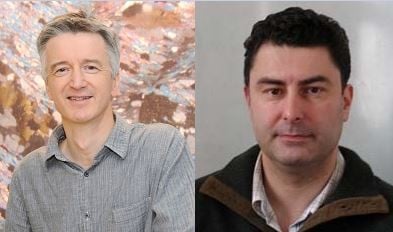
Dr Jan Zalasiewicz (left) and Professor Mark Williams. (Image: University of Leicester)
Crutzen did not give a specific date for the start of the Anthropocene epoch. Dr. Zalasiewicz, Professor Williams and other scientists have suggested that the turning point occurred in the middle of the twentieth century, when the world’s population grew rapidly, carbon emissions increased dramatically, animal and plant species became extinct at a faster rate, the production of concrete, plastics and metal, and the start of the nuclear age.
They suggest the start of the Anthropocene could be the detonation of the world’s first nuclear test – July 16th, 1945, at Alamogordo, New Mexico.
The birth of the nuclear age marks a historic turning point when human beings first accessed an enormous new energy source. It is also a moment in history that can be effectively tracked within geological strata, using several geological clues.
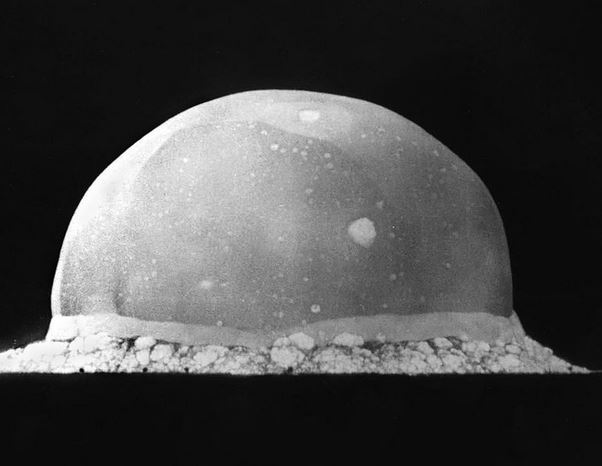
The Trinity Site explosion, 0.016 of a second after explosion, July 16, 1945. The world’s first nuclear test. Is this when the Anthropocene started? (Image: Wikipedia)
The Anthropocene Working Group says it will gather more evidence on the Anthropocene, and include discussion of possible alternative time boundaries. A formal date for the birth of the epoch is expected to be agreed in 2016.
Citation: “When did the Anthropocene begin? A mid-twentieth century boundary level is stratigraphically optimal,” Jan Zalasiewicz, Mark Williamsa et al. Quaternary International. Available online January 12th, 2015. doi:10.1016/j.quaint.2014.11.045.
