
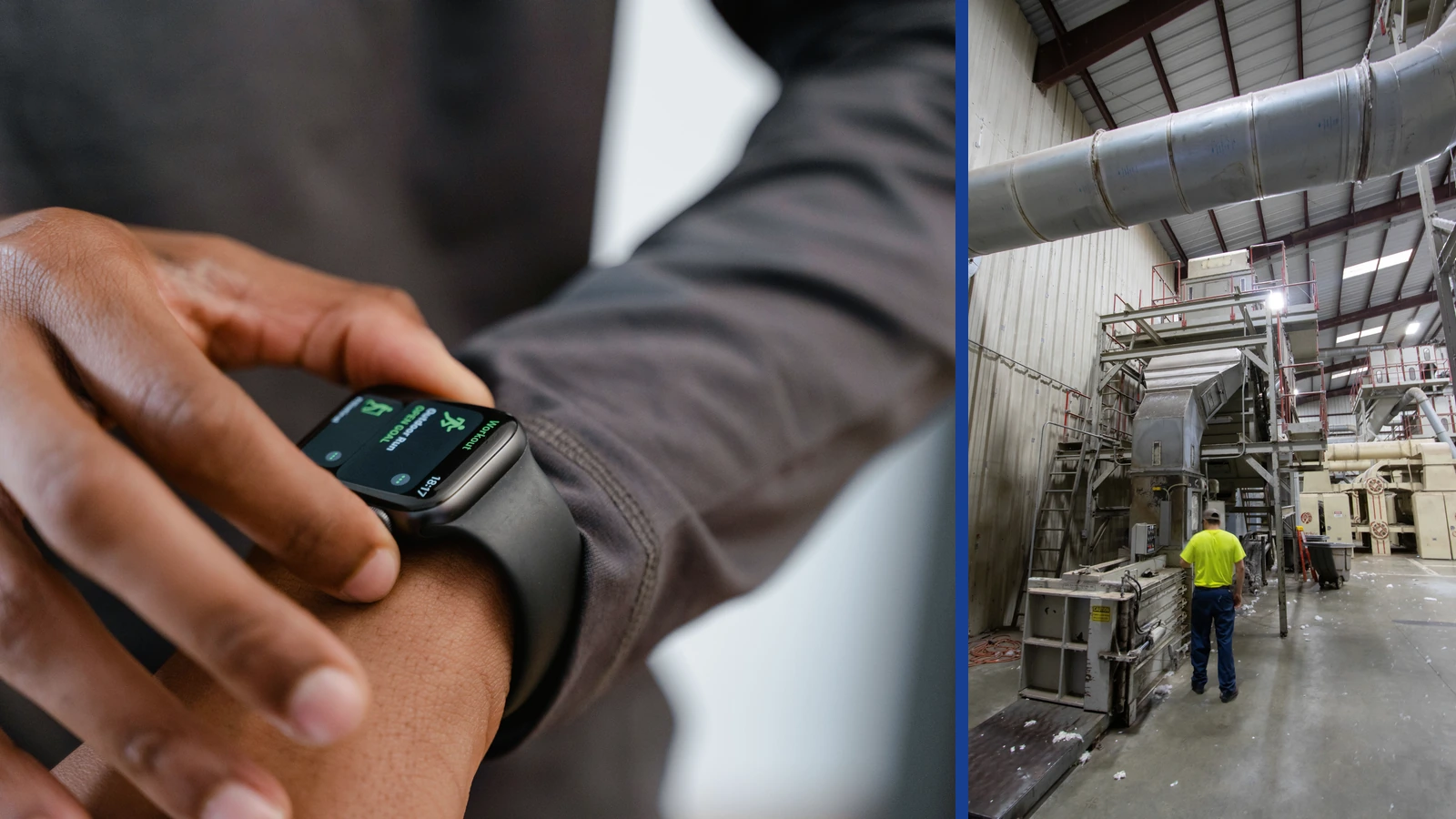
A wearable could warn a construction worker of mounting heat strain, alert a warehouse employee to repeated awkward bending or raise an alarm after a possible fall. For the person wearing it, an earlier warning could mean time to stop, change the task or get help.
These are examples of the intended uses of workplace wearables. Their appeal is immediate: information reaches the worker while a hazard is developing.
But a device that records someone’s movements or physical condition also creates a record about that person. Employees need to know whether it will be used to protect them, assess their performance or both.
For businesses, buying the sensor is the beginning of a decision about working conditions, responsibility and access to personal information.
What are workplace wearables?
Workplace wearables are electronic devices worn on the body or incorporated into clothing and protective equipment. They can include movement sensors, wristbands and smart helmets. Some collect information; others provide feedback or physical assistance.
Personal gas monitors are an established example of body-worn equipment that can warn workers about dangerous exposures. Newer applications include sensors that identify awkward postures, monitor signals associated with heat strain or detect a possible fall.
The US National Institute for Occupational Safety and Health, known as NIOSH, has described construction applications ranging from exposure monitoring to proximity warnings around equipment. The capabilities differ between products. A fitness watch should not be assumed to perform the same job as a validated occupational safety device.
An alert also needs a response. Someone must know whether to stop work, investigate the reading, take a break or summon assistance.
Detecting a risk is different from preventing an injury
A review of 60 studies in Applied Sciences, published in May 2026, found that wearables can help detect risks, but consistent evidence of sustained accident reduction remains limited.
David Mendes of the Polytechnic Institute of Setúbal and colleagues found that much of the evidence came from controlled experiments, small samples or short evaluations. The studies’ different methods and settings prevented a quantitative meta-analysis, a statistical calculation combining their results.
A sensor may classify a bending movement accurately without establishing that using it reduces back injuries over several years.
The European Agency for Safety and Health at Work, or EU-OSHA, has documented a posture-monitoring system that gives workers immediate feedback. Information about repeated awkward movements can also help employers identify tasks or equipment needing redesign.
If many employees bend awkwardly at the same workstation, the readings may point to a badly positioned shelf or equipment that needs changing. Repeated warnings to individuals can leave that problem untouched.
Fatigue detection requires similar care. NIOSH’s guidance on choosing fatigue-monitoring technology recommends examining validity, reliability, usability and the intended working environment. An algorithm’s fatigue estimate is not automatically a medical diagnosis or a dependable measure of someone’s fitness for every task.
Employers also need to understand false alarms and missed warnings. Devices that repeatedly interrupt work without a clear reason can become difficult to use effectively.
What do data protection rules say?
A worker might welcome a device that helps colleagues locate them in an emergency, yet object to managers using its records to examine every break. Physiological readings can be more sensitive still, because they may reveal health information.
In the UK, the Information Commissioner’s Office’s health-monitoring guidance says employers must justify monitoring as necessary and proportionate. They must identify a lawful basis for processing personal information and an additional condition where health information is involved.
The regulator advises a data protection impact assessment, which examines risks to individuals before processing begins. Such assessments are mandatory in some circumstances.
Consent is rarely appropriate in employment because of the power imbalance. A genuine optional program, with no adverse consequences for declining or withdrawing, can be different. Getting a worker to sign a form does not by itself settle the issue.
The ICO currently marks this guidance as under review following the Data (Use and Access) Act. Companies need to check the rules applicable to their jurisdiction and proposed use.
Protection depends on what happens after the alert
NIOSH’s ethical framework for wearable sensors recommends the least intrusive means needed to achieve the objective and minimizing adverse consequences. Employers should explain what is collected, who receives it, how long it is kept and whether it could be used outside the safety program.
A limited pilot can assess comfort, accuracy, maintenance and whether alerts produce useful changes. Workers should be involved in identifying difficulties, including interference with protective equipment or confusing instructions.
Software, training, support and secure storage add to the purchase cost. Companies evaluating a pilot need to examine whether working practices change, not simply how many alerts the device generates.
EU-OSHA’s implementation guidance says digital monitoring should complement existing safety procedures. Longer workplace evaluations are still needed to establish whether newer systems reduce injuries consistently.
The worker who receives a heat warning needs somewhere to cool down and time to recover. A device can send the alert, but the employer must make that response possible. Keeping the worker’s readings out of unrelated performance decisions is part of delivering the protection the program was introduced to provide.
