
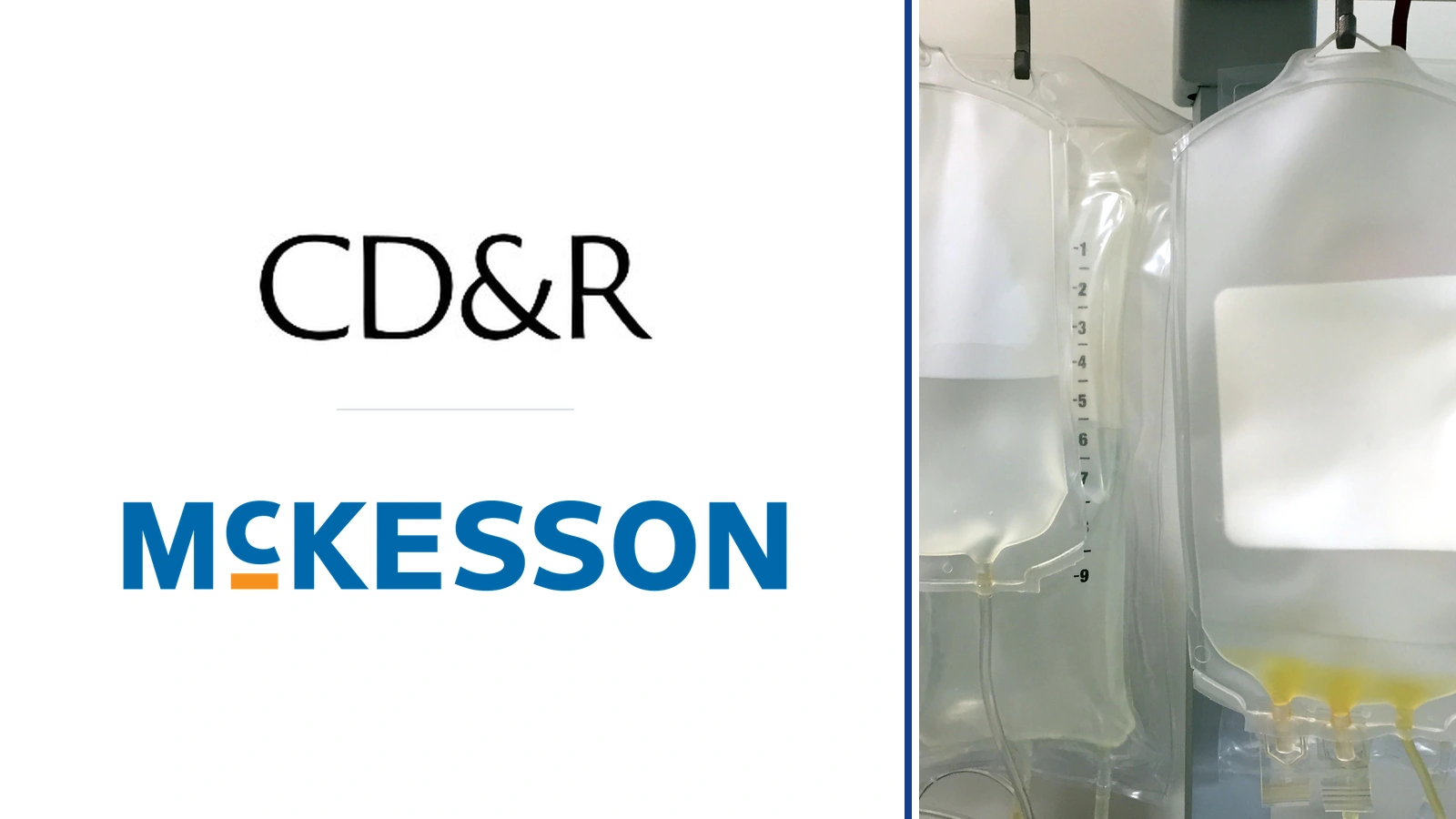
CD&R and McKesson have agreed to acquire home infusion provider Option Care Health for $32.05 per share in cash, valuing the business at approximately $5.8 billion including debt. The agreement announced October 6 would give CD&R majority ownership and McKesson a substantial minority stake.
The offer represents a premium of about 37% to Option Care’s October 5 closing share price. The companies expect the transaction to close in the first half of 2027, subject to shareholder and regulatory approvals, according to their joint announcement.
Option Care provides infusion services at home and in outpatient settings. Its business combines medicines, equipment and clinical support.
McKesson would initially own 49%
CD&R would hold approximately 51% of Option Care. McKesson plans to invest about $1.4 billion for approximately 49%. The $5.8 billion enterprise valuation measures the business including debt; it is separate from the amount McKesson would invest for its ownership interest.
The agreement provides a framework for McKesson to acquire CD&R’s interest later, subject to specified conditions and regulatory approvals. Option Care would remain a separate company with its own management team.
CD&R is a private equity investment firm. Its proposed controlling stake means the initial ownership arrangement would combine a financial investor with an established healthcare business.
Home infusion depends on a coordinated service
The Centers for Medicare & Medicaid Services defines home infusion as administering drugs or biological medicines intravenously, into a vein, or subcutaneously, under the skin, at home.
It involves the medicine, equipment such as pumps, and supplies including tubing and catheters. Nurses may train patients or caregivers, explain side effects and check the infusion site during subsequent visits.
CMS describes a process involving patients, physicians, hospital discharge planners, health plans and infusion pharmacies. Moving treatment outside a hospital therefore requires a service that can coordinate delivery, equipment and clinical support.
For a provider, expansion depends on maintaining that coordination as patient volumes grow. More referrals are commercially useful only if the organization can supply the prescribed treatment and provide appropriate support.
Payment arrangements matter too. Medicare’s home infusion benefit covers specified professional services associated with certain drugs administered through qualifying equipment. The benefit’s defined scope should not be read as a promise that every home treatment or associated expense is covered.
Revenue growth has been modest this year
Option Care’s second-quarter results show the operating position behind the transaction. Net revenue was $1.442 billion in the three months ended June 30, up 1.9% from a year earlier. Net income rose 6.7% to $53.9 million.
Gross profit, revenue after the direct cost of providing services, fell to $267.3 million from $269.0 million despite the increase in sales. Selling, general and administrative expenses declined, helping operating income rise to $85.1 million from $82.7 million.
The figures show why revenue alone provides an incomplete picture of the business. The costs associated with delivering care, together with overhead expenses, determine how much of that revenue becomes profit.
In July, the company forecast full-year revenue of $5.675 billion to $5.775 billion. That was management guidance, rather than a completed annual result. It reported more than 8,000 employees, including over 5,000 clinicians, and services across all 50 states.
The merger filing says Option Care’s board unanimously recommended the agreement. Closing requires a majority shareholder vote, completion of antitrust procedures and specified healthcare regulatory approvals, including certain state approvals. The buyers’ obligation to complete the deal is not conditioned on obtaining financing.
