
Aurora Innovation says its commercial autonomous trucks have passed 500,000 driverless miles, with vehicles serving customers including McLane and Werner running at an annualized rate above 225,000 miles per truck. The operating figures put vehicle utilization at the center of the business case for driverless freight.
At its September 23 investor day, Aurora described that mileage rate as more than twice the utilization of a traditional truck. The comparison is the company’s own benchmark, not an industry-wide finding.
An annualized rate projects an operating pace over a year. It does not mean each truck has already completed 225,000 miles in a full year of service.
Aurora targets 200 driverless trucks in operation by the end of 2026 under transport-as-a-service agreements, in which customers buy freight transport. Its longer-term ambition exceeds 30,000 trucks by 2030. Both are deployment targets.
For a carrier, higher mileage is only part of the calculation. The revenue earned from those miles must cover the vehicle, fuel, driving technology, maintenance, insurance, and people supporting the operation.
What is an autonomous truck?
An autonomous truck uses sensors, computers, and driving software to monitor its surroundings and control steering, acceleration, and braking. Cameras, radar, and lidar, which uses laser pulses to measure distance, can help it detect vehicles, lanes, and obstacles.
Some autonomous journeys still have a safety driver or observer in the cab. Driverless operation removes the need for an onboard human driver within the conditions the system is designed to handle.
The National Highway Traffic Safety Administration’s definition of Level 4 automation describes a system responsible for driving within a limited service area. That capability does not extend automatically to every road or weather condition.
Aurora said in July that roadside-assistance staff sometimes rode in a rear seat without driving or supervising. Its use of “driverless” refers to the driving function; it does not establish that every trip has no person aboard.
Freight planning software is a separate technology. As we explained in our earlier coverage of Einride’s planned Tesla Semi deployment, using an AI platform to schedule trucks does not make those vehicles driverless.
Kodiak’s highway launch is still ahead
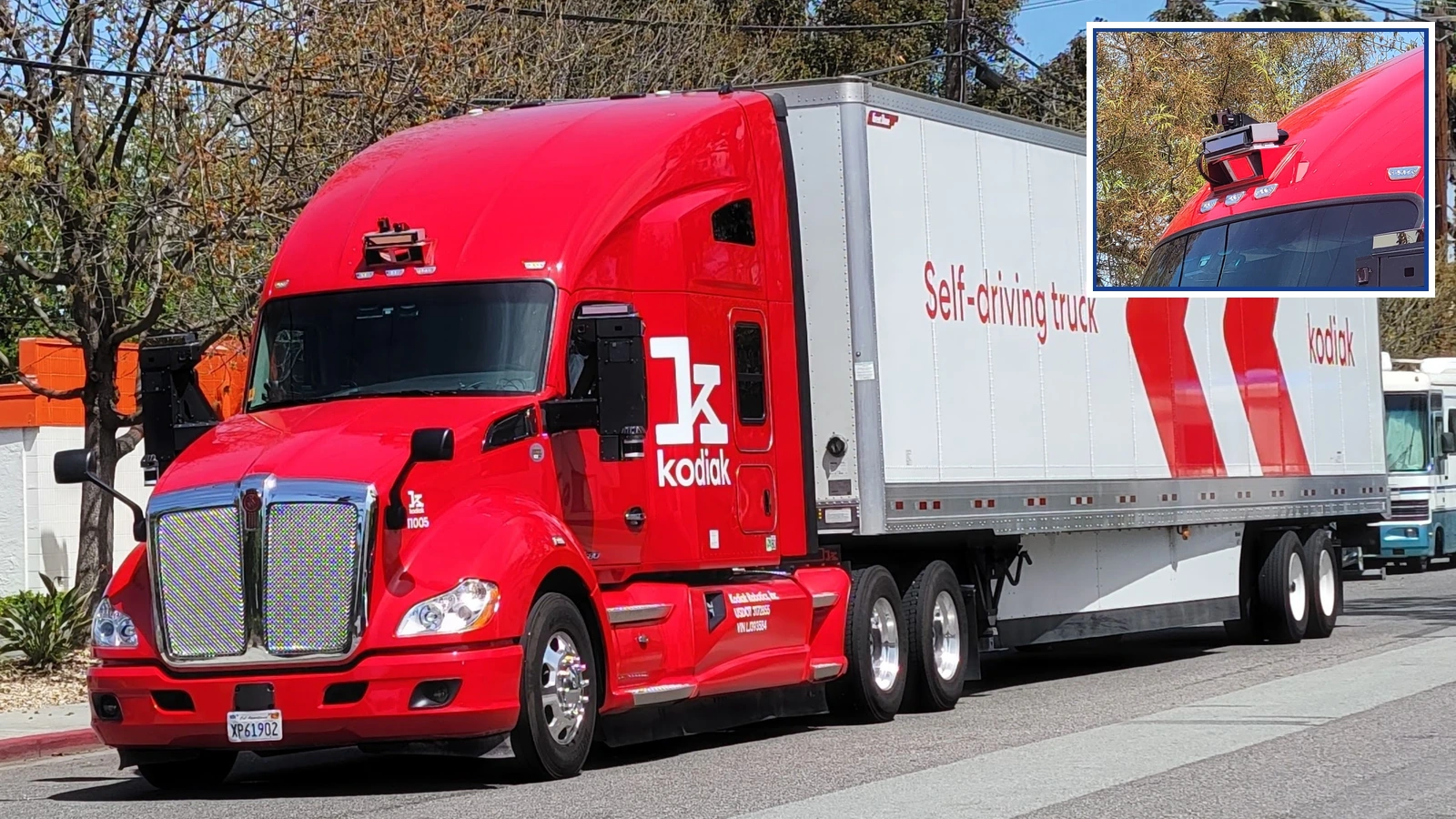
Kodiak AI already supplies technology for driverless industrial freight. Its second-quarter results reported 35 customer-owned driverless trucks at June 30. The vehicles operated for Atlas Energy Solutions in the Permian Basin.
Its planned highway service is a separate rollout. On September 25, Kodiak selected the Dallas-Houston corridor for an unsupervised commercial launch by year-end.
The company said it was completing end-to-end deliveries without human intervention, including on surface streets. A safety observer was still aboard during those preparation runs. Intervention-free driving is not the same as an empty cab.
Kodiak subsequently named IKEA as its launch shipper partner on September 29. The initial driverless portion would cover 219 miles, primarily along Interstate 45 between its Houston and Dallas-area facilities, within a 292-mile IKEA delivery route.
Kodiak said its four-year IKEA partnership had produced more than 1,300 loads and 750,000 autonomous miles with a safety observer aboard. Those figures describe the supervised service preceding the planned driverless launch.
More running time can spread fixed costs
The utilization argument starts with the limits on human driving time. Under the Federal Motor Carrier Safety Administration’s general rules, a property-carrying driver may drive up to 11 hours after 10 consecutive hours off duty, within a 14-hour driving window.
A 30-minute interruption is required after eight cumulative hours of driving without one. Weekly limits and specified exceptions also apply. These rules regulate the driver, not a blanket daily limit on how long the truck can move.
Conventional fleets can already extend vehicle operating time through relays or two-driver teams. The Bureau of Labor Statistics describes team driving, in which one driver rests while the other drives. An autonomous system’s advantage depends on the operation it replaces.
More productive miles can spread annual equipment and financing costs over more work. In a simplified example, an unchanged $50,000 annual fixed cost divided by 100,000 miles is 50 cents per mile. At 200,000 miles it is 25 cents. That arithmetic illustrates the mechanism, not Aurora’s costs or a forecast of savings.
Fuel, tires, and mileage-related servicing still accumulate as a truck travels farther. Faster use can also bring forward replacement of equipment with a finite mileage life.
Operators need to distinguish total miles from paid miles. Driving an empty trailer back to a terminal increases utilization without necessarily earning revenue. A truck that cannot find a paying return load may look busy while producing disappointing margins.
Labor savings bring technology expenses
BLS reported nearly 2.1 million heavy and tractor-trailer truck drivers in May 2025, with a mean, or average, annual wage of $59,710. The median, the midpoint of the pay distribution, was $58,640, according to its Occupational Outlook Handbook.
Wages exclude benefits and other employer expenses. They also are not a ready-made estimate of savings per autonomous truck: fleets differ in staffing, driver pay, schedules, and the work their drivers perform away from the wheel.
Driverless operation adds sensors, computing equipment, software fees, communications, and maintenance requirements. It still needs dispatchers, technicians, terminal staff, and arrangements for roadside assistance.
Aurora describes remote assistance as guidance to its driving system when needed, with roadside help available. It says remote staff do not take over driving. Support costs depend partly on how frequently trucks need assistance and how quickly they can resume a trip.
Contract structure determines who pays which bills. Aurora’s current transport service puts truck ownership and operation with Aurora. Under its planned driver-as-a-service model, carriers would own and operate vehicles and pay for the driving technology.
A technology fee per mile and a complete freight rate cover different services. Comparing them without adding the carrier’s remaining costs would overstate savings.
In FreightWaves’ reporting from the investor event, Werner executive Daragh Mahon said the companies still had an economic gap to resolve and expected larger-scale operations to make the arrangement viable.
Warehouses can limit the benefit
A truck able to travel overnight gains little from arriving at a closed receiving dock. Loading appointments, gate access, inspections, refueling, and trailer availability can restrict productive hours even when the vehicle needs no driver rest.
Kodiak’s IKEA announcement described planning arrival times around unloading at a specific dock door and using maintenance data to schedule work. The surrounding operation is part of the service, not an afterthought.
A hub-to-hub model can let autonomous trucks cover the highway leg while people handle local collection and delivery. Each additional tractor swap or terminal stop adds time and expense. Direct access to customer facilities could remove some handoffs, but only where the system and operating procedures can accommodate the route.
For shippers, the relevant comparison is the total cost and reliability of moving a load from origin to destination. A cheaper highway leg can be offset by extra handling, delays, or local transport.
Driver jobs and insurance remain unsettled
BLS projects 4% growth in heavy and tractor-trailer driver employment from 2025 to 2035, with about 214,500 annual openings, many replacing people who retire or move occupations. Openings are not the same as newly created jobs.
The projection is not a guarantee against disruption on individual routes. Drivers also secure cargo, inspect equipment, and report mechanical defects. Removing highway driving leaves those tasks to be assigned elsewhere, while local deliveries and customer-facing work may remain human-operated.
Fleet supervision and specialized maintenance can create work, but there is no evidence here that those positions would replace lost driving jobs one for one.
Safety affects costs through claims, repair bills, cargo losses, and downtime. Lower insurance prices have yet to be established across autonomous freight. FreightWaves reported that Apollo, Aurora’s insurer, was pricing autonomous trucks slightly above human-driven vehicles, reflecting uncertainty about the severity of claims.
Kodiak reported 93% readiness for its highway safety case at the end of August. A safety case is an argument, backed by evidence, that a system can operate safely within a defined environment.
The percentage measures how much of Kodiak’s stated claims and evidence was materially complete. It is not a crash probability, a government safety rating, or proof that driverless service had begun.
Aurora targets a larger fleet by December, while Kodiak plans to start its driverless IKEA service before year-end. The service contracts will determine who pays for a stalled truck, a missed delivery, or a cargo claim, and how much of any operating saving the carrier keeps.
