
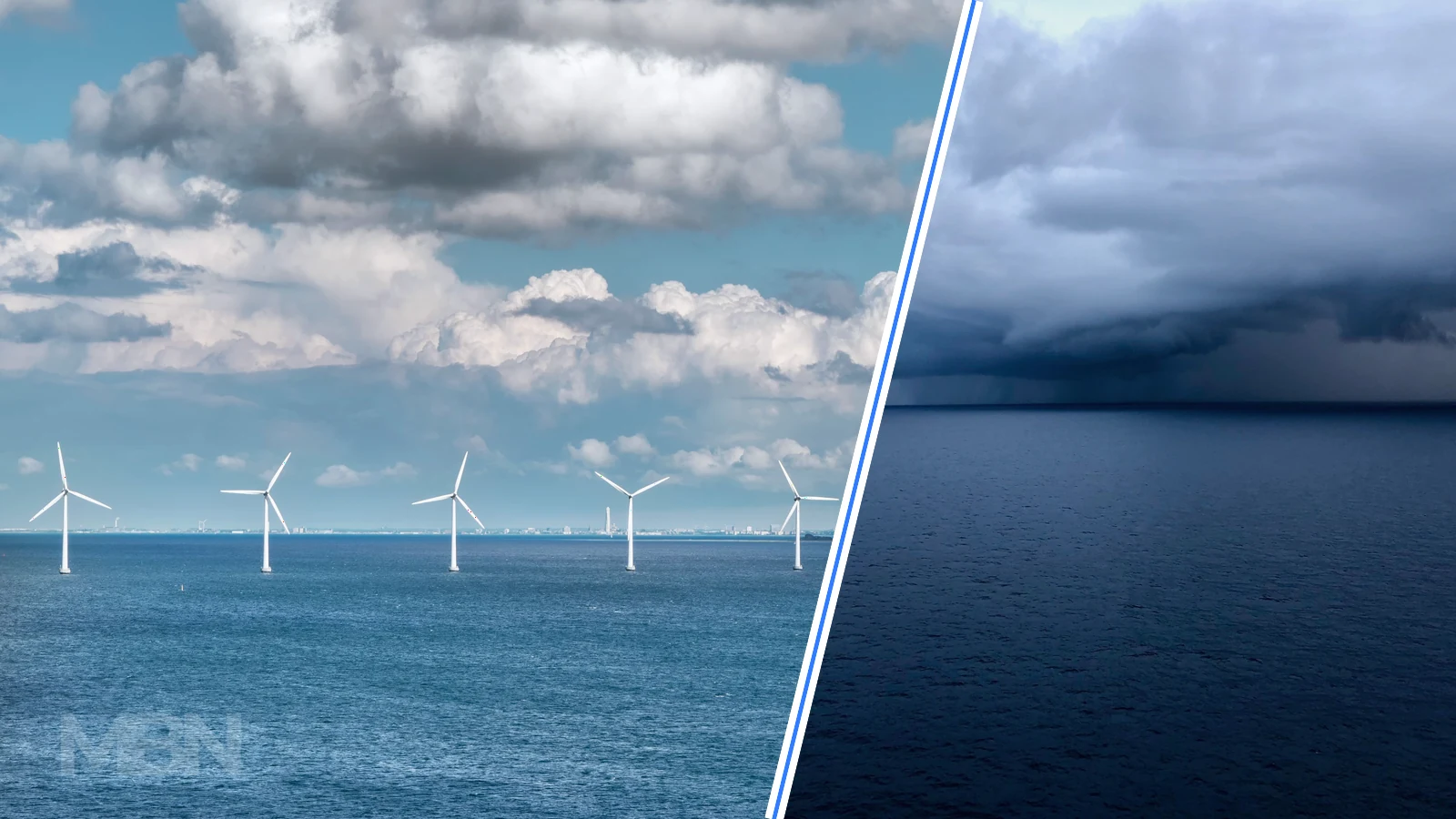
A new climate-model study found that very large offshore wind farms could increase rainfall at sea while leaving some European coastal areas drier. In the most extensive scenario, precipitation fell by 10% to 12% in parts of Germany, the Netherlands and the United Kingdom, and by more than 15% in parts of Denmark. The scenario was designed as an upper limit, not as a forecast of what today’s wind farms are doing.
The research, published on 12 August 2026 in Communications Earth & Environment, examined the Northwest European Shelf, including the North Sea, Baltic Sea and UK-Irish Sea region.
Researchers Naveed Akhtar, Alberto Elizalde, Beate Geyer and Corinna Schrum, based at Helmholtz-Zentrum Hereon, wanted to know whether the combined wakes of thousands of turbines could alter the movement of moisture towards land.
What the model actually tested
The team used COSMO-CLM, a regional climate model that represents weather processes on a grid with points roughly five kilometres apart. It ran the model using ten years of weather conditions from 2008 to 2017.
The researchers compared a control with no wind farms against layouts representing offshore development in 2023, 2030 and beyond 2050. The 2023 and 2030 layouts produced only small precipitation effects, mostly over the sea.
The larger rainfall shifts appeared in the final layout. It placed turbines throughout all offshore development zones identified in the study’s data, using a constant capacity density of 8 megawatts per square kilometre.
Capacity density is the amount of generating capacity assigned to an area of sea. Holding it constant allowed the researchers to compare layouts using turbines rated at 5 MW, 10 MW and 15 MW.
This highest-deployment case was a controlled modelling exercise. It was not a proposed construction plan, and it did not predict the weather of a particular future decade.
How wind farms could move rainfall
A wind turbine converts part of the air’s kinetic energy into electricity. The air behind it becomes slower and more turbulent, forming a wake.
One turbine has a fairly local effect. Across a large wind farm, however, many wakes can alter airflow over a much wider area. In the study’s upper-limit simulations, surface wind speeds over some wind farm zones fell by as much as 2 to 3 metres per second.
The model also produced more upward movement of moist air above the turbines. Rising air cools, which can cause water vapour to condense and fall as rain. Monthly precipitation over some wind farm areas increased by as much as 8 to 10 millimetres, or 12% to 18%, compared with the control.
That left less moisture in the air moving towards land. The simulated wind farms did not block rain clouds. They changed wind speed, turbulence and where some of the moisture fell.
The resulting coastal effect was uneven. The largest reduction appeared in Jutland, Denmark, particularly near Herning. Lower rainfall also appeared in coastal areas of Germany and the Netherlands, and along parts of the UK’s west coast.
Wind direction helped determine who was affected. South-westerly winds carry moisture towards much of northwestern Europe, and they produced the clearest redistribution in the model. North-westerly winds produced little coastal effect.
Season mattered as well. The reduction was most apparent in autumn and winter. The researchers found no consistent signal in summer.
The 5 MW layout generally produced a stronger coastal reduction than the layouts using larger turbines. It needed more individual machines to provide the same capacity density, creating more combined turbulence. The modelling therefore indicates that the number and size of turbines may matter alongside the stated generating capacity.
What this means for offshore wind planning
Europe is planning a large expansion of offshore energy. The European Commission’s 2020 offshore strategy set benchmarks of at least 60 GW of offshore wind by 2030 and 300 GW by 2050. EU countries later agreed regional, non-binding goals for all offshore renewable generation of 86 to 89 GW by 2030 and 355 to 366 GW by 2050.
Those targets state how much capacity countries want. They do not determine the exact turbine count, spacing or location used in the paper’s maximum-development scenario. The study therefore cannot tell planners how much rainfall would change if Europe met a particular gigawatt target.
It does point to an issue that may become more relevant as projects grow and neighbouring wind farms begin to form much larger clusters. Weather crosses national boundaries. A layout approved in one country’s waters could, in principle, affect an area downwind in another.
For developers and regulators, that means cumulative effects may matter more than the assessment of one project in isolation. Turbine size and spacing could also become environmental planning variables rather than purely engineering and financial choices.
The evidence is not yet strong enough to turn those possibilities into planning rules. The estimates came from one atmospheric model, one maximum-development footprint, one capacity density and a ten-year weather period.
The authors called for further work using other models, densities and geographical layouts. The next task is to find out whether the same pattern appears under more realistic buildouts, and at what scale it becomes large enough to measure.
