

A campaign can double its clicks and still bring in fewer customers. Click-through rate measures the response to an ad, listing or other eligible exposure. Deciding whether that response is worth buying requires a second check: what happens after the click, and what it costs.
For a small business, a publisher or a marketing team, CTR is often an early sign that an audience has responded to a message. It is also easy to misread. A broader audience, a different reporting definition or automated traffic can move the rate without telling you whether the message got better.
What is click-through rate?
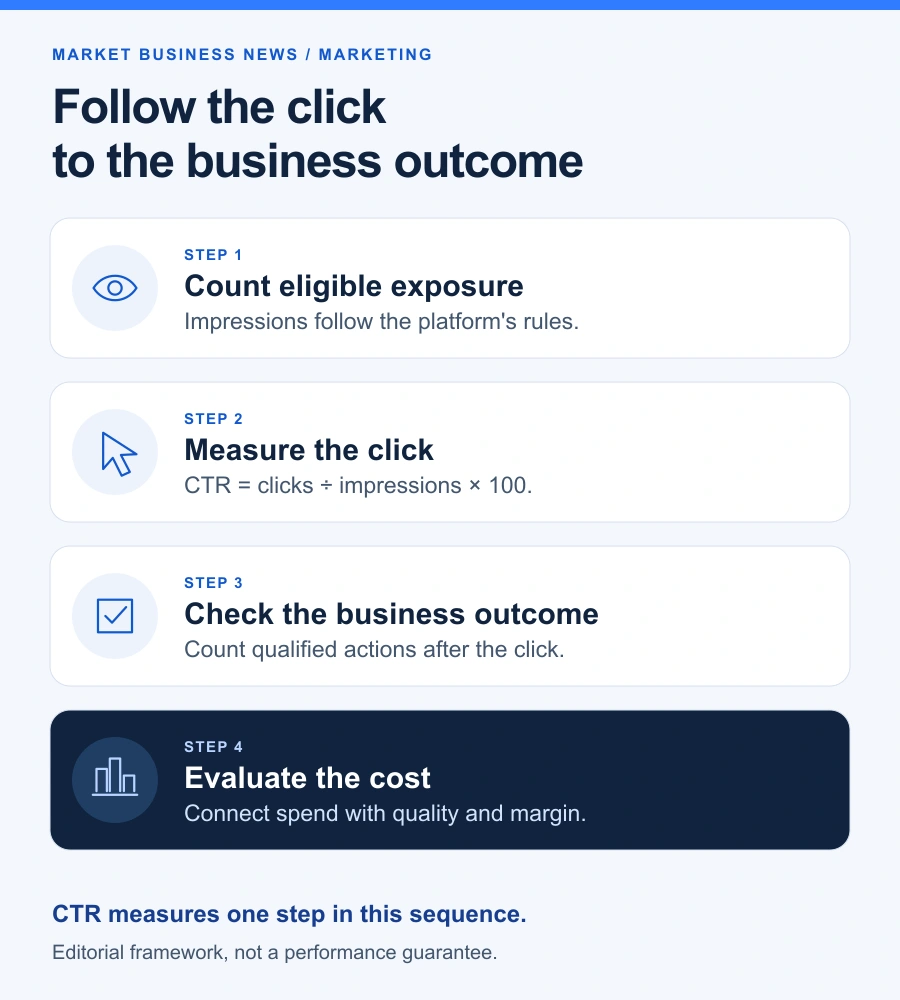
Click-through rate, usually shortened to CTR, divides recorded clicks by recorded impressions and expresses the result as a percentage. An impression is a counted showing of an ad or other item, under the reporting system’s rules. It is not necessarily a different person each time.
The calculation is clicks ÷ impressions × 100. For example, 200 clicks from 10,000 impressions produce a 2% CTR. Google Ads uses this definition for its ads and free product listings, and says a good rate depends on what is advertised and the network.
Our Marketing Business Network video introduces the calculation and the limits of judging a campaign by clicks alone. The exercises below go further, connecting CTR with costs, outcomes and changes in audience.
Watch “What is Click-Through Rate (CTR)?” on YouTube if the player does not load. The examples and tools in this article are separate editorial illustrations.
Calculate the rate and the cost of the outcome
Keep the reporting period, audience and attribution window consistent. An attribution window is the period during which a reporting system connects a later action with an earlier interaction. Google Ads calls its corresponding setting a conversion window. Yesterday’s clicks and this morning’s incomplete sales figures can make a working campaign look unsuccessful.
The calculator uses impression-based CTR and converting clicks: clicks that led to your chosen outcome, counted once each. An outcome might be a completed purchase or a qualified inquiry. Counting every form event, purchase and repeat purchase together would answer a different question. For email click rates, use your provider’s delivered-message definition in the channel guide below.
What did the clicks deliver?
Enter matching totals for one campaign and one reporting window. The loaded figures are fictional.
The fictional example has 200 clicks from 10,000 impressions; 20 clicks led to the selected outcome.
Calculations stay in this page; the tool does not send or store your inputs. It performs arithmetic, not an attribution analysis, profitability forecast or statistical test. It excludes view-through conversions, repeat outcomes per click and cross-device reconciliation.
Cost per click, or CPC, divides spend by clicks. Cost per converting click divides the same spend by the clicks that achieved the selected outcome. A qualified inquiry is not yet a customer, and neither cost measure includes a customer’s future purchases unless you explicitly add them.
For organic search, a zero media bill does not make the work free. Writing, design and technical maintenance still cost money. Use a consistent cost basis when comparing investments.
More clicks can buy fewer customers
Consider two fictional campaigns, each with 10,000 impressions and a $5 average CPC. Campaign A attracts 200 clicks and 20 converting clicks. Campaign B attracts 400 clicks, but only 12 convert.
| Measure | Campaign A | Campaign B |
|---|---|---|
| CTR | 2% | 4% |
| Click-to-outcome rate | 10% | 3% |
| Converting clicks | 20 | 12 |
| Media spend | $1,000 | $2,000 |
| Cost per converting click | $50 | $166.67 |
B doubles CTR but produces eight fewer converting clicks at twice the media spend. Moving from 2% to 4% is a rise of two percentage points, or 100% relative to the original rate. Those descriptions should never be swapped in a report.
The reason for a weak outcome still needs investigation. The ad might attract unsuitable buyers, the offer might disappoint, the form might fail or the reporting might miss completed orders. CTR cannot identify which explanation is correct.
A sale credited to advertising is also not proof the advertisement caused an extra sale. Our guide to measuring whether marketing creates additional sales explains how a comparison group helps address that question. For budget decisions, record lead quality, cancellations and money left after serving the customer.
Check what your channel actually counts
A paid-search CTR and an email click rate can both display “3%” while using different denominators. Choose the relevant channel below before comparing reports. These are starting checks, not performance targets.
For a benchmark to inform a decision, it needs a comparable channel, audience, placement, objective and period. Start with your own matched campaigns. A higher rate among existing customers does not establish that a new-customer campaign is failing.
Paid search
CountAd clicks divided by ad impressions. Keep networks and ad formats separate.
CompareBrand searches with brand searches, and new-customer searches with similar queries. Check devices, geography and placements.
Follow throughTrack qualified leads or purchases, costs and conversion delay.
First checkAre the actual search terms consistent with the offer? A stronger headline cannot fix the wrong audience.
Google Ads’ CTR definitionOrganic search
CountSearch Console clicks divided by its counted impressions. A click is not the same measurement as an Analytics session.
CompareKeep query, page, device, country, search type and similar positions in view. Check branded and non-branded traffic separately.
Follow throughExamine visits and completed actions on the destination page.
First checkDid your result move, or did the mix of queries change? Review the title actually shown and what the page delivers.
Google’s Search Console reporting guideYouTube
CountViews arising from registered thumbnail impressions. Total video views include other sources, so total views divided by impressions can give the wrong CTR.
CompareSeparate Search, Home and other traffic sources where the reports allow. A wider audience can lower CTR.
Follow throughCheck watch time, viewer retention and whether the video fulfills its title’s promise.
First checkDid the video reach a different audience? Do not treat every small movement as a reason to replace a thumbnail.
YouTube’s impressions and CTR FAQCountCheck your provider’s definition. Mailchimp’s click rate counts delivered emails registering at least one click, divided by successfully delivered emails.
CompareUse consistent bot filtering, recipient segments and message purposes. Keep unique recipients separate from total click events.
Follow throughReview completed actions, unsubscribes and complaints alongside clicks.
First checkAre security scanners generating clicks? Opens are also affected by privacy protections, so click-to-open rate needs caution.
Mailchimp’s open and click definitionsYouTube’s thumbnail impression rules require more than one second on screen with at least half the thumbnail visible. External website embeds, including the player in this article, are not counted as thumbnail impressions in that report. Do not reconstruct its CTR from all video views.
Google says traffic from AI Overviews and AI Mode is included in Search Console’s Web search reporting. A movement in the combined rate, by itself, cannot establish how much AI features caused. Changes in queries, positions and audiences also need checking.
For email, Mailchimp documents how security scanners and other automated activity can inflate clicks. A change in filtering can lower the reported rate without a change in human response. Click-to-open rate, which uses recorded opens as its denominator, is a separate measure and inherits open-tracking limitations.
A falling average can hide better performance
Calculate an overall CTR by adding clicks and dividing by the corresponding total impressions. Averaging two percentages gives the wrong answer when their impression counts differ.
In the fictional example below, returning customers and new audiences each gain one percentage point. The combined CTR still falls because the campaign shifts most of its impressions toward the lower-rate audience. Move the sliders, then hold the audience mix constant to separate the effects.
Both audiences improve. Why did CTR fall?
Each period has 10,000 impressions. Returning-customer CTR rises from 8% to 9%; new-audience CTR rises from 1% to 2%.
Both segments improve by 1 percentage point. The combined CTR falls from 6.60% to 3.40% because the audience mix changes. This is a fictional arithmetic example, not an experiment.
Rates and total impressions are fixed for illustration. Only the audience shares change. The example does not suggest that a new audience is commercially worse; costs, reach and later outcomes still need evaluation.
The same problem appears when a site starts ranking for more unfamiliar searches or a video reaches beyond its regular viewers. Before declaring that a message failed, compare like-for-like segments and examine both rates and volumes.
Search Console adds another complication: its chart and tables can use different aggregation rules. Property-level and page-level totals do not always reconcile by summing rows. Use matched totals from the same report definition for your calculation.
Improve the promise before making it louder
Start with the job the audience is trying to complete. A person looking for emergency repairs needs different information from someone comparing annual maintenance contracts. More dramatic wording will not resolve a mismatch between the query, offer and destination.
For an illustrative repair service, “Schedule a heating repair” identifies an action. “View available appointments and service call fees” tells a prospective customer what the next page contains, provided it actually supplies both. Such wording can help people decide whether to continue; it carries no guaranteed CTR uplift.
Check whether the page fulfills the specific promise. Show eligibility limits, relevant prices and the next step clearly. A headline that wins clicks by hiding restrictions can leave the sales team handling inquiries it cannot serve.
For search results, Google recommends descriptive, concise titles and may generate the displayed title from several page signals. Editing the title element does not guarantee that exact wording will appear. Inspect the result actually shown before evaluating the edit.
AI can generate variations for review, but check every price, feature and factual promise. Test a defined difference, such as explaining the next step more clearly. If one version changes the offer, image and wording together, its result will not identify which edit mattered.
Run a test that can answer the decision
An A/B test compares versions under a planned allocation. Where the platform allows it, random assignment helps prevent one version receiving people who were already more likely to respond. NIST’s guidance on randomized experimental designs explains the principle.
Google Ads experiments can split traffic or budget between an original campaign and an experiment. The setup still needs to fit the question. Running one headline during a quiet week and another during a sale compares more than wording.
Specify the main outcome before starting. For a lead-generation business, qualified inquiries per assigned visitor might matter more than button clicks. Check cost and total qualified inquiries too: an efficient rate on a tiny audience may not generate enough business.
Choose the smallest difference worth acting on and plan the observation period and sample size around it. There is no universal number of impressions or fixed test length that makes every CTR comparison reliable. Repeated exposures to the same person also complicate treating impressions as independent observations.
Allow for delayed outcomes and examine uncertainty, including the interval of effects consistent with the data. Microsoft’s experimentation guidance explains why repeated checks require methods that account for early peeking. Stopping at the first favorable result can otherwise produce a misleading winner. Neither calculator above tests statistical significance.
Write the decision down
Bring the original counts to the review, not just the two percentages. If the response rises but qualified outcomes fall, investigate the audience, promise and destination before buying more traffic. If the evidence remains inconclusive, record that result and decide whether a larger test is worth its cost.
