
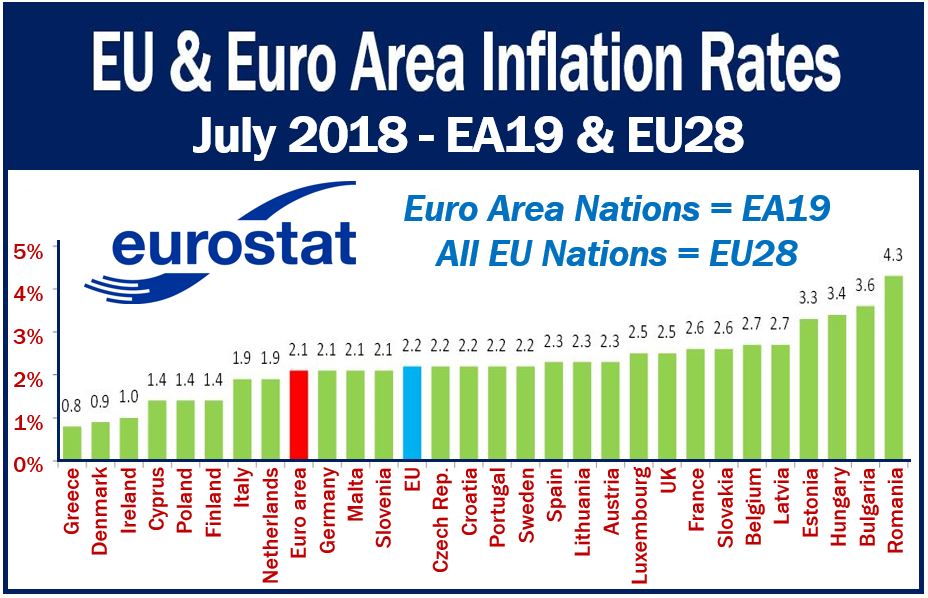
EU and Euro Area Inflation Rates

Euro Area inflation up to 2.1%

Published: 12:04, August 17, 2018

The euro area inflation rate rose to 2.1% in July 2018 compared to 2.0% in June 2018. In July 2017, the euro area inflation rate was 1.3%.

The EU28 inflation rate in June 2018 increased to 2.2%, from 2.1% a month earlier. In June 2017, the EU28 inflation rate was 1.5%, says Eurostat, the EU’s statistical office.

Euro area, EA19, and EU28

EU28 stands for the 28 European Member states, including those that do not use the euro as their national currency. The euro area, on the other hand, includes only those 19 European Union countries that adopted the euro as their national currency. We sometimes refer to the euro area as the EA19.

Therefore, Germany, which uses the euro as its national currency, is both an EA19 and EU28 country. The UK, which still uses the pound sterling, on the other hand, is an EU28 but not an EA19 nation.
EU and Euro Area Inflation Rates
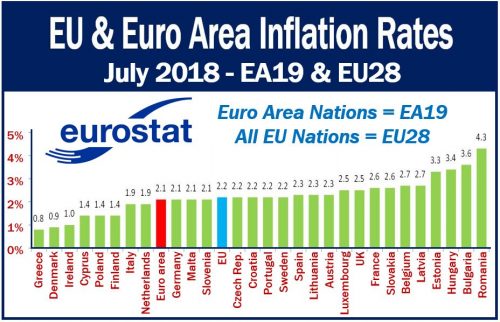
The euro area inflation rate in July 2018 was 2.1%, while that of the EU28 was 2.2%.
Lowest inflation rates

The following countries registered the lowest annual inflation rates:

– Greece 0.8%.

– Denmark 0.9%.

– Ireland 1.0%.

Highest inflation rates

The following member states registered the highest annual inflation rates:

– Romania 4.3%.

– Bulgaria 3.6%.

– Hungary 3.4%.

– Estonia 3.3%.

Annual inflation declined in nine Member States in July 2018 compared to June 2018.
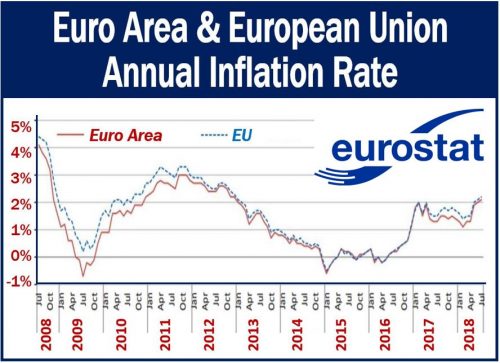
EU and Euro Area inflation rates over ten years
The EU and euro area inflation rates declined significantly during the Global Financial Crisis of 2008/9.

Euro area inflation – contributors

The biggest contributors to the euro area inflation rate for July 2018 were:

– Energy +0.89 percentage points.

– Services +0.64 percentage points, food.

– Alcohol and tobacco +0.49 percentage points.

– Non-energy industrial goods +0.12 percentage points.

European Union

The European Union or EU is a political and economic union of 28 Member States. With a population of 510 million, it is the world’s largest single consumer market.

The EU is a free trade area. This means there are no tariffs or quotas between member states. A tariff is a tax that a country levies on imports. A quota is a limit on imports.

Christian Nordqvist Avatar

Other News

Board diversity is linked to faster drug recalls, research finds

Oct 22, 2026

Young audiences favor new actors over influencers in UCLA survey

Oct 22, 2026

Added-sugar labels can change which foods shoppers buy

Oct 22, 2026

Stanford’s thermal-noise research advances low-power wireless sensing

Oct 21, 2026

Connected-car security risks increasingly sit in apps and cloud services

Oct 21, 2026

A freelancer’s financial guarantee can make a bid less attractive

Oct 21, 2026

A housing slump can change store shelves far beyond the downturn

Oct 21, 2026

Europe’s cheaper solar imports bring a manufacturing trade-off

Oct 20, 2026

Annual price reviews lose ground in regional Fed survey

Oct 20, 2026

Europe’s startup funding gap grows after the early rounds

Oct 20, 2026

Business data sharing has a funding problem beyond the technology

Oct 20, 2026

Why strong headline earnings growth needs a closer look

Oct 19, 2026

Why a supply-chain backup plan can fail when disruption strikes

Oct 19, 2026

Streaming customers are canceling and returning, changing the meaning of loyalty

Oct 19, 2026

Why falling consumer confidence is not a sales forecast

Oct 19, 2026

MidOcean and Idea Financial form venture for small-business loans up to $1 million

Oct 18, 2026

AI incidents reach senior leaders while governance changes lag, IBM survey finds

Oct 18, 2026

Euro area trade deficit widens as imports outpace exports

Oct 18, 2026

New studies examine research costs alongside academic publishing profits

Oct 18, 2026

Tariff uncertainty disrupts supply-chain sustainability plans, MIT survey finds

Oct 18, 2026