

With Germany and other EU lenders refusing to budge, and leftist Greek Prime Minister Alexis Tsipras announcing on Sunday that his country’s “cruel” austerity program was unacceptable and that he would not consider any extension of Greece’s international bailout, the two are set on an almighty collision course.
In his first major speech to parliament since his far-left Syriza party won the general election in January, Mr. Tsipras announced a list of measures that would undo the reforms imposed by the lending European nations, the European Central Bank, and the International Monetary Fund (IMF).
The Syriza party failed to get the necessary votes to gain an absolute majority in parliament, and decided to form a coalition with the far-right Independent Greeks. The Greek government today consists of lawmakers from the extremes of the political spectrum.
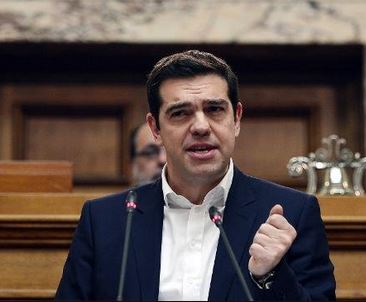
Mr. Tsipras’ speech was full of bravado and promises, but what will he do when the EU refuses to budge and Greece can’t pay its bills?
Mr. Tsipras vowed to bring back pension bonuses, scrap a property tax, raise the tax-free threshold, end mass layoffs, re-hire public workers, and bring back the minimum wage to pre-crisis levels.
Two of the new government’s measures – the minim wage hike and restoring the tax-free threshold to €12,000 – breach the agreements made previously as conditions for receiving bailout funds.
EU officials say “No Deal”
European Union officials have turned down his efforts to renegotiate his country’s bailout terms.
Despite warnings from his EU partners regarding abandoning Greece’s commitments to its €240 billion bailout, Mr. Tsiras promised to see through his election campaign pledge to bring his country back from the austerity abyss. Greece’s total debt is €323 billion.
While being able to attain a balanced budget, Greece was not going to aim for unworkable primary budget surpluses, he insisted. The EU requires that Greece’s budget be in surplus, before factoring in debt repayments.
Mr. Tsipras said his government refused to negotiate its national sovereignty, to enthusiastic applause from lawmakers. “The bailout failed. We want to make clear in every direction what we are not negotiating,” he added.
He said Greece will seek reparations from Germany, the country that has lent it the most money, for the damage incurred during the Second World War.
Greece’s current bailout expires on February 28th, 2015. After that it will need to extend it if it wants access to further funds. Mr. Tripras said there would be no bailout extension, and assured parliament he would strike a deal with his European partners with a bridge agreement.
Greece would not ask for an “extension of mistakes,” he said.
Economists say that Greece, which is locked out of bond markets, will find it impossible to finance itself without prompt financial help from outside. Despite knowing his country is on the edge of an abyss, Mr. Tsipras is sure he will be able to service the debts.
Mr. Tsipras said:
“The Greek people gave a strong and clear mandate to immediately end austerity and change policies. Therefore the bailout was first cancelled by its very own failure and its destructive results.”
Alan Greenspan, the former Chairman of the US Federal Reserve, said in a BBC Radio 4 interview on Sunday that what is happening now is a prelude to Grexit – Greece’s exit from the Eurozone. He thinks Grexit now is not a question of “if”, but “when”.
Mr. Greenspan says that without total political union the Eurozone is doomed to fail.
British Chancellor (Finance Secretary) said the UK is getting ready for a possible Grexit. If Greece leaves the Eurozone, the UK will need to be ready for the market instability that such an event could trigger.
A significant number of economists across the world argue that austerity is self-defeating. It raises unemployment, which reduces tax revenues.
