
A startup company that develops ground-based, autonomous delivery robots or “ground drones” has secured $17.2 million in a funding round led by Daimler AG.
Starship Technologies – launched in 2014 by Skype founders Ahti Heinla and Janus Friis – is building a fleet of autonomous ground drones to deliver parcels, groceries and food in 15-30 minutes within a 2-3 mile radius.
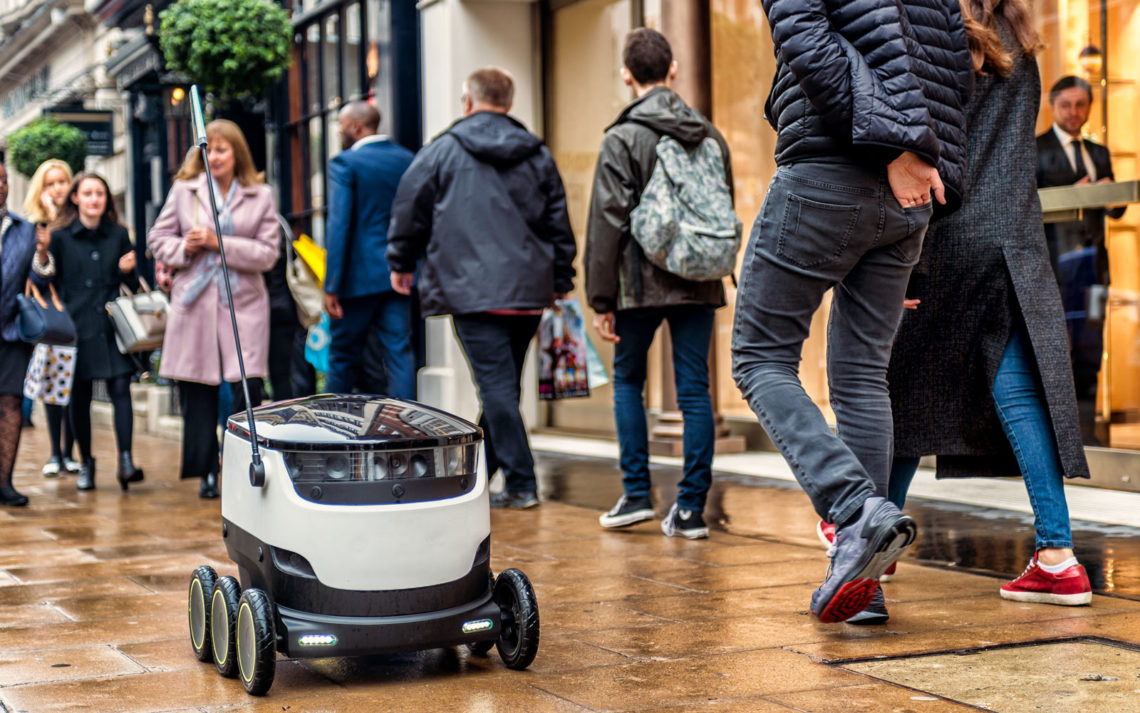
Heinla, who is the company’s CEO, says the funding “further accelerates development of our technologies and enables us to launch pilot programs in several new markets.”
Tackling the ‘last mile’
The ground drones are designed to tackle the notoriously challenging “last mile” problem that has created headaches for retailers, logistics firms, and delivery providers.
Compared to the main leg of bulk shipping journeys completed on trains, trucks, ships, and aircraft, the final leg or last mile from the final logistics hub to the consumer is usually the most difficult and costly.
Starship’s ground drones are six-wheeled intelligent, kerbside robots that drive autonomously under the watchful eye of humans who can intervene and take control at any time.
They stay on the ground and use pavements like pedestrians, travelling at slow speeds and with zero emissions.
Pilot programs
Starship is running commercial pilot programs of its ground drones in the United States, the United Kingdom, Germany, Switzerland, and Estonia, partnering with Just Eat, Hermes, Metro Group, Swiss Post, Wolt and others.
Following completion of a pilot program, the ground drones are reported already to be in active service in Greenwich, a borough of London, UK, where they are handling the last mile of food delivery from JustEat restaurants.
Starship celebrated its first year of testing the ground drones on public sidewalks in October 2016. The event marked the completion of over 10,000 delivery miles in 16 countries and 56 cities, where the robots came into contact with over 1.7 million people.
The point of the testing programs is not just to prove the technology, but also to find out how people – road users and pedestrians – react to the ground drones.
The results of tests so far show the overall public perception of the ground drones is neutral to positive, say Starship. Most people (70 percent) seem unfazed by the robots and generally ignore them. The other 30 percent reacted positively and some even stopped to ask questions of the robot handlers.
Daimler van as ‘mothership’ for ground drones
Daimler’s Mercedes-Benz Vans division are already working with Starship Technologies. They teamed up back in September 2016 to introduce the idea of the ground drone “mothership.” This combines the advantages of a delivery van – which serves as a mobile hub – with those of an autonomous delivery robot. The mothership can carry eight ground drones.
The aim is to implement the concept over the coming months, starting with pilot trials of the van and robot combination in Europe.
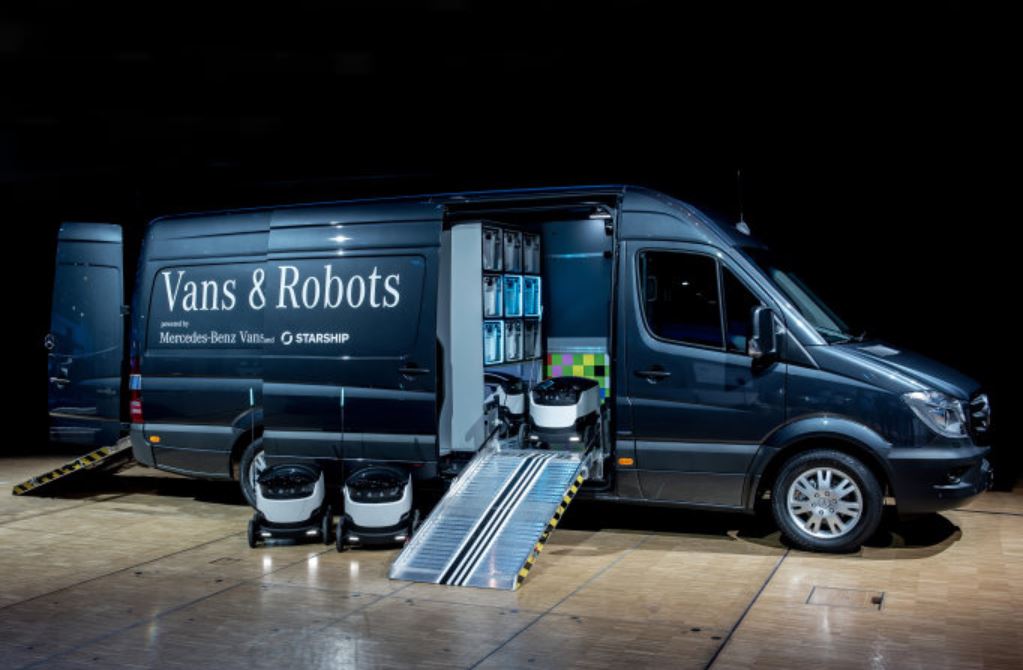
Volker Mornhinweg, Head of Mercedes-Benz Vans, explains that the ground drone can only travel short distances and has to return to the warehouse for reloading after each delivery.
Using a van as a mobile hub “widens the operational radius of the robots significantly, while also rendering superfluous the cost-intensive construction and operation of decentralized warehouses,” he adds, and notes “the concept makes it much easier to deliver goods to the end customer on time.”
