

manufacturing

Manufacturing output rose in October, boosted by falling pound

Written by Joseph Nordqvist

Published: 23:52, November 1, 2016

The falling pound boosted manufacturing output in the UK last month, but also sharply increased the prices of imports.

The Markit/CIPS UK Manufacturing purchasing managers’ index (PMI) dropped from a two-year high of 55.5 in September to 54.3 in October – a reading in line market expectations. Anything above 50 signals growth.

New order volumes increased for the third straight month and at a pace close to September’s recent high.
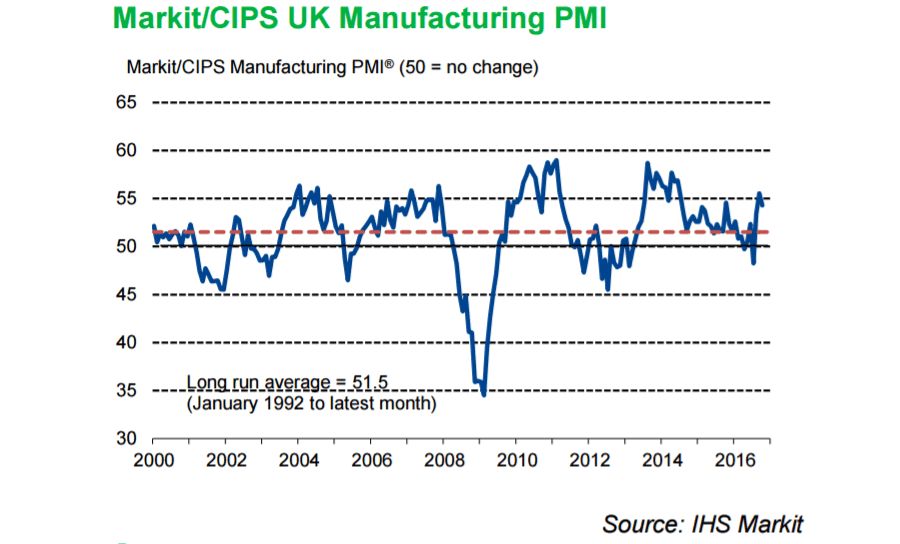
markit_pmi_october
Source: Markit/CIPS UK Manufacturing PMI

Rob Dobson, senior economist at IHS Markit, said: “The UK manufacturing sector remained on a firm footing in October and should return to growth in the fourth quarter.

“The main topic of the latest PMI survey was, however, the impact of the sterling depreciation on manufacturers.

“On the positive side, the boost to competitiveness drove new export order inflows higher, providing a key support to output volumes.”


The depreciation of the pound drove import prices up, increasing purchasing costs.

The survey revealed that 90% of companies that offered a reason for the rise in purchasing costs made some reference to the declining value of the pound sterling.

“The down-side of the weaker currency is becoming increasingly evident, however, with increased import prices leading to one of the steepest rises in purchasing costs in the near 25-year survey history,” Mr Dobson added.

“Around 90% of companies offering a reason for increased costs made some reference to the sterling exchange rate.”

David Noble, Group Chief Executive Officer at the Chartered Institute of Procurement & Supply, said:

“The sector held firm in positive territory as new orders, staffing levels and overall activity rose – though generally at a slower rate than the previous month. Growth continued to be driven by both domestic and particularly export markets buoyed by the weak pound and bringing orders from China, the US and the EU.

Joseph Nordqvist Avatar

Other News

Corporate climate targets often change before their deadlines

Oct 22, 2026

Ad auction averages can hide how prices are set, research shows

Oct 22, 2026

California nursing homes cluster just below a staffing-rule cutoff

Oct 22, 2026

Chipmaking expertise crosses borders through suppliers, engineers and investment

Oct 22, 2026

Employer pay differences reach beyond wages into household spending

Oct 22, 2026

Late-payment problems rise among UK firms that offer customer credit

Oct 22, 2026

Repair firms trail recyclers on margins in South Korean study

Oct 22, 2026

Personalized grocery prices could help most shoppers while costing others more

Oct 22, 2026

Board diversity is linked to faster drug recalls, research finds

Oct 22, 2026

Young audiences favor new actors over influencers in UCLA survey

Oct 22, 2026

Added-sugar labels can change which foods shoppers buy

Oct 22, 2026

Stanford’s thermal-noise research advances low-power wireless sensing

Oct 21, 2026

Connected-car security risks increasingly sit in apps and cloud services

Oct 21, 2026

A freelancer’s financial guarantee can make a bid less attractive

Oct 21, 2026

A housing slump can change store shelves far beyond the downturn

Oct 21, 2026

Europe’s cheaper solar imports bring a manufacturing trade-off

Oct 20, 2026

Annual price reviews lose ground in regional Fed survey

Oct 20, 2026

Europe’s startup funding gap grows after the early rounds

Oct 20, 2026

Business data sharing has a funding problem beyond the technology

Oct 20, 2026

Why strong headline earnings growth needs a closer look

Oct 19, 2026