
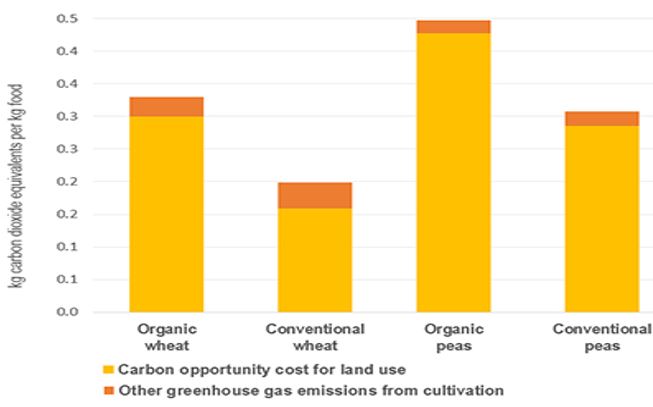
Organically farmed food is worse for our planet’s climate than conventionally farmed food, says a team of researchers. The main reason is that organic food requires more land. This is what Timothy D. Searchinger, Stefan Wirsenius, Tim Beringer, and Patrice Dumas wrote in Nature (citation below).
The research team developed a method for assessing how land-use can impact the climate. They used their method, along with others, to compare organically farmed with conventionally farmed food.
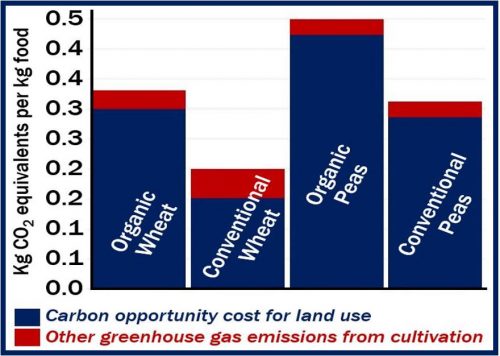
According to their findings, organic food can result in significantly greater greenhouse gas emissions.
A greenhouse gas is a gas that absorbs and emits radiation. In other words, it helps keep our planet warm. Methane and carbon dioxide (CO2), for example, are greenhouse gases.
Organically farmed vs. conventionally farmed peas
Co-author, Stefan Wirsenius, said:
“Our study shows that organic peas, farmed in Sweden, have around a 50 percent bigger climate impact than conventionally farmed peas. For some foodstuffs, there is an even bigger difference – for example, with organic Swedish winter wheat the difference is closer to 70 percent.”
Wirsenius is an Associate Professor at the Department of Space, Earth and Environment, Physical Resource Theory, at Chalmers University of Technology.
Organically farmed food requires more land. Yields per hectare are much lower compared to conventionally farmed food.
The main reason we need more land for organic food is that we don’t use fertilizers to produce them.
Organically farmed food – CO2 emissions
Prof. Wirsenius said:
“The greater land-use in organic farming leads indirectly to higher carbon dioxide emissions, thanks to deforestation.”
“The world’s food production is governed by international trade, so how we farm in Sweden influences deforestation in the tropics. If we use more land for the same amount of food, we contribute indirectly to bigger deforestation elsewhere in the world.”
Prof. Wirsenius claims that, from a climate perspective, even organic dairy products are worse than conventionally produced dairy products. This is also the case with the production of organic vs. conventionally produced meat.
Prof. Wirsenius explained:
“Because organic meat and milk production uses organic feed-stocks, it also requires more land than conventional production. This means that the findings on organic wheat and peas in principle also apply to meat and milk products.”
“We have not done any specific calculations on meat and milk, however, and have no concrete examples of this in the article.”
Carbon opportunity cost – a new metric
The research team used a new metric – Carbon Opportunity Cost – to evaluate the impact of greater land use. Specifically, relating to land use’s contribution to higher CO2 emissions from deforestation.
Carbon opportunity cost takes into account the amount of carbon that forests store and subsequently release as CO2 as an effect of deforestation. This is one of the first studies to use this metric.
Prof. Wirsenius said:
“The fact that more land use leads to greater climate impact has not often been taken into account in earlier comparisons between organic and conventional food.”
“This is a big oversight, because, as our study shows, this effect can be many times bigger than the greenhouse gas effects, which are normally included.”
“It is also serious because today in Sweden, we have politicians whose goals are to increase production of organic food. If those goals are implemented, the climate influence from Swedish food production will probably increase a lot.”
Why didn’t previous studies take this into account?
So, why didn’t previous studies identify this specific climate impact of organically farmed food? Prof. Wirsenius believes there are many possible reasons.
Prof. Wirsenius said:
“An important explanation, I think, is simply an earlier lack of good, easily applicable methods for measuring the effect. Our new method of measurement allows us to make broad environmental comparisons, with relative ease.”
Citation
“Assessing the efficiency of changes in land use for mitigating climate change,” Timothy D. Searchinger, Stefan Wirsenius, Tim Beringer & Patrice Dumas. Nature, volume 564, pages 249–253 (2018). DOI: https://doi.org/10.1038/s41586-018-0757-z.
