
Hundreds of thousands of old oil and gas wells may be hiding under fields, forests, and neighborhoods across the United States. Many never made it into official records. For years, these undocumented orphaned wells have quietly leaked toxic gases, tainted water, and added methane to the atmosphere. Methane can trap far more heat than carbon dioxide, making it a potent player in climate change. Yet the scale of this issue has remained murky. Where do we start looking?
A team at Lawrence Berkeley National Laboratory (Berkeley Lab) is combining new tools and old records to tackle the problem. They say artificial intelligence (AI) can scan decades-old U.S. Geological Survey (USGS) topographic maps to spot well symbols that people have long forgotten. Then, guided by these clues, researchers can bring modern detection methods—like drones, sensors, and magnetometers—into the field to confirm what lurks beneath the surface.
“This problem is equivalent to finding a needle in a haystack, since we are trying to find a few unknown wells that are scattered in the midst of many more documented wells,” said Charuleka Varadharajan, a scientist at Berkeley Lab and senior author of the study, which was published in the journal Environmental Science & Technology. Her words capture the challenge well. Early drilling records are patchy, and old infrastructure is often abandoned without proper sealing. If a metal casing is still underground, it can corrode over time, letting harmful substances leak into water and air. Untold numbers of wells, some drilled more than a century ago, remain off the radar.
To narrow the search, the Berkeley Lab team started with 190,000 digitized scans of USGS maps, some dating back to the late 1800s. Between 1947 and 1992, these maps used a consistent symbol—a hollow black circle—to mark oil and gas wells. Although easy for a human to spot on one or two maps, scanning thousands by eye would be an impossible chore. So the researchers trained AI algorithms to pick out these circles and distinguish them from lookalike shapes, such as cul-de-sacs or the letter “o.”
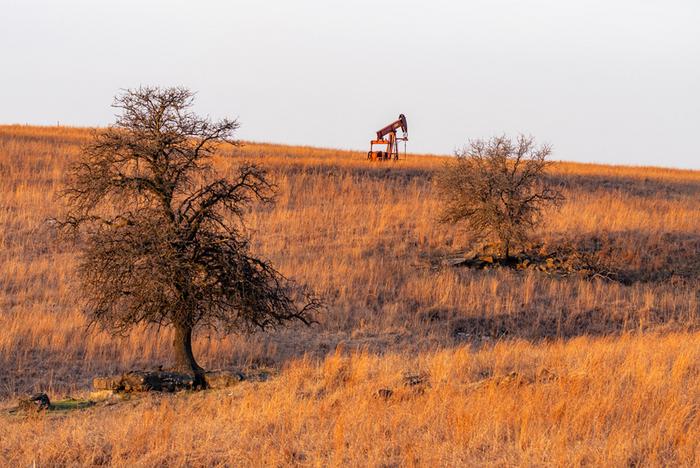
Once the AI identifies well symbols on a map, the team checks whether those coordinates match known wells. If a symbol is more than about 100 meters from any documented well, it may represent an undocumented orphaned well. In a test focusing on four counties with a history of oil production—Los Angeles and Kern in California, and Osage and Oklahoma in Oklahoma—the AI flagged 1,301 potential undocumented wells.
“With our method, we were conservative about what would be considered as a potential undocumented orphaned well,” Varadharajan explained. “We intentionally chose to have more false negatives than false positives, since we wanted to be careful about the individual well locations identified through our approach. We think that the number of potential wells we’ve found is an underestimate, and we might find more wells with more refinement of our methods.”
To confirm the AI’s findings, the team uses a step-by-step approach. First, they look at satellite images and historical aerial photos. If they see hints like old derricks or pumping equipment, it supports the well’s existence. In many cases, though, nothing is visible aboveground. That’s when field crews step in.
On-site, researchers check for any surface structures. If they find none, they carry a magnetometer and walk in a grid or spiral pattern around the predicted spot. If a buried steel casing still sits underground, it disturbs the magnetic field. The team may also measure methane levels. Early results show the AI-led predictions can place them within about 10 meters of the actual well location—close enough to guide physical verification and eventual plugging.
But the area of the United States is huge. Manually surveying every candidate site would be slow and exhausting. To cover more ground, the researchers rely on drones and other airborne methods. Some drones hang magnetometers from a cable, helping spot wells without slogging through tall grass. Others carry methane sensors that “sip” air, measuring gas levels and considering wind direction to track down leaks. There’s also interest in using specialized cameras and even smartphone apps to detect buried wells, making the hunt more flexible and accessible.
The Berkeley Lab effort is part of the Consortium Advancing Technology for Assessment of Lost Oil & Gas Wells (CATALOG), a larger program involving multiple national laboratories and other partners. One region where these tools are tested is the Osage Nation in Oklahoma, where local input guides research on the ground.
“The collaboration between the Osage Nation and CATALOG has been mutually beneficial and productive,” said Craig Walker, director of Osage Nation Natural Resources. “Utilizing AI and state-of-the-art detection equipment has filled data gaps in records and led to the discovery of some undocumented wells in the area, and has streamlined various processes within the Osage Nation Orphan Well Program.”
Berkeley Lab scientist Sebastien Biraud, who leads efforts on methane measurement under CATALOG, notes that speed is key. Checking how much methane is leaking from each discovered well can be costly and time-consuming with sophisticated technology. Instead, Biraud’s team tests off-the-shelf sensors that can give a rough, reliable estimate of a well’s emissions quickly.
“We don’t need to know if it’s leaking exactly 2.3 grams per hour,” Biraud said. “We need to know if it’s not leaking, if it’s leaking between 10 and 100 grams per hour, or if it’s leaking kilograms per hour. And we need to be able to do it in five minutes.”
For the people living near these old drilling sites, knowing where these wells lie can mean safer drinking water and cleaner air. It’s about making sure oily residue doesn’t seep into rivers and making sure methane—a gas that warms our planet faster than we’d like—doesn’t keep leaking. With some officials estimating that there might be as many as 800,000 of these undocumented wells scattered across the country, every bit of progress matters.
Reference: Biron (2024, December 4). AI helps researchers dig through old maps to find lost oil and gas wells. Berkeley Lab News Center. https://newscenter.lbl.gov/2024/12/04/ai-helps-researchers-dig-through-old-maps-to-find-lost-oil-and-gas-wells/
