
The UK construction industry recovered slightly in August after expectations plunged to a seven-year low in July, new figures suggest – but Brexit fears still persist. Before the 23rd June referendum, when Britons voted for Brexit, many economists, politicians and industry leaders had warned that leaving the EU would be the kiss of the death for the housing market, the construction industry and the overall economy.
The Markit/CIPS Construction Purchasing Managers’ Index (PMI) showed a surprising rise to 49.2 in August, compared to 45.9 in July.
The closely-watched Markit/CIPS Construction PMI goes from 0 to 100 – anything over 50 suggests growth, while any figure below it indicates contraction. So, even though August’s figure was still below fifty, it was considerably less pessimistic than July’s.
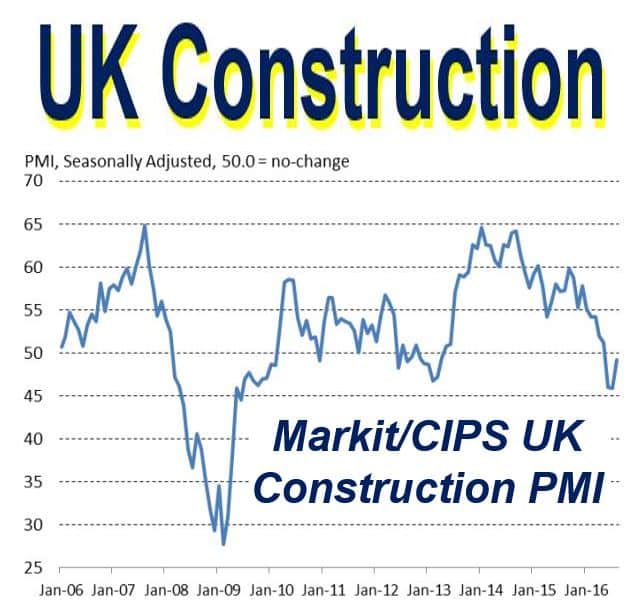 While the decline in UK construction purchasing managers’ activity and expectations continued in August, the pace was much softer than July’s seven-year record. (Image: markiteconomics.com/Survey)
UK construction – life after Brexit?
At first, everything did appear to fall apart. Within 24 hours of the pro-Brexit referendum result, the pound sterling plummeted, the FTSE-100 took a nosedive, and stock markets across the rest of Europe, North America, Asia and Australasia declined significantly. David Cameron, Britain’s Prime Minister, resigned.
However, the London stock market soon recovered, and is now at its highest level since February. Over the past few weeks, the pound has shown some signs of a recovery, and manufacturing, consumer confidence and retail sales have risen surprisingly.
New order volumes in the construction industry are moving closer to stabilization, to the surprise all those Remain campaigners who spent weeks warning us of a Brexit meltdown.
Housing, commercial building & civil engineering
According to the Markit/CIPS report, the contraction in UK housing activity and commercial building was the slowest for three months.
Construction industry shows signs of recovery, PMI survey says https://t.co/ArOfwmgs5H
— BBC Business (@BBCBusiness) September 2, 2016
Civil engineering activity was stable in August, after declining in July. Civil engineering activity includes the construction and maintenance of the physically and naturally built environment, such as roads, tunnels, bridges, canals, dams, other infrastructure items, and some buildings.
The construction update follows a surprising turn in manufacturing output in August, which posted the highest monthly increase in a quarter of a century.
A growing number of economists are now beginning to wonder whether the UK might be able to avoid a recession – something they were certain of just a couple of months ago.
Experts say that all these recent promising statistics point to a partial move towards stabilization, and not yet a return to business as usual in most sectors, including construction.
The slowdown in construction decline in August was mainly driven by better-than-expect activity in commercial building, which was still in decline, but only just.
UK construction nascent client confidence
According to Tim Moore, Senior Economist at Markit and senior author of the latest construction report, construction firms cited a nascent recovery in client confidence since the referendum pro-Brexit result and a relatively steady flow of invitations to tender in August.
Mr. Moore added, however:
“There were still widespread reports that Brexit uncertainty had dampened demand and slowed progress on planned developments, especially in relation to large projects. As a result, total new order volumes continued to fall during August, which stands in contrast to the 3-year run of sustained growth seen prior to May 2016.”
Even so, the latest figures can be viewed as promising news overall after a ‘challenging summer’ for the construction industry.
Mr. Moore said:
“The move towards stabilisation chimes with the more upbeat UK manufacturing PMI data for August, and provides hope that the near-term fallout from Brexit uncertainty will prove less severe than feared.”
David Noble, CEO at the Chartered Institute of Procurement & Supply, said that purchasing costs rose at a rate not seen for five years, as the impact of a cheaper pound was felt by the construction sector. Consequently, companies reduced their purchasing volumes, as new orders and activity continued declining – though at a significantly slower rate than in July.
Company margins were squeezed by higher steel and timer prices, as well as some other raw materials.
Mr. Noble said:
“Employment levels recovered to a modest degree, though at the second-lowest pace for three years. Some firms reported that they planned to increase staff numbers in hopeful anticipation of a surge in activity towards the end of the year.
“Business sentiment was moderately more positive than that seen in the immediate aftermath of the Brexit vote.”
“After the shock of last month’s seven-year low in the overall index, the picture now is more about stabilisation than searing growth, as the sector remained in contraction. The Housing sector continued its downward slide, but the drop in activity was much softer in August.”
Video – UK Construction data
Economists and business leaders are finding this stream of promising data ‘comforting’.
What do the PMI figures from yesterday tell us about the post-Brexit economy?Here is our Business Editor, @helentbbc pic.twitter.com/mv3FvKAj3i
— BBC Newsnight (@BBCNewsnight) September 2, 2016
