
House on pile of money

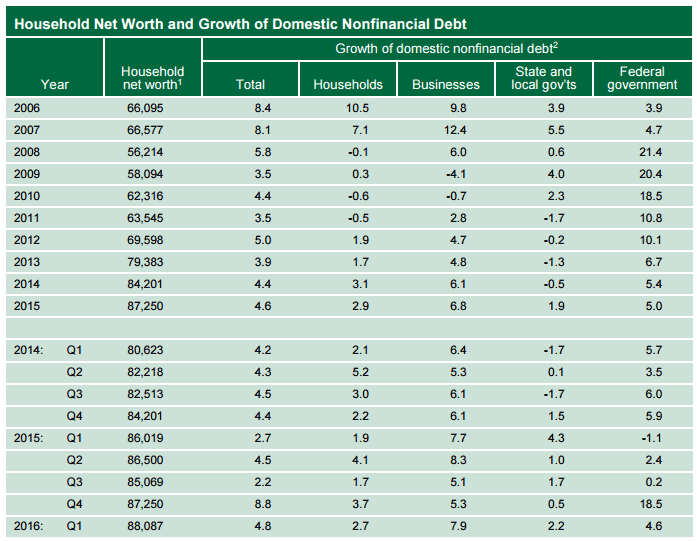
US household wealth rose to a record $88.1 trillion in Q1 2016

Written by Joseph Nordqvist

Published: 00:25, June 11, 2016

US household wealth rose by one percent in the first quarter of 2016 to a record $88.1 trillion, according to data released by the Federal Reserve on Thursday.

The increase in wealth was boosted by a $477.5 billion increase in the value of household real-estate assets, with owner’s equity as a share of total real-estate holdings up from 56.9 percent to 57.8 percent.

The value of financial assets, which includes stocks and pension funds, rose by $299.5 billion.
US_Household_Wealth_Federal_Reserve
Source: US Federal Reserve – ‘Financial Accounts of the United States’

Household debt increased at an annual rate of 2.7 percent in the first quarter of 2016, while consumer credit, including student and auto loans, grew 6.1 percent, and mortgage debt (excluding charge-offs) grew 1.6 percent at an annual rate – a fourth consecutive gain.

Federal government debt increased 4.6 percent at a seasonally adjusted annual rate in the first quarter, while State and local government debt rose at an annual rate of 2.2 percent.

Total non-financial debt rose at a 4.8 percent annual pace.

The results highlight the economic recovery since the financial crisis. In 2009 US household wealth plunged to as low as $55 trillion – it has since recovered by over $33 trillion.

House on pile of money
Household wealth was boosted by an increase in the value of real-estate assets.

In addition, the wealth increase in the first quarter is believed to have been more widely shared than in previous periods as home ownership is one of the middle-class’s primary sources of wealth – the wealthiest Americans rely more on financial assets. The U.S. homeownership rate is currently at 63.7 percent.

“Real estate wealth tends to be a bit more evenly spread across households than equities,” Paul Ashworth, chief U.S. economist for Capital Economics, told the Wall Street Journal.

He added: “People are freer to go out and spend now, based on those wealth gains.”

Joseph Nordqvist Avatar

Other News

AI labels changed how consumers judged food images in three experiments

Nov 12, 2026

Shared AI tools were linked to higher sales for small online sellers

Nov 12, 2026

An image ad people like may not be the one they remember

Nov 12, 2026

Upfront rental prices changed competition as nightly rates rose in a study

Nov 12, 2026

Showing payment options earlier can influence online purchase decisions

Nov 11, 2026

Cash-back offers for positive reviews brought more responses but fewer repeat purchases

Nov 11, 2026

Turning a free business service into a paid one is harder than changing the price

Nov 11, 2026

Small businesses that sought customer feedback reported higher revenue in Rwanda experiment

Nov 11, 2026

Checkbox coupons were less effective than direct discounts in an online shopping experiment

Nov 11, 2026

The way online reviews are organized can make them more useful to shoppers

Nov 11, 2026

AI feedback helped some customer service agents in a workplace study

Nov 11, 2026

In-store screens can increase purchases of advertised products, retail study finds

Nov 11, 2026

A loyalty campaign can lose sales when stores struggle to carry it out

Nov 10, 2026

Offering a choice of discounts can sometimes reduce purchases, study finds

Nov 10, 2026

A fee to place a bid can lift a seller’s profit, but the effect may fade

Nov 10, 2026

Experiences can make loyalty rewards more engaging, retail research finds

Nov 10, 2026

Most emerging-market firms in an IFC survey use AI, but few have embedded it across core operations

Nov 10, 2026

Startups given examples of AI workflows found more uses for the technology

Nov 9, 2026

Showing product costs can change how shoppers judge a brand’s motives

Nov 9, 2026

Hiding most Facebook ads increased users’ time on the platform in a study

Nov 9, 2026