

Before the advent of the Internet, nearly everybody’s workplace was at their employers’ offices or factories. Hundreds of millions of people across the world got up every morning and travelled to work by car, bus, train, or underground. For some, the commute lasted just ten or fifteen minutes, for others the trip could take an hour-and-a-half, or even longer.
Office attendance symbolized worker loyalty, professionalism, and optimum productivity.
When the Internet arrived, in the late 1980s / early 1990s, the number of remote workers began to grow—ever-so slowly at first. A remote worker is somebody who does not work at their employer’s premises. Maybe they work at home or on the road, traveling from one hotel to another. Those who work at home are often referred to as home workers.
After the turn of the century, the number of remote workers worldwide increased slightly faster, but the pace of growth was still relatively slow. It wasn’t until 2020 that things started to change dramatically.
COVID-19 – the Coronavirus Pandemic
When COVID-19 (COVID) was declared a pandemic by the World Health Organization (WHO), things started to change rapidly. WHO declared a pandemic in March 2020, and lockdowns began later that month in many countries. A lockdown occurs when residents are told to remain at home, schools and businesses close, and people can only go out for essential activities like grocery shopping.
During the lockdown, the number of remote workers worldwide exploded. In the UK, for example, 1.7 million people mainly worked from home one year before the pandemic. In 2020, this number increased to 17–18 million—it grew from 5% of the working population to nearly 50%!
Expectations during the pandemic
During the pandemic, when employers had no choice but to ask employees to work remotely, they did not know what to expect. Some feared that with reduced supervision, productivity would suffer. There was much talk about the potential loss of teamwork quality and creativity.
To the surprise of many, remote workers remained productive. Some studies found that remote working reduced employee turnover and boosted job satisfaction. Employers also commented that talent retention improved, as did recruitment.
Rather than finding the office a better place to concentrate, many employees said that there were fewer distractions at home, which meant that they could focus on tasks effectively for much longer. Obviously, this was not the case for all employees; if you live in a tiny apartment with four young children and a large dog, you are probably more productive in the office.
Pros and cons of remote working
For both employees and employers, remote working offers pros and cons. Let’s have a look at some of them:
Employees – pros
- No commuting (traveling to/from work).
- Better work-life balance.
- Get up later—more sleep.
- Lower spending on meals and transport.
- You can live outside the city—an option for cheaper housing.
- Better for disabled and mobility-limited workers.
- Workers in low-wage countries can find better-paying jobs abroad without having to emigrate.
Employees – cons
- Social isolation at home; loneliness. You may miss chatting to colleagues and office banter.
- More difficult to separate personal from professional life.
- Remote workers are more likely to overwork and suffer from burnout.
- Networking opportunities are more limited.
- Your boss might promote your office-working peers rather than you because they know them better.
- Home distractions, especially if you have small children, may reduce concentration.
Employers – pros
- Less office space needs to built or rented.
- Lower operating expenses.
- Access to talent worldwide.
- Better employee retention.
- Easier to attract top talent – many professionals will only consider jobs that offer remote or hybrid working.
- Increased productivity in some industries.
- Smaller carbon footprint (more environmentally friendly).
Employers – cons
- Supervising or monitoring employees is harder.
- A worker’s employment contract may stipulate that having two jobs is not allowed. Enforcing this rule is much more difficult.
- Managers face coordination and communication challenges.
- New employees may not bond with the company as strongly as their office-working predecessors did.
- Team bonding is more difficult.
- Onboarding needs to be organized in a different way; this is not easy.
- Being an effective leader of remote workers requires a specific set of skills. Some great leaders of on-site workers struggle when their employees work from home.
Hybrid work is the winner
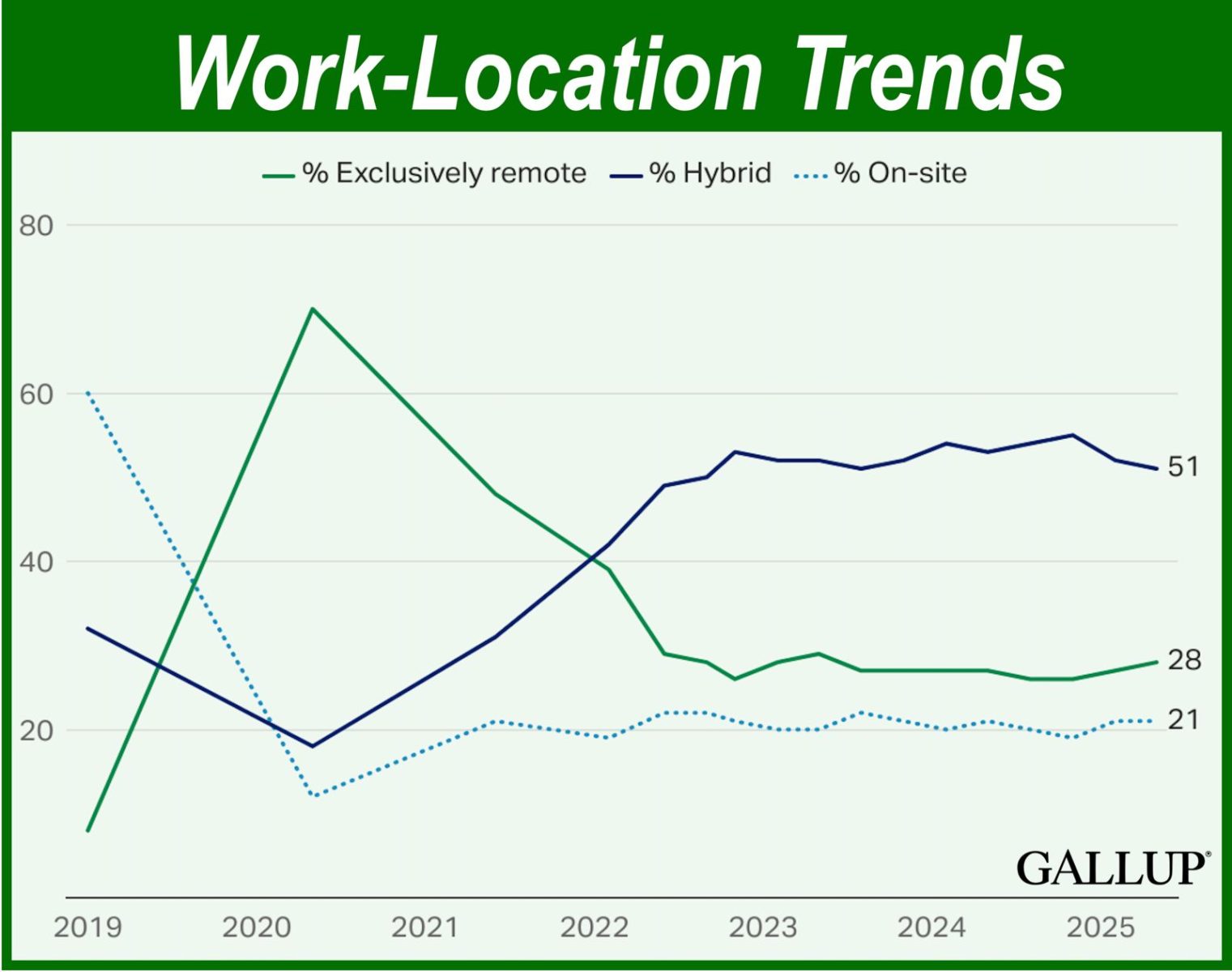
So, which of the three work options is the winner today: office work, hybrid work, or remote work? A growing number of employers and employees are opting for hybrid work, while office and remote work numbers have remained relatively stable.
Media coverage today tells us about well-known companies, such as Amazon and JPMorgan Chase, which are ordering their employees to stop working remotely and come back to the office full time. Most of us believe that today we are being asked to return to the office. This is not actually the case.
Gallup’s 2025 Workplace Research, however, tells us that work-location trends have not changed much since 2022. The researchers stated that hybrid work is by far the dominant model.
These are the figures from Gallup:
- 51% of employees whose job can be done remotely work hybrid.
- 28% work remotely all the time.
- 21% work full-time at the office, that is, the employer’s premises.
