
The UK economy is £700 million smaller than it could be as far as HM Treasury is concerned if employers were more willing to consider flexible working practices with their female workers, says a new report published by the IPPR think tank.
The report looked at how flexible working options across Europe could enhance female employment rates, as well as reducing the number of women working well below their skill capacity.
The huge employment gap between European men and women means the continent is failing to utilize its society’s full potential.
Even though participation and attainment in education among women has improved, as well as legislation guaranteeing maternity and parental leave, there is still a long way to go, the authors wrote.
The gap between men and women’s employment rates across the European Union’s 28 member states stood at 11.7 percentage points last year, while the female employment rate remained unchanged at about 62.5% from 2008 to 2013.
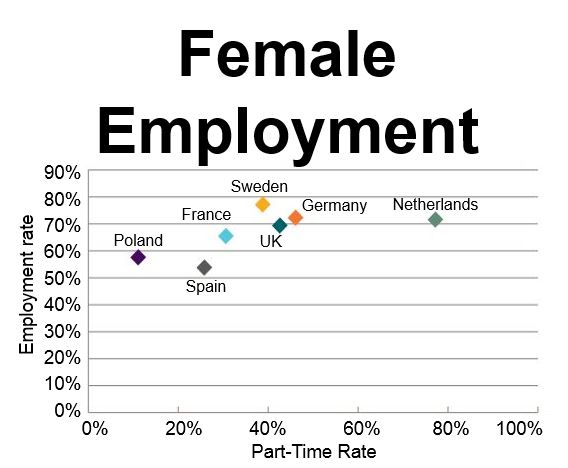
Source: “Women and Flexible Working,” IPPR.
The combined result of companies’ and governments’ actions and regulations, plus cultural developments over time have altered the nature of households and supply of labour, leading to three undesirable employment outcomes for women:
1. Female employment rates have remained low, which weigh on economic output.
2. A high percentage of women are doing jobs well below their ‘qualification grade’, which is not an effective way of getting the most out of an economy.
3. Fewer hours worked. There is a persistent yet variable gap in the hours worked between women and men across typical life phases, which raises issues of staff retention, recruitment costs, and productivity.
According to the report, 64% of British working women’s bosses do not let them vary their starting and finishing working times, while 25% say they find it hard to take up to two hours off work to attend to personal matters or an emergency.
Employers’ inflexibility bad for them too
Only 19% of British working women can adapt their hours of work compared to 41% in Sweden and 38% in the Netherlands. The report points out that this lack of autonomy is not only bad for female workers, but also for their employers.
The authors say that a lack of flexibility in full-time jobs is pushing many female workers onto a “mummy track”, i.e. they become stuck in part-time jobs far below their skill levels. By expanding part-time work, employers will still be missing out on the best and brightest employees, they add.
Forty-two percent of female workers who opt for part-time employment do so mainly to take care of family dependants (children or disabled adults), compared to just 6% of male part-time workers.
IPPR associate director, Dalia Ben-Galim, said:
“Employers are missing out on top talent and highly qualified women are working in low-skilled jobs. That’s a missed opportunity for both employers and employees. How work is arranged, and employees’ level of autonomy over working hours, can have a big impact on how well people reconcile paid work with other commitments.”
“Flexible working in its current reduced-hours form simply isn’t flexible enough. The prevalence of rigid scheduling, especially in low-income jobs, often means that even reduced-hours work is not sufficient for meeting the more spontaneous demands of care-giving.”
About one quarter of all British women who work part-time would like to be able to do fewer hours, while 13% would prefer longer hours.
If employers were more willing to consider more flexible working hours and the number of women in full-time work increased by 5 percentage points, HM Treasury would be £700 million better off due to more tax revenues and lower benefit payments, the report informs.
