
Any anticipated benefits from reduced migration are likely “to be dwarfed” by the larger economic impact of the Brexit vote to leave the European Union, if forecasts are “remotely right.”
While it has squeezed pay in some lower-paid jobs and skilled trades occupations, migration has not reduced wages in the UK overall. Moreover, its effect is small compared to that of broader economic forces, such as the financial crisis.
So concludes a new Resolution Foundation analysis whose author Stephen Clarke remarks: “Anyone expecting a post-Brexit pay boost is going to be disappointed.”
 Study says reduced migration could pose a serious challenge for some low-paying sectors in the UK.
Immigration was one of voters’ biggest concerns in the recent EU referendum. Also, as the UK government has promised to reduce net migration, the study takes a timely look at migration and wages.
Since 2004, when the EU enlarged, net migration in the UK has been over 200,000 a year, increasing the population’s share of migrants from 10 percent to just under 16 percent today. (In 2004, Czech Republic, Estonia, Hungary, Latvia, Lithuania, Poland, Slovenia, and Slovakia became EU members, with Bulgaria and Romania joining in 2007.)
The study finds the increased percentage of migrants in the UK does appear to have pulled down wages in some sectors by between 0.5-2.0 percent.
However, the effect is small compared to the general squeeze on pay that happened over the same period – this pulled down pay by between 4.7-9.7 percent.
Consequently, reducing migration is unlikely to reduce the squeeze on wages for British-born workers, says Clarke.
In fact, some low-paying sectors are likely to face serious challenges if fewer migrants enter the UK.
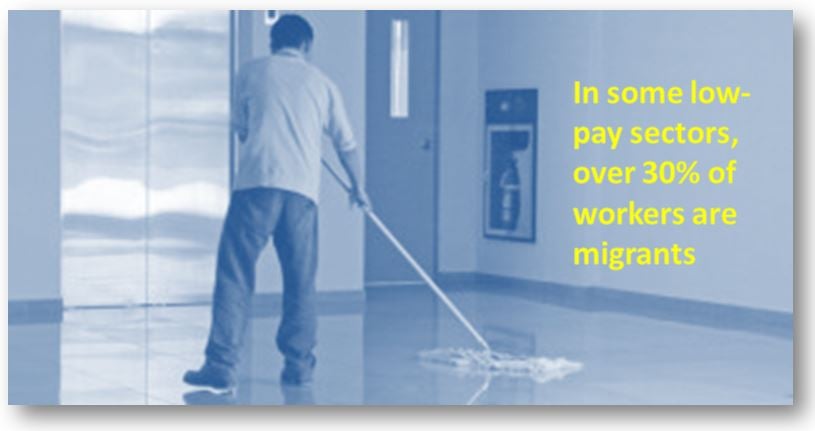
Firms in sectors such as food manufacturing and domestic personnel – where over 30 percent of workers are migrants – would face a number of choices.
One choice is to hire more British-born workers. But so-called “native” workers typically earn £2.76 an hour more than migrant workers from accession EU countries (the countries that joined since 2004).
With employment at record levels, employers who have relied on migrant workers may well have to find ways to close the pay gap to attract British-born workers.
Another option is to increase investment in skills and technology. “This is perhaps the greatest opportunity that reduced immigration offers,” notes Clarke.
Business owners may be forced to rethink how they operate – how to pick and process crops with less labour, how to wash and valet cars with fewer workers.
Coupled with the introduction and increase in the National Living Wage, the “result could be fewer, better-paid jobs,” says Clarke.
