
A 2-D magnet has been discovered by scientists from MIT (Massachusetts Institute of Technology) and the University of Washington, both in the United States. They have, for the first time, discovered magnetism in the 2-D world of monolayers, i.e. materials that are just 1-atom thick.
Magnetic materials form the basis of most technologies that play ever-growing pivotal roles in our lives in the modern world, including sensing and hard-disk storage of data.
In their quest to create ever-faster and smaller devices, scientists are seeking new magnetic materials that are tinier, more efficient, and can be controlled using reliable and precise methods.
Xiaodong Xu, a professor of physics and of materials science and engineering at the University of Washington, and colleagues wrote about their study and findings in the prestigious journal Nature, published June 8, 2017, titled ‘Layer-dependent ferromagnetism in a van der Waals crystal down to the monolayer limit‘.
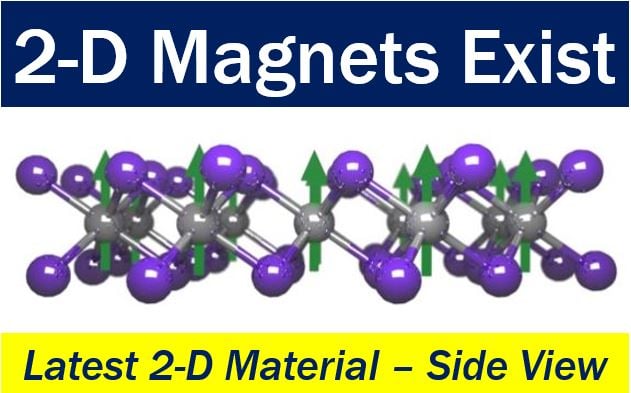 Side view of a single Crl3 layer. Grey balls represent Cr atoms, and purple balls are I atoms. It was with this material that the scientists discovered that a 2-D magnet was possible. (Image: adapted from washington.edu. Credit: Efren Navarro-Moratalla)
2-D magnet opens ‘a world of potential’
The authors wrote that their findings demonstrate that even in the 2-D realm, magnetic properties can exist, i.e. a 2-D magnet does exist. This opens a world of potential applications, they added.
Xu, who is a member of the University of Washington’s Clean Energy Institute, said:
“What we have discovered here is an isolated 2-D material with intrinsic magnetism, and the magnetism in the system is highly robust. We envision that new information technologies may emerge based on these new 2-D magnets.”
The team, led by Xu and Pablo Jarillo-Herrero, a physics professor at MIT, proved that the material – CrI3 (chromium triiodide) – has magnetic properties in its monolayer form (one-atom thickness form).
Previous studies, including one led by co-author Michael McGuire at the Oak Ridge National Laboratory, had shown that CrI3 – in its 3-D, multilayered, bulk crystal form – is ferromagnetic.
In ferromagnetic materials, the spins of the constituent electrons, analogous to super-small, subatomic magnets, align in the same direction, even with no external magnetic field present.
Physicists have finally created a 2D magnet https://t.co/E4CaDvsJyR @MIT @ScienceMIT @NatureNews #physics #2dmagnets #chromiumtriiodide
— MIT Physics (@MIT_Physics) June 9, 2017
However, when thinned down to a single atomic sheet, every 3-D magnetic substance had lost its magnetic properties. In fact, monolayer materials can demonstrate unique properties not observed in their 3-D, multilayered forms.
Co-lead author Bevin Huang, a doctoral student at UW, said:
“You simply cannot accurately predict what the electric, magnetic, physical or chemical properties of a 2-D monolayer crystal will be based on the behavior of its 3-D bulk counterpart.”
Atoms that make up monolayer materials are considered functionally two-dimensional because the electrons are only able to travel within the atomic sheet, like chess pieces do on a chessboard.
Scotch tape used in 2-D magnet quest
In order to discover what the properties of CrI3 are in its 2-D form, the scientists used Scotch tape to shave a monolayer of CrI3 off the bigger, 3-D crystal form.
Regarding using Scotch tape, co-lead author, Genevieve Clark, a UW doctoral student, said:
“Using Scotch tape to exfoliate a monolayer from its 3-D bulk crystal is surprisingly effective. This simple, low-cost technique was first used to obtain graphene, the 2-D form of graphite, and has been used successfully since then with other materials.”
In ferromagnetic materials, the aligned spins of electrons always leave a telltale signature when a polarized light beam is reflected off the surface of the material.
Using a special type of microscopy, the researchers were able to detect this signature in CrI3. This is the first time a definitive sign of intrinsic ferromagnetism has been detected in an isolated monolayer.
The authors were surprised to find that in CrI3 flakes that were two layers thick, the optical signature vanished. This suggests that the electron spins are oppositely aligned to one another – this type of alignment is called anti-ferromagnetic ordering.
Ferromagnetism was observed in 3-layer CrI3. The authors say they will need to carry out further studies to find out why CrI3 displayed these surprising layer-dependent magnetic phases.
Stacking monolayers with different physical properties
For Xu, these are just a few of the truly unique properties discovered by combining monolayers. Xu said:
“2-D monolayers alone offer exciting opportunities to study the drastic and precise electrical control of magnetic properties, which has been a challenge to realize using their 3-D bulk crystals.”
“But an even greater opportunity can arise when you stack monolayers with different physical properties together. There, you can get even more exotic phenomena not seen in the monolayer alone or in the 3-D bulk crystal.”
In a previous study, UW electrical engineering and physics professor Kai-Mei Fu, Xu’s research group, and some other scientists published the findings of a study in Science Advances, published in May 2017, titled ‘Van der Waals engineering of ferromagnetic semiconductor heterostructures for spin and valleytronics‘, which showed that an ultrathin form of CrI3, when stacked with a 1-atom-thick layer of tungsten diselenide, creates an ultra-clean ‘heterostructure’ interface with unique and surprising photonic and magnetic qualities.
Xu said:
“Heterostructures hold the greatest promise of realizing new applications in computing, database storage, communications and other applications we cannot even fathom yet.”
