
Scientists have created an artificial ‘skin’ that can sense the force of static objects using specialized pressure sensors and flexible organic circuits.
They were also able to transfer these sensory signals to the neurons (brain cells) of mice in vitro using optogenetics. Optogenetics is a biological technique which involves using light to control cells in living tissue, typically neurons.
For millions of people worldwide who live with prosthetics, this research could mean that one day they will be able to feel sensation in their artificial limbs.
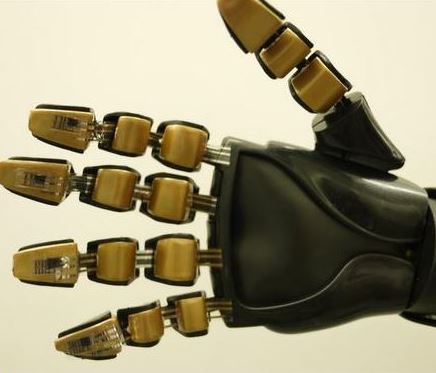
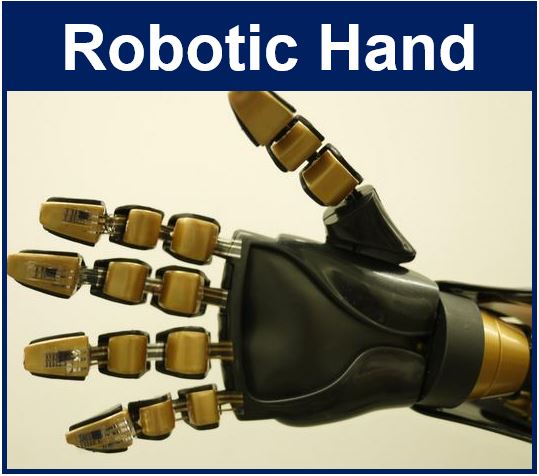 Model robotic hand with artificial mechanoreceptors. (Image: Eurekalert. Credit: Bao Research Group, Stanford University)
To create the artificial skin, Global Biodesign Innovation Fellow, Benjamin Tee, and team developed a specialized circuit out of organic, flexible materials. It translates static pressure into digital signals that change, depending on how much mechanical force is applied.
Making skin that senses like human skin
The scientists published their research in the journal Science (citation below)
The scientists said their main challenge was creating sensors that are able to ‘feel’ the same range of pressure that human skin can.
They used carbon nanotubes molded into pyramidal microstructures on the sensors. They are very effective in tunneling the signals from the electric field of objects nearby to the receiving electrode in a way that optimizes sensitivity.
 Stretchable skin with flexible artificial mechanoreceptors. (Image: Eurekalert. Credit: Bao Research Group, Stanford University)
Another major challenge was transferring the digital signal from the man-made skin system to the cortical neurons of mice, because conventional light-sensitive proteins used in optogenetics do not trigger neural spikes long enough for these digital signals to be sensed.
Dr. Tee and colleagues therefore engineered new optogenetic proteins that can accommodate longer intervals of stimulation.
 Artificial mechanoreceptors mounted on the fingers of a model robotic hand. (Image: Eurekalert. Credit: Bao Research Group, Stanford University)
By applying these newly engineered proteins to rapidly-spiking interneurons of the somatosensory cortex of mice in vitro prolonged the stimulation interval enough so that the neurons could fire in accordance with the digital stimulation pulse.
Their findings suggest that the system may be compatible with other rapidly-spiking neurons, including peripheral nerves.
In an Abstract in the journal, the authors wrote:
“This work represents a step toward the design and use of large-area organic electronic skins with neural-integrated touch feedback for replacement limbs.”
Citation 1: “A skin-inspired organic digital mechanoreceptor,” by B.C.K. Tee; A. Chortos; A. Berndt; A.K. Nguyen; A. Tom; A. McGuire; Z.C. Lin; K. Tien; W.-G. Bae; H. Wang; H.-H. Chou; B. Cui; K. Deisseroth; Z. Bao at Stanford University in Stanford, CA; P. Mei; T.N. Ng at Xerox Palo Alto Research Center in Palo Alto, CA. Science. 16 October 2015. DOI: 10.1126/science.aaa9306.
Citation 2: “Restoring the sense of touch,” by P. Anikeeva; R.A. Koppes at Massachusetts Institute of Technology in Cambridge, MA; R.A. Koppes at Northeastern University in Boston, MA. Science. 16 October 2015. DOI: 10.1126/science.aad0910.
