

Brand executives are rapidly increasing their investment in artificial intelligence, but consumers appear to be judging companies by a more basic standard: whether products work, deliveries arrive, and problems get solved.
A new survey from PA Consulting found that 75% of brand executives were scaling AI investment across their organizations.
However, only 29% of consumers said they were comfortable using AI in brand interactions.
Dependable delivery, which PA defines broadly as providing reliable products, services, and experiences that make customers’ lives easier, emerged as the strongest driver of consumer engagement.
The results suggest that businesses and customers may be using different scorecards. Executives can count the number of AI tools launched, processes automated, or employees trained. Customers experience the outcome: whether information is accurate, the product is available, and the company keeps its promise.
The research does not show that consumers broadly oppose AI. It indicates that investment in the technology does not automatically translate into greater trust or a better customer experience.
What the survey measured
PA Consulting’s 2026 Brand Impact Index was based on separate surveys of 7,000 U.S. consumers and 370 brand executives.
Consumers rated 297 consumer packaged goods and consumer electronics brands across five areas:
- Dependable delivery
- Intelligent innovation
- Customer centricity
- Sustainable stewardship
- Community connection
The executive survey examined business investment, strategic actions, and challenges across the same areas.
PA Consulting also conducted in-depth interviews with 19 business leaders.
AI investment is moving faster than consumer comfort
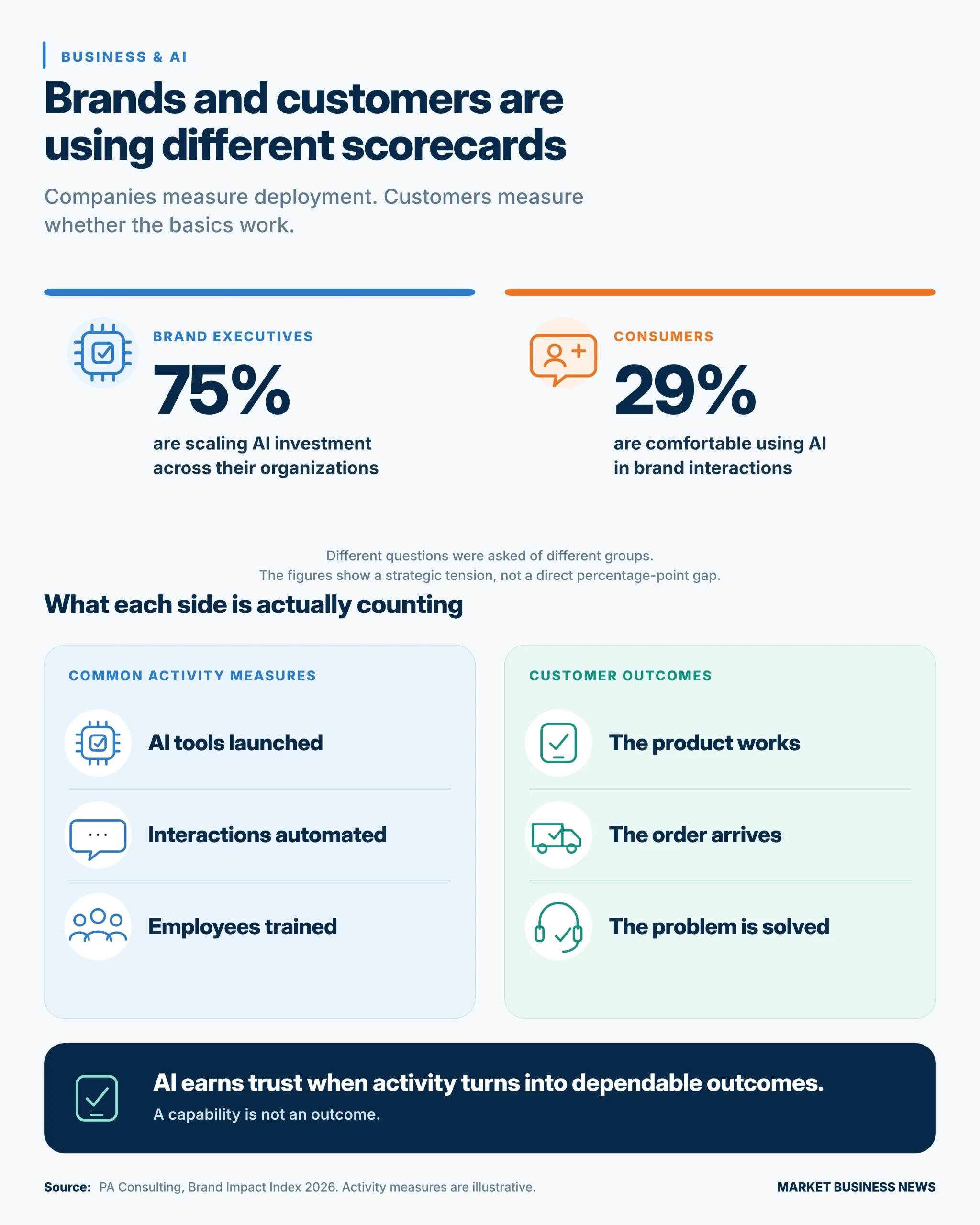
Three-quarters of the executives surveyed said their organizations were scaling their investment in AI.
At the same time, 33% said the business impact of AI was lagging behind the level of executive attention it received.
Only 45% said their companies adapted quickly when important assumptions changed.
PA Consulting said consumer comfort with AI in brand interactions had fallen from 60% in its 2025 survey to 29% in 2026.
The reported fall is striking, but it should be interpreted cautiously.
PA changed the range of brands and categories included in the index in 2026. Travel, automotive, and retail brands were removed, while more challenger brands were added in areas including food, beverages, personal care, and sports and fitness.
The public reports also do not provide the complete questionnaires or enough detail about the administration of the AI question to establish how closely the two annual results can be compared.
The figures support PA’s conclusion that comfort with AI in brand interactions has weakened. They should not be treated as a precise measure of how much general trust in all forms of AI has fallen.
Dependability topped the consumer priorities
Dependable delivery ranked as the strongest driver of consumer engagement in the 2026 index.
Brand executives, however, were placing greater emphasis on customer centricity and innovation.
There was also a difference between how executives assessed their own performance and how consumers assessed brands.
Half of the executives said their companies were excellent at dependable delivery. Only 37% of consumers said brands delivered dependably.
This gap can emerge when a company measures internal performance differently from the way customers experience it.
A business may consider a delivery process successful because most orders arrive on time. A customer affected by an inaccurate estimate, damaged product, difficult return, or unresolved complaint sees the same system differently.
PA reported that consumers interacting with its highest-performing brands were:
- Twice as likely to be willing to pay a premium
- 1.9 times as likely to say they could not imagine life without the brand
- 1.8 times as likely to forgive the brand after a mistake
These are associations within PA Consulting’s analysis. They do not prove that dependability alone caused those responses.
They do suggest that reliable performance can contribute to pricing power, loyalty, and a greater chance of retaining customers when something goes wrong.
Higher living costs are raising the cost of disappointment
The increased importance of reliability comes as many households face pressure from rising costs.
PA Consulting found that:
- 87% of consumers said rising costs were affecting them.
- 82% had changed their household and grocery purchasing behavior.
- 47% had bought fewer items overall.
- 43% had reduced purchases of items they considered “nice to have.”
- 37% were switching from national brands to store brands more often.
When customers have less room in their budgets for a disappointing purchase, predictable performance becomes more valuable.
A product offering a new feature may attract attention. However, its appeal weakens if the product is difficult to use, arrives late, produces poor recommendations, or creates additional work when something goes wrong.
Reliability is therefore more than an operational concern. It can become part of a brand’s marketing position.
Band-Aid and Dawn led the brand ranking
Band-Aid ranked first overall in PA Consulting’s 2026 index, followed by Dawn.
Once Upon a Farm, Canon, and Beech-Nut completed the top five.
Samsung, The Honest Company, PlayStation, Apple, and Ring filled the remaining places in the top 10.
Several of these brands are associated with relatively clear customer promises. Consumers generally understand what the product is supposed to do and can quickly judge whether it has worked.
That does not mean innovation is unimportant. PlayStation, for example, ranked first for intelligent innovation and eighth overall.
The broader pattern is that innovation appears most valuable when it strengthens a product or experience that customers already find useful and dependable.
The findings do not mean consumers reject AI
Other research shows that customers can respond positively to AI when it provides a clear benefit.
Adobe’s 2026 AI and Digital Trends Consumer Report, based on a global survey of 4,000 consumers, found that nearly half would use AI to receive personalized product recommendations.
Some 44% said they would use it for instant customer service.
Adobe also found that:
- 56% believed AI would improve their customer experience.
- 49% believed it would save them money.
- 46% believed it would produce more relevant recommendations.
- 46% said they did not care whether a brand used AI as long as their needs were met.
Comfort was higher for routine, relatively low-risk uses such as answering simple questions, providing recommendations, sending reminders, and automating repetitive processes.
It fell when AI was used for sensitive health or financial information, important decisions, or situations in which customers expected human involvement.
The Adobe and PA percentages should not be compared directly. Adobe surveyed consumers across several global markets, used different questions, and examined a wider range of AI experiences.
Together, the studies indicate that consumer attitudes are conditional rather than simply positive or negative.
Customers may welcome AI that saves time or improves a decision while rejecting AI that removes control or stands between them and the support they need.
AI chosen by the customer may be viewed differently
Research from Accenture also suggests that the role assigned to AI changes how consumers respond.
Its 2026 Consumer Pulse Research surveyed 25,590 people across 16 countries about personal AI agents working under the consumer’s instructions.
In that setting, 74% said they would trust a personal AI agent more than their best friend to make a purchase on their behalf.
However, willingness fell as the agent gained greater control:
- 74% would let an agent perform routine tasks under their instructions.
- 32% would allow it to make a purchase decision within defined limits, provided the consumer approved the payment.
- 9% were open to fully autonomous purchases.
These figures are not directly comparable with PA Consulting’s result. Accenture examined personal agents acting for consumers, not AI introduced by a brand during an interaction.
The contrast nevertheless highlights an important distinction.
Consumers may be more comfortable with AI that clearly works for them than with AI that appears primarily designed to reduce a company’s costs, collect information, promote products, or delay access to an employee.
AI can help as an assistant and frustrate as a gatekeeper
Academic research provides evidence that the position of AI within the customer journey can affect its value.
A randomized field experiment published in Information Systems Research examined an AI assistant on a major livestream-shopping platform.
Consumers in the treatment group had access to the assistant during livestream sessions, while those in the control group did not.
Access to the assistant increased sales by 3% and reduced product return rates by 12.55%.
The researchers linked the results to better access to information, lower uncertainty, and greater confidence in purchasing decisions. Although the assistant could interrupt the shopping experience, its information benefits outweighed that disadvantage in the study.
A different effect can emerge when AI acts as a compulsory first stage before customers can reach a person.
A 2026 study published in Manufacturing & Service Operations Management found that customers could be reluctant to use chatbots when an imperfect automated system acted as a gatekeeper to a human expert.
The researchers called this “gatekeeper aversion.” Chatbot adoption declined further when the stakes were higher.
The studies examined different services and cannot be combined into a universal rule. They do support a useful distinction:
- An AI assistant helps a customer find information, compare options, or complete a task.
- An AI gatekeeper creates another stage the customer must pass through before obtaining the support they want.
Automation is not necessarily an improvement when it removes work from the company by transferring that work to the customer.
Human support still matters
Adobe found that 37% of consumers would stop interacting with a brand if they discovered they were dealing with AI after expecting a person.
The ability to switch to a human at any time was the most important safeguard consumers identified, ranking above labels, explanations of how the AI worked, and information about data use.
This gives brands a practical lesson.
An automated system should explain what it can handle and provide a clear route to a person when the issue falls outside its capabilities.
A chatbot that resolves a simple question immediately can reduce friction. One that repeatedly asks for information, misunderstands the problem, and hides the human-support option can increase it.
A capability is not the same as an outcome
The survey’s central business lesson is not that companies should stop investing in AI.
It is that AI deployment should not be confused with customer value.
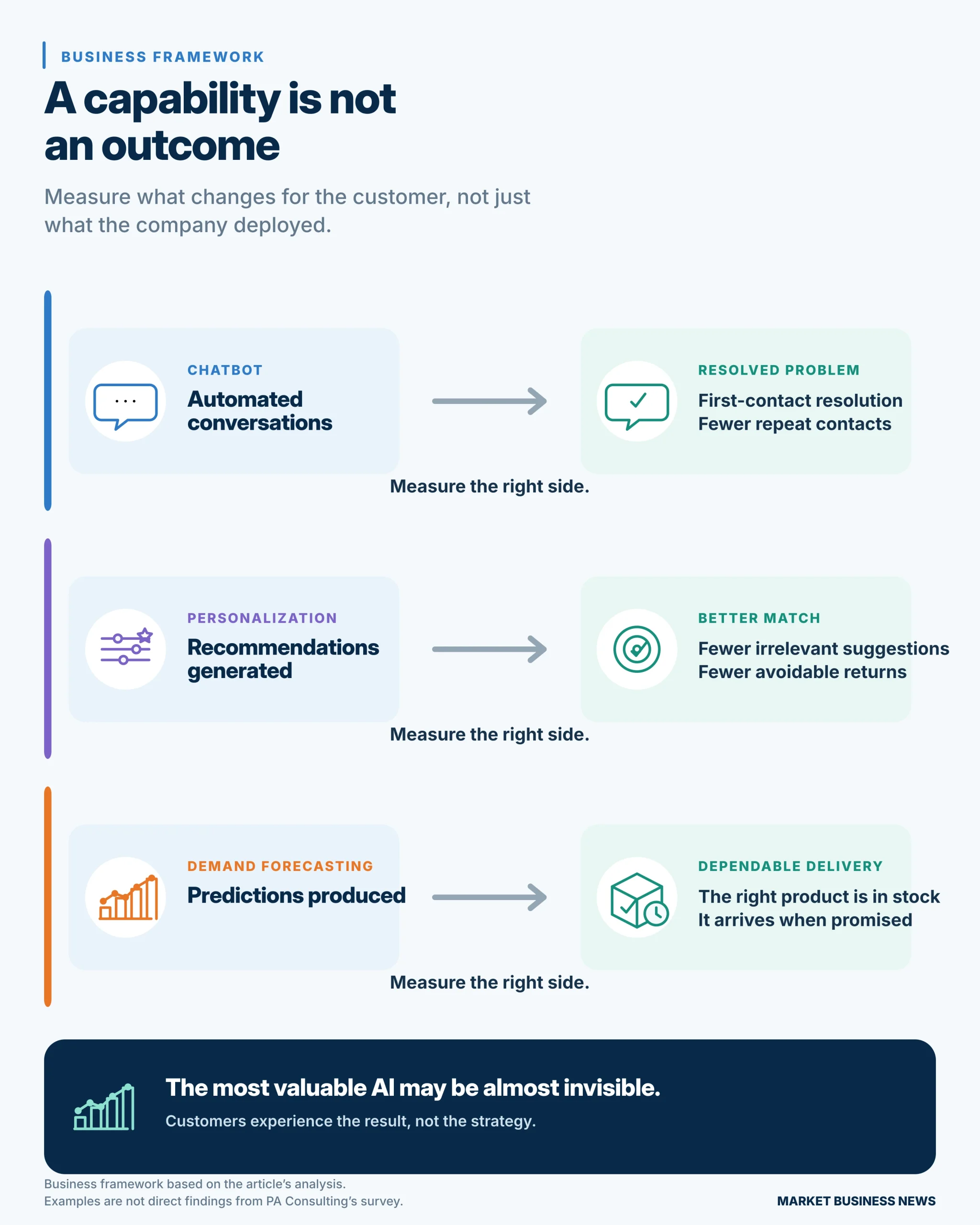
A chatbot is a capability. A resolved problem is an outcome.
Personalization is a capability. Fewer irrelevant recommendations and fewer returned products are outcomes.
Demand forecasting is a capability. Having the right product available and delivering it when promised are outcomes.
Customers do not experience an AI strategy. They experience the results of that strategy.
This means some of the most valuable uses of AI may be relatively invisible.
AI could help a company improve inventory forecasts, identify recurring product faults, provide employees with accurate information, or warn customers that a delivery estimate has changed.
These examples were not directly tested by the PA Consulting survey. They illustrate how AI investment could support the dependable delivery that consumers ranked most highly.
A useful test for any AI project is whether it would still appear valuable if customers were never told that it used AI.
If the answer is no, the project may be producing more innovation signaling than customer value.
Brands should measure resolved problems, not just automated interactions
Companies often report the number of AI tools launched, conversations automated, employees trained, or customer contacts handled without a person.
Those figures measure activity. They do not establish that the customer received a better result.
More useful measures may include:
- On-time delivery and inventory accuracy
- First-contact resolution rates
- Repeat contacts about the same problem
- Time required to reach a solution
- Successful transfers to human employees
- Product return and cancellation rates
- Recommendation-related complaints
- Retention and repeat-purchase rates
A rising automation rate can coexist with a worsening customer experience.
If customers repeatedly return, abandon the process, contact the company again, or search for a person after the automated interaction, the system may be containing conversations without resolving problems.
The research has limitations
PA Consulting’s Brand Impact Index is proprietary research produced by a consulting company that sells strategy, technology, innovation, and transformation services.
Its commercial interest should be considered when interpreting its conclusions.
The research primarily measures reported perceptions, priorities, and intentions. It does not prove that AI investment causes lower consumer comfort or that dependable delivery alone causes customers to pay more.
The consumer and executive surveys were separate. The public methodology does not describe a company-by-company match between the 370 executives and the 297 brands rated by consumers.
PA also changed the scope of the brand index in 2026, making some annual comparisons less direct.
The supporting Adobe and Accenture surveys used different samples, countries, definitions, and questions. Their results provide context but should not be combined statistically with PA Consulting’s findings.
The academic studies examined particular settings, including livestream shopping and chatbot-led customer service. Their findings identify useful patterns rather than rules that will apply to every company or interaction.
AI still has to pass the reliability test
The companies most likely to benefit from AI may not be those that make it most visible.
They may be the businesses that use it to make product information more accurate, recommendations more useful, deliveries more predictable, and customer problems easier to solve.
Consumers appear willing to accept automation when it performs a clear job, provides an obvious benefit, and leaves them with meaningful control.
They become more resistant when it creates another obstacle or asks them to trust a company that has not yet proved dependable.
Brands are measuring how much AI they have deployed, while customers are measuring whether the basics work. Until those two scorecards produce the same answer, greater AI investment may not automatically create greater trust.
