

Confidence among leaders of large U.S. companies has returned to positive territory, but the details suggest a modest easing of concern rather than a broad rush to expand.
The Conference Board Measure of CEO Confidence, produced in collaboration with The Business Council, rose to 52 in the third quarter of 2026, up from 47 in the second quarter.
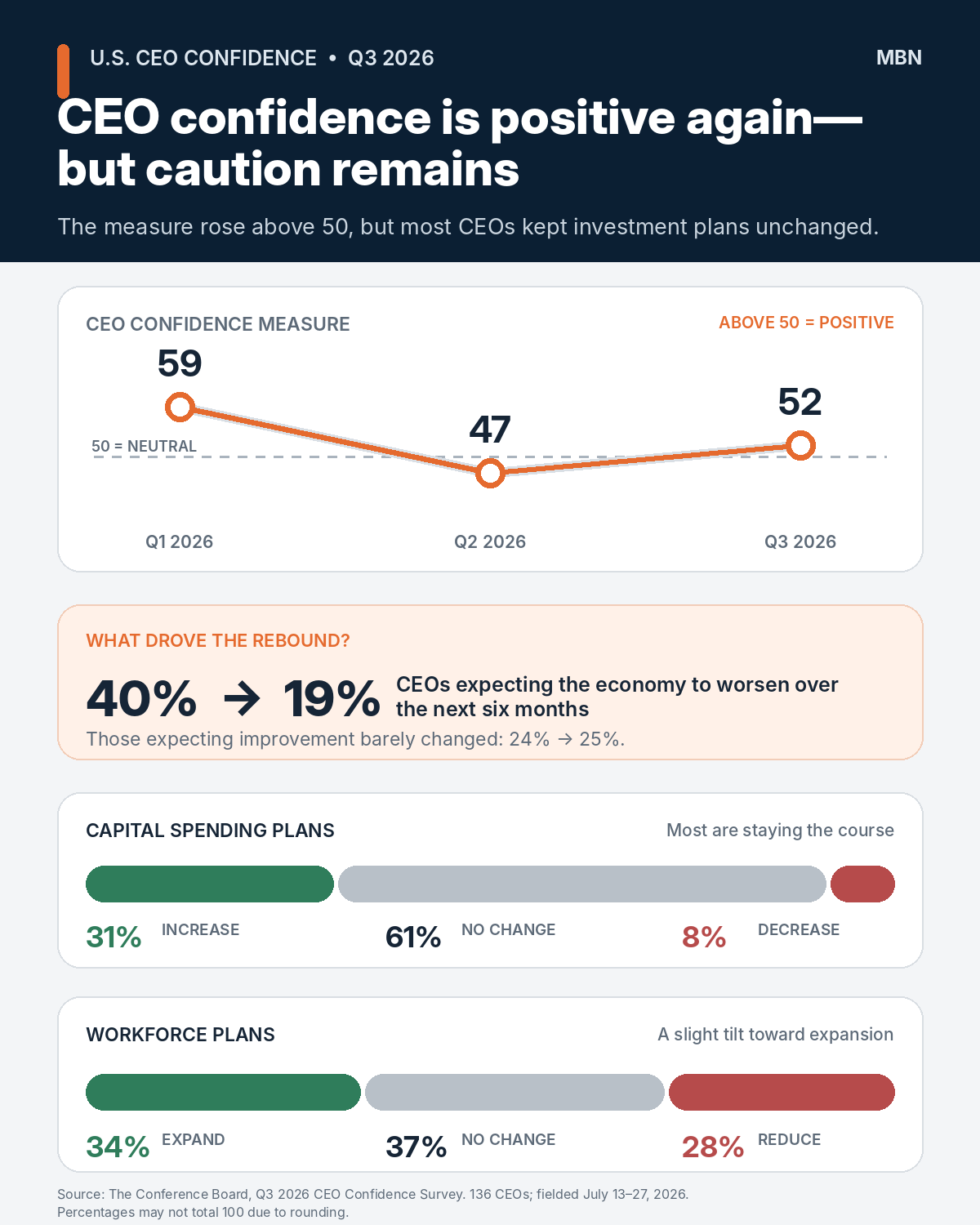
A reading above 50 means positive responses outnumber negative ones. However, the latest result remained below the first-quarter reading of 59, indicating that confidence has only partially recovered from its earlier decline.
The survey was conducted from July 13 to July 27 and included responses from 136 CEOs of large U.S. companies.
Less pessimism drove much of the recovery
One of the most important details in the survey is where the improvement came from.
The share of CEOs expecting general economic conditions to improve over the next six months increased only slightly, from 24% in the second quarter to 25% in the third quarter.
The much larger change came from the other direction. Only 19% expected economic conditions to worsen, down sharply from 40% in the previous quarter.
A similar pattern appeared in executives’ expectations for their own industries. The share expecting industry conditions to improve actually slipped from 38% to 36%. However, the proportion expecting conditions to worsen fell from 22% to 13%.
This suggests that the rebound in confidence was driven less by a sudden surge in optimism than by a significant decline in the number of CEOs expecting conditions to deteriorate.
Executives also became less negative about current conditions. Twenty-three percent said the economy was performing better than it had six months earlier, up from 15%. Meanwhile, the share saying conditions were worse fell from 47% to 26%.
Even so, The Conference Board’s measure of CEOs’ views of current economic conditions remained slightly negative at 49.
Capital spending plans remain restrained
The improvement in confidence has not yet produced a broad acceleration in planned business investment.
Most CEOs, or 61%, said they did not plan to revise their capital spending. Another 31% expected to increase spending, while 8% planned to revise it downward.
The share planning an increase declined from 37% in the second quarter to 31% in the third quarter. Although relatively few companies intended to cut investment, the results do not indicate that businesses are responding to improved confidence by rapidly expanding their spending plans.
Instead, most appear to be maintaining their existing strategies while monitoring how economic and industry conditions develop.
Hiring tilts toward growth, but only slightly
Employment plans presented a similarly cautious picture.
Thirty-four percent of CEOs expected to expand their workforces, up from 28% in the previous quarter. The share expecting to reduce employment fell from 31% to 28%, while 37% anticipated no change.
The balance therefore shifted slightly toward workforce growth, but the results fall well short of indicating a widespread hiring boom. The Conference Board described the environment as “low-hire, low-fire,” with many companies reluctant to make large changes in either direction.
Hiring difficulties also appeared relatively manageable. Sixty-one percent of CEOs expected either no problems recruiting qualified employees or only difficulties in certain areas during the following 12 months.
Business risks have changed, not disappeared
The survey also asked CEOs about risks affecting their industries.
Cybersecurity remained the most widely cited high-impact risk, selected by 63% of respondents. Artificial intelligence and new technology ranked second at 58%, overtaking geopolitics.
Geopolitical risks were cited by 53% of CEOs, down from 62% in the previous quarter. Energy supply concerns also declined, from 34% to 25%.
The survey does not establish that these concerns caused companies to hold back investment or hiring. However, the findings illustrate the range of technological, geopolitical and operational risks that executives continue to manage.
Why CEO confidence matters
CEO confidence is closely watched because corporate leaders influence decisions involving investment, employment, technology and business expansion.
However, the measure records executives’ perceptions and expectations rather than their companies’ completed spending or hiring. It should therefore be treated as an indicator of business sentiment, not as a precise forecast of future economic activity.
The third-quarter results are best understood as a move away from the much greater pessimism recorded earlier in the year. CEOs are less likely to expect economic conditions to deteriorate, and slightly more expect to expand their workforces than reduce them.
At the same time, most are leaving capital spending plans unchanged, and the share planning to increase investment has declined. Confidence is positive again, but the survey points to cautious stabilization rather than a broad corporate expansion.
