
The most marketable footballer (soccer player) globally is Portugal’s Cristiano Ronaldo, according to marketing research experts Repucom’s latest rankings.
Argentina’s Lionel Messi takes second spot, while Spain’s Gerard Piqué and Fernando Torres came in third and fourth respectively.
Repucom’s ranking measures the perceptions of more than 6,500 respondents in 13 countries, and are accepted as representative of the opinions of over 1.5 billion people worldwide.
If something or a person is marketable, it means they are easy to sell. The term marketability refers to how marketable a person or thing is.
Cristiano Ronaldo
According to Repucom:
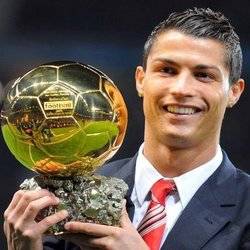
“Having won his second FIFA Ballon d’Or earlier in 2014, Cristiano Ronaldo has secured his place as the current best player and now as the most well-known and best ‘trend-setting’ footballer today.”
Internationally, 83.9% of people questioned say they have heard of Real Madrid striker Cristiano Ronaldo. In Argentina, Germany, Spain, Turkey and Italy over 95% have heard of him.
A trendsetter – he is perceived as somebody who reflects today’s trends in society by 82.5% of people.
Founder and CEO of Repucom, Paul Smith describes Ronaldo as an endorser’s dream. He is valued as highly by the companies that endorse him as the clubs he plays for. His commercial power is driven by a global awareness of him.
He is one of the most liked people in business, with more than 82 million Facebook likes and 26 million Twitter followers.
Ronaldo was transferred from Manchester United to Real Madrid in 2009, the Spanish club paid £80 million (€94 million, $134 million).
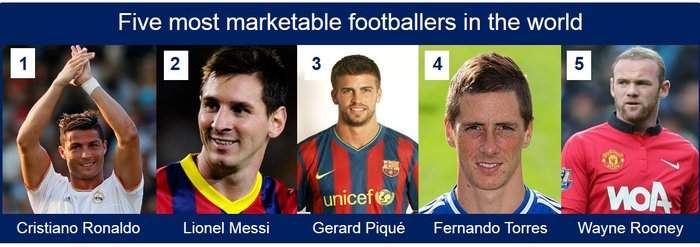
(Data source: Repucom)
Lionel Messi
Barcelona’s Lionel Messi, who has won the Ballon d’Or four times, ranked second, while taking the first spot for the best player on the planet. He earns approximately $27.5 million annually. His endorsement and likeability scores were the main drivers of his ranking.
Mr. Smith, said:
“With just over two weeks to go before the 2014 FIFA World Cup kicks off, the world’s gaze is firmly on the competing teams and players. The World Cup is the most watched sporting event in the world and as such, big brands, official partners or otherwise, will and are using its global appeal to drive sales.”
“Endorsements of celebrities and in this case footballers have an incredibly powerful way of doing just that creating an emotional connection with a brand. The star can raise awareness and create a buzz for brands and products at a time when breaking through the marketing clutter that surrounds such huge events is critical for commercial success.”
Gerard Piqué
Barcelona’s Gerard Piqué was a surprise entry at number three. As a player, he has won three UEFA Champions League finals, two of them in successive years for two different clubs. He was also in the Spanish squad that won the FIFA World Cup in 2010.
His level of worldwide public awareness is heightened by his relationship with the international music star Shakira.
More than 58% of people worldwide have heard of Gerard Piqué, and over three-quarters like him. Ninety-seven percent of his fellow Spaniards like him.
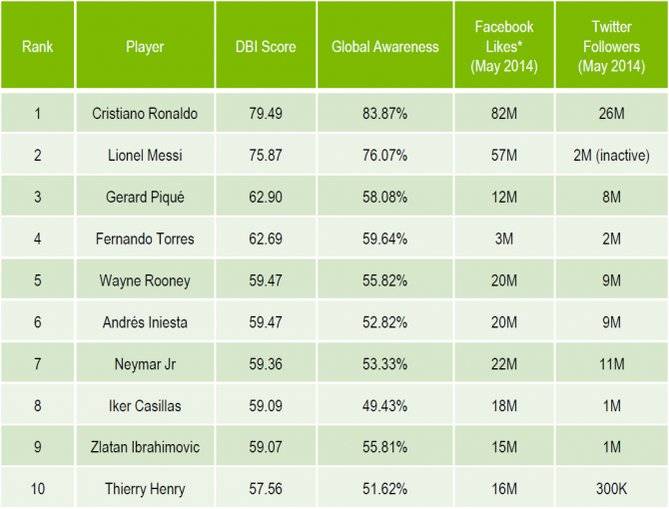
(Source: Repucom)
The richest football (soccer) clubs in the world are Real Madrid, followed by Barcelona and then Bayern Munich, according to Deloitte. Brand Finance says Bayern Munich has the highest brand value, followed by Real Madrid and then Manchester United, whose brand value dipped $98 million after a bad season.
