

Customers who play a major role in creating or customizing a product may still speak positively about it after a disappointing result, according to new research.
The finding matters for businesses that use beta communities, customer panels, crowdsourcing, product configurators, or joint design programs. Positive comments from the people closest to a project may sound encouraging, but they may not provide an accurate measure of whether the product has succeeded.
The study, published in the European Journal of Marketing on July 29, 2026, was carried out by researchers from Hainan University and the University of Kent.
What the researchers tested
Customer co-creation occurs when customers help shape a product or service instead of simply buying the finished result. They might suggest features, choose components, test an early version, create a design, or contribute their own knowledge and effort.
The researchers conducted four experiments using participants recruited through the online research platforms Prolific and Credamo.
In the first three experiments, participants were randomly placed in situations where they had either a high or low level of involvement in a product or service that later failed to meet expectations.
The fourth experiment also tested whether the failure was private or already known to other people.
Participants were asked how positively they would speak about the company. The researchers also measured their satisfaction, enjoyment, perception of the failure, sense of responsibility, and desire to manage how other people saw them.
Highly involved customers expressed more positive word of mouth
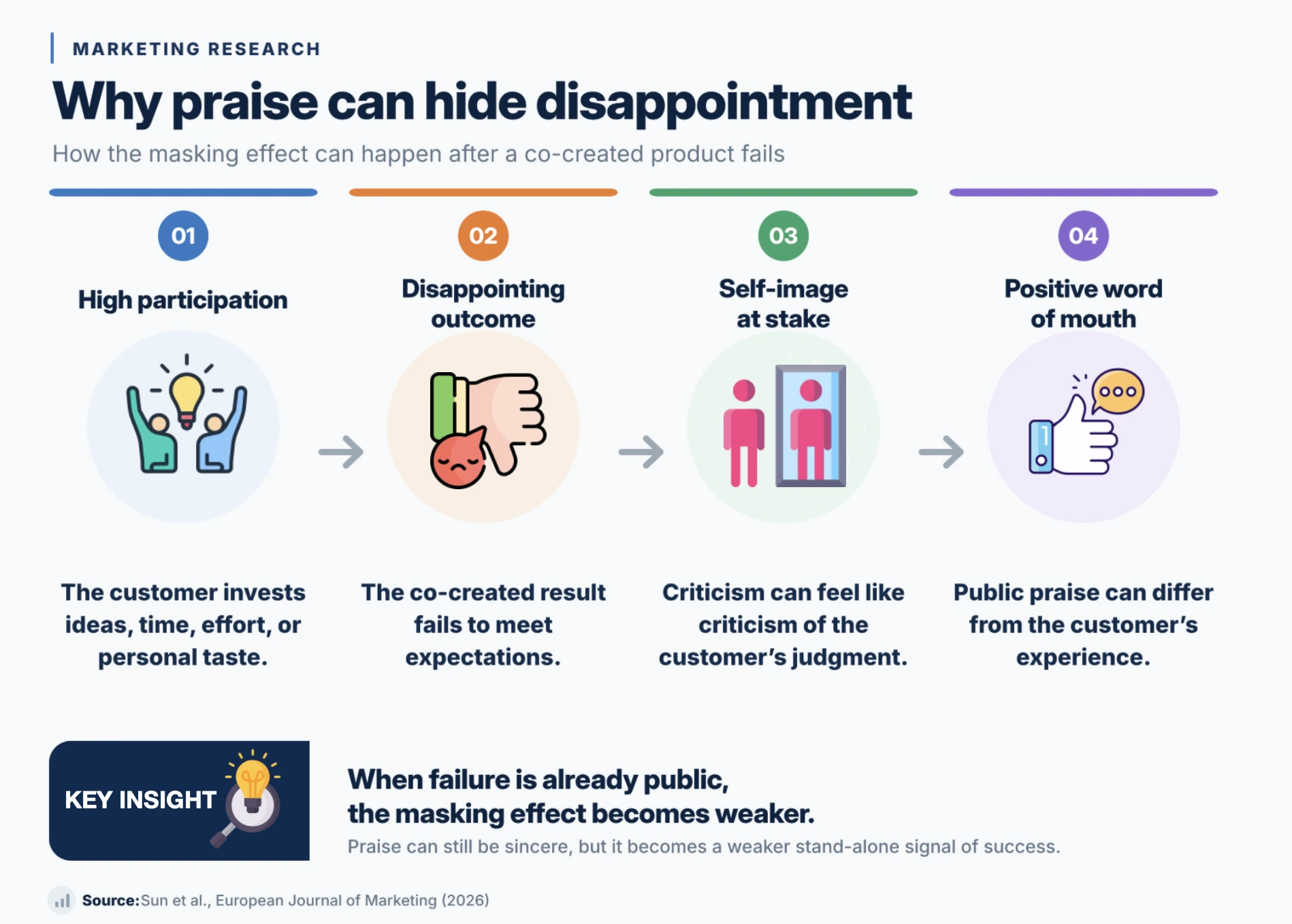
After a co-created product or service failed, highly involved customers expressed more positive word of mouth than customers who had played a smaller role.
The researchers called this the “word-of-mouth masking effect.”
The positive comments did not fully reflect the customers’ experience. Instead, the effect was linked to impression management, which is the effort people make to influence how others see them.
A customer who contributed ideas, effort, skill, or personal taste may see the finished product as a reflection of their own judgment. Admitting that it failed could also feel like admitting that their contribution was poor.
Speaking positively about the company may therefore help the customer protect their reputation or sense of competence.
This does not mean every highly involved customer is deliberately lying. People may still recognize some positive features, feel loyalty toward the team, or soften their criticism without consciously deciding to mislead anyone.
The effect weakened when the failure was already public
The researchers found that the masking effect became weaker when other people already knew the co-created result had failed.
Once the outcome was visible, presenting it positively was less useful as a way to protect the customer’s image. The difference between highly involved and less involved customers became smaller.
This part of the study is particularly relevant to private beta programs and internal customer communities. Problems that remain hidden from the wider market may be easier for participants to play down.
It does not prove that private communities are unreliable. It suggests that companies should avoid treating praise from those communities as their only evidence of product quality.
Co-creation can add value while weakening feedback
The findings reveal an important trade-off for businesses.
Previous research has shown that customers often value products more when they help create them. A Management Science study on mass customization found that self-designed products generated a higher willingness to pay. Feelings of accomplishment helped explain the effect.
Related research on the “IKEA effect” found that people can place greater value on products they have successfully assembled themselves.
Co-creation can therefore strengthen attachment, perceived value, and customer engagement when the process goes well.
The new study identifies the other side of that attachment. When the result disappoints, the customer’s involvement may reduce the diagnostic value of what they say about it.
In business terms, the participation premium can come with a measurement penalty. The same sense of ownership that makes customers value a successful product can make them less comfortable identifying a failed one.
Positive comments do not necessarily mean customers are satisfied
Earlier research also suggests that failure can be especially uncomfortable when customers helped produce the outcome.
A study published in the Journal of the Academy of Marketing Science found that failed services with high levels of customer participation could create a larger gap between the expected and actual result. Customer participation also encouraged people to assign some responsibility to themselves, which increased feelings of guilt.
Another Journal of Marketing Research study found that product failures can threaten a customer’s self-image when the customer believes they caused the problem. Complaining under those conditions can trigger defensive thinking rather than simply providing emotional relief.
Together, the studies suggest that disappointment, self-blame, and positive public comments can exist at the same time.
For a business, this means a customer saying “I still think it is great” may not answer the more important question: “Did the product actually meet the customer’s needs?”
Businesses should separate promotion from product diagnosis
Companies often ask the same group of customers to test a product, recommend it, provide testimonials, and judge whether it is ready for launch.
That approach mixes two different jobs.
Advocacy asks customers to support the brand publicly. Product diagnosis asks them to identify defects, weak assumptions, and reasons the product might fail. A participant may struggle to perform both roles objectively, especially when their own ideas are attached to the outcome.
Businesses could collect private diagnostic feedback before asking participants for testimonials, referrals, social media posts, or public launch support.
Anonymous surveys and confidential interviews may also reduce the personal cost of criticizing the result. The new study did not directly test these methods, but they are practical responses to the bias it identified.
Compare co-creators with independent users
Feedback from co-creators remains valuable. They understand the project, its intended users, and the decisions made during development.
However, their feedback should be compared with a separate group of customers who had no role in creating the product.
This creates a useful control group. Independent users are less likely to see the outcome as a reflection of their own competence or judgment.
For example, a software company could test a new feature with both the customers who requested it and customers who are seeing it for the first time. A consumer brand using crowdsourced designs could compare reactions from contributors with those of ordinary buyers.
If co-creators are highly positive while independent users repeatedly struggle, the difference itself becomes useful information.
Look for a gap between praise and behavior
Businesses should also compare what customers say with what they do.
Useful behavioral signals may include:
- Whether customers continue using the product
- Whether they complete important tasks successfully
- Repeat purchases and subscription renewals
- Refunds, returns, and cancellations
- Support requests and repeated errors
- Features that customers abandon or avoid
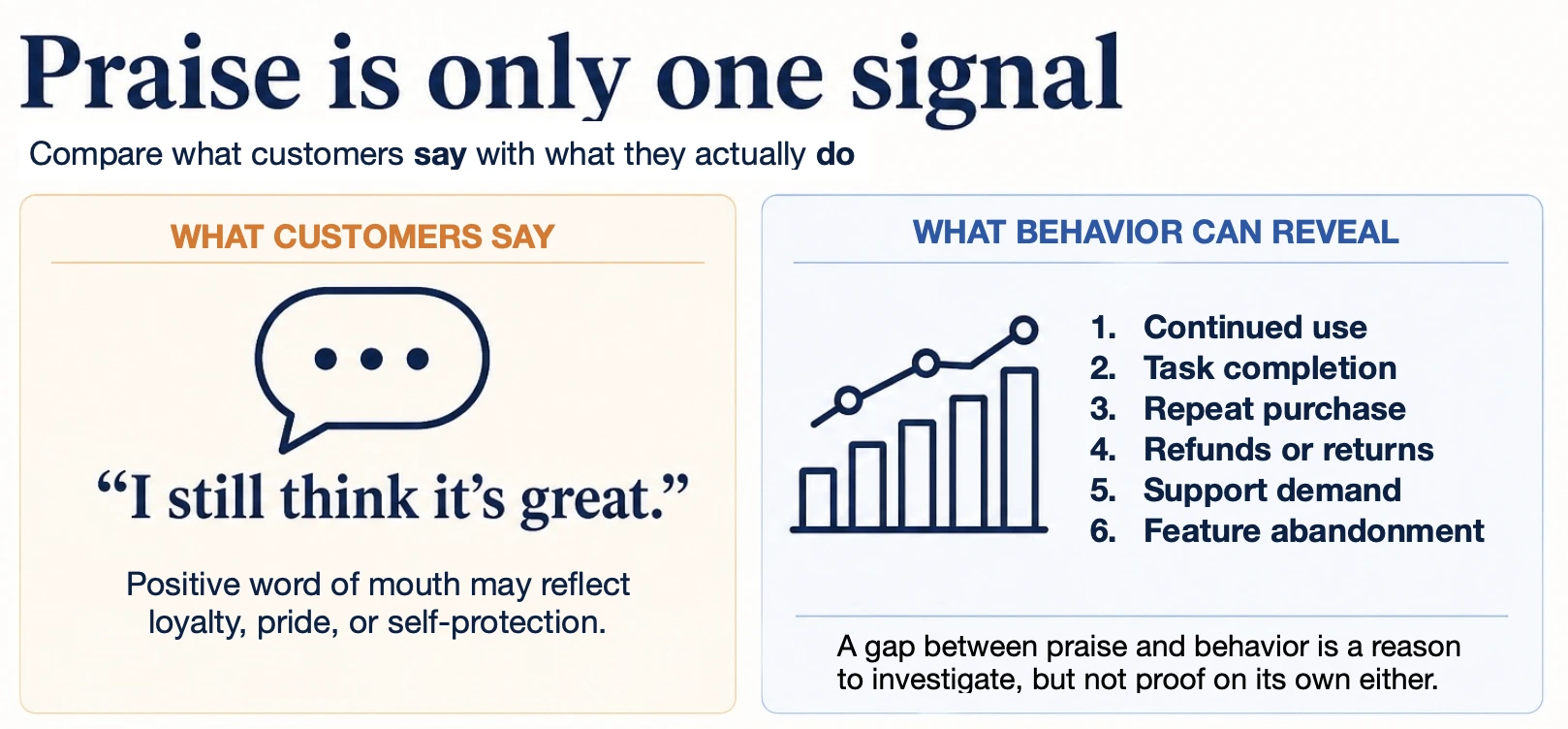
A product may receive positive comments while also producing low usage, high support demand, or weak repeat purchases. That praise-behavior gap should trigger further investigation.
It does not automatically prove that customers are masking disappointment. It shows that the positive comments are not supported by the commercial or operational evidence.
Ask questions that make criticism easier
Broad questions such as “Would you recommend this product?” can encourage customers to give a socially acceptable answer.
More specific questions may reveal problems that general satisfaction scores miss:
- What should be changed before this product is released?
- Which part would cause a first-time customer to stop using it?
- What did you expect to happen that did not happen?
- Which feature should be removed rather than improved?
- Would you pay the full planned price for the finished version?
- What would you criticize if someone else had designed it?
These questions give participants permission to be critical without requiring them to reject the entire project or their own contribution.
Do not confuse praise with successful recovery
A customer who continues speaking positively may still need a refund, correction, redesign, or service recovery.
Research published in the Journal of Services Marketing found that intensive customer participation in a failed service could damage perceptions of the company’s ability and ethics. Involving customers in developing the recovery improved their perceptions of fairness and ethical treatment.
This suggests that businesses should respond to a co-creation failure with a real repair process, even when the customer is not openly angry.
Customers can help shape the solution, but their continued involvement should not replace independent quality testing.
The study has important limitations
The new findings came from controlled experiments and co-creation scenarios. The researchers did not analyze actual product reviews, sales, returns, or long-term customer behavior.
The study therefore does not prove that beta testers, customization customers, or brand communities routinely hide failed products behind positive reviews.
The authors said future studies could test the effect using real-world data. They also identified the severity of the failure and cultural differences in concern about social image as areas requiring further research.
The main lesson is not that businesses should stop involving customers in product development.
Customer participation can produce better ideas, stronger relationships, and products that fit customer needs more closely. It also changes what customer feedback means.
The people closest to a product may be an excellent source of ideas. After a failure, however, they should not be its only judges.
