
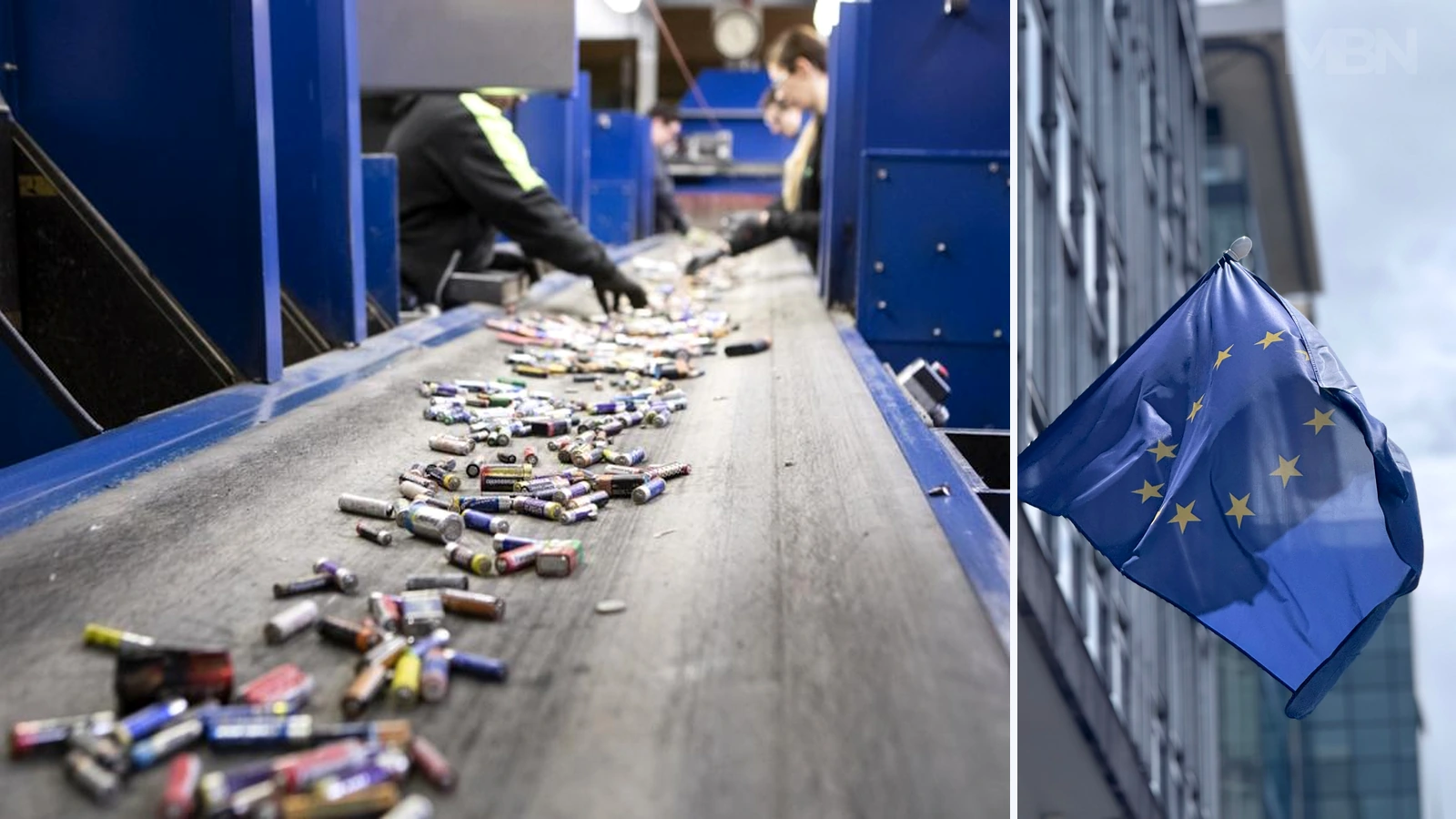
The European Commission has decided that the EU’s existing battery recycling targets should remain unchanged, leaving recyclers to prepare for rising requirements on recovering lithium and other valuable materials.
The assessment published on 11 September examined whether changes in technology, markets and raw-material supplies justified revising the rules. The Commission concluded that the current targets still provide an appropriate balance between what the industry can achieve and what the EU wants it to recover.
Keeping the rules does not mean the industry has already met every requirement. Several deadlines are still ahead, and the report acknowledges gaps in the evidence available for this first review.
Two targets measure different things
The rules use both recycling efficiency and material recovery. Recycling efficiency looks at how much battery material is recycled by weight, under the prescribed calculation method. Material recovery measures how much of a particular substance, such as lithium, is recovered.
A recycler can recover a substantial amount of casing and other material without recovering the same proportion of every metal inside the cells. Looking only at total recycled weight would miss that difference.
Under the current Batteries Regulation, lithium-based batteries had a recycling-efficiency target of at least 65% by average weight by the end of 2025. That rises to 70% by the end of 2030. These percentages describe weight, not the share of batteries collected from owners.
For lead-acid batteries, the equivalent targets are 75% and 80%. Separate material-recovery requirements apply to five metals.
Lithium recovery requirements rise in stages
By the end of 2027, recycling must recover at least 50% of lithium and 90% of each of cobalt, copper, lead and nickel. By the end of 2031, the lithium target rises to 80%, while the other four metals move to 95%.
The Commission’s full report explains that the initial lithium target allows time for processes to be developed and scaled up. It is not a statement that recovering more than half the lithium is technically impossible.
Some industry respondents questioned whether the later targets would be achievable in all circumstances. Battery size and composition affect what a recycling process can recover, and a new plant may need time to improve its performance.
The review does not settle the business case
The assessment drew on industry feedback and modelling by the Commission’s Joint Research Centre. Many stakeholders considered the timing premature because recyclers’ first reports to national authorities are due in mid-2027, followed by national reporting to the Commission in mid-2028.
The Commission nevertheless found no grounds to amend the targets. It said changing recovery percentages would have a limited effect on overall material supply compared with the challenge of expanding treatment capacity.
Capacity and the supply of used batteries also have to develop together. Our earlier report on the wait for retired electric-vehicle battery packs examined why a recycling factory can be ready before sufficient used packs become available.
A recovery target describes the output a process must achieve from the material it treats. It does not guarantee a steady supply of incoming batteries, a buyer for the recovered material or a profit for the operator.
The next assessment is due by 18 August 2031. In the meantime, the existing timetable gives businesses the requirements to plan against, while the coming reporting rounds should provide a clearer picture of performance.
