

Over the past decade, 3D printing has advanced from prototyping to mainstream manufacturing. It is transforming the shop floor in a range of industries.
3D printing is “starting to press into manufacturing operations that require quick-to-market builds, unique design requirements and even low-volume production runs,” says Pete Basiliere, analyst and co-author of the latest annual report from research and advisory firm Gartner about the future of 3D printing.
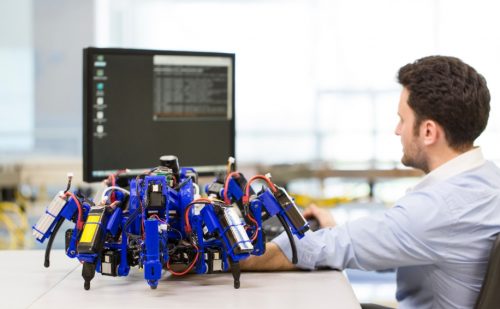 Siemens has developed prototype spider-like robots incorporating 3D printing that can work in groups to print structures and surfaces. Image: Siemens
Among other things, the report predicts that by 2020:
– 10 percent of industrial operations will be using robotic 3D printers in their manufacturing processes
– 75 percent of manufacturing operations around the world will be using 3D-printed tools, jigs, and fixtures to make finished goods
– 3D printing will cut new product timelines by 25 percent
‘Mobile manufacturing’
Gartner cite the example of the Siemens spider-bot, introducing the idea of “mobile manufacturing” where 3D printing combines with robotics. Currently at the prototype stage, the spider-like robots work in teams to print structures and surfaces.
Such technology promises to speed up production of large-scale, complex structures, such as aircraft fuselages and ship hulls, says Siemens.
Fused Deposition Modeling (FDM)
Another example of where 3D printing – also known as additive manufacturing – is transforming traditional methods is Fused Deposition Modeling (FDM). With FDM, a designer can sketch an idea and test it in the same day.
This cuts lead times and costs, helping better quality products get to market faster.
FDM systems use 3D printing to make jigs, fixtures, and factory tooling for the automotive, aerospace, and other industries.
Changing the rules of the game
3D printing is changing the rules of the game.
The game is changing from analog technology to digital technology. This will involve a “massive shift from a handful of products that sell in the millions, to millions of products that sell by the handful,” says Weijmarshausen. It also changes who is in control.
In the analog world, big companies produce large quantities of the same product. Analog manufacturing needs market research, prototyping, testing, manufacturing processes with dedicated tools, supply chains, and retail channels for distribution and sales.
In the digital realm, it is possible for users to decide their own product. For example, with Shapeways, with the help of 3D software, users work with designers to customize or produce new products, upload the 3D printable files, and the company prints the objects.
Weijmarshausen also says the other important change is the time to market for new products will shrink from years to days.
