
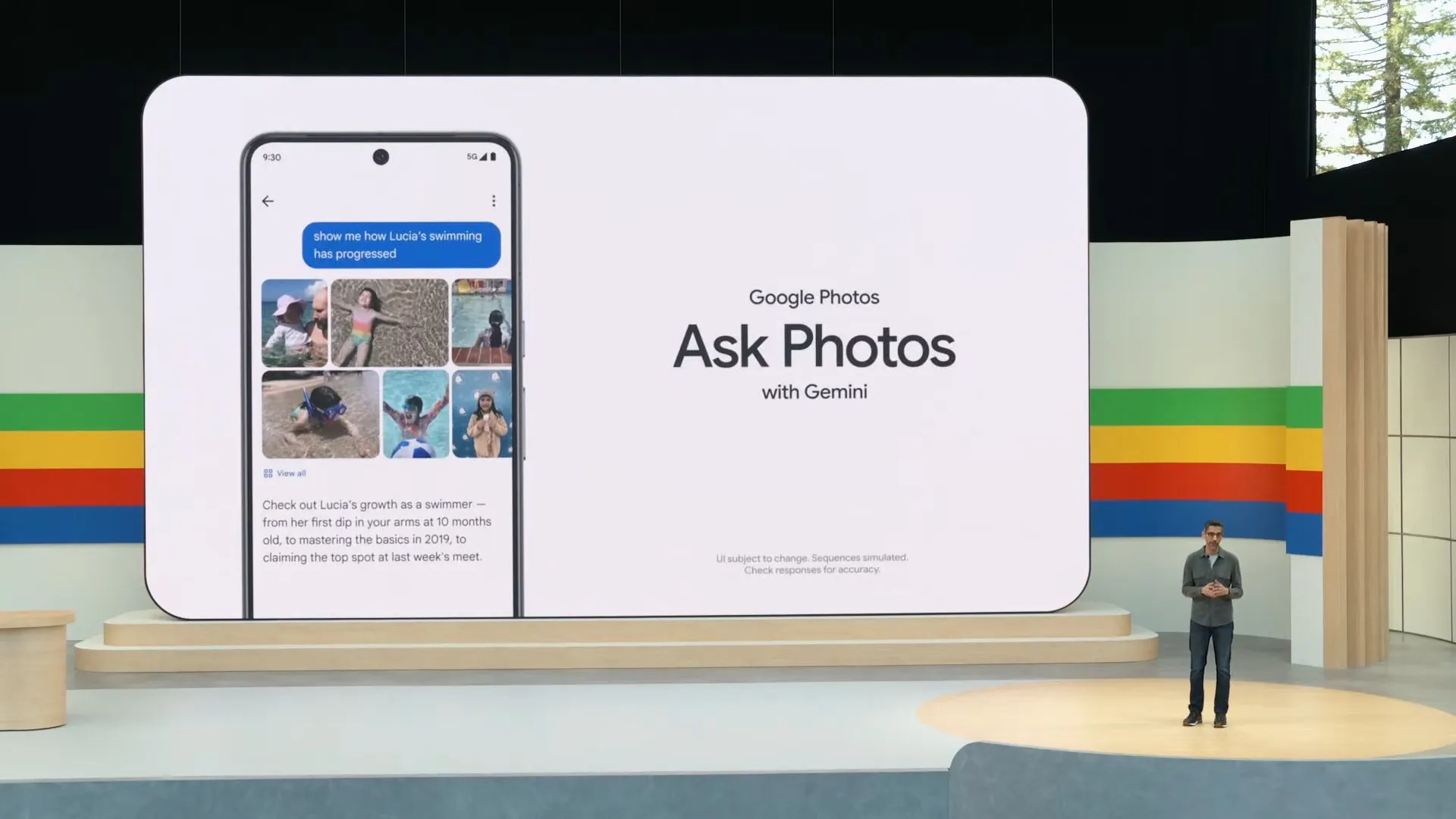
Google today announced that its AI-powered Ask Photos is rolling out to select US users. The rollout follows a pause to fix critical performance issues. The revamped feature now combines traditional search speed with Gemini AI’s conversational capabilities. It addresses user complaints about slowness that plagued the original 2024 rollout.
The hybrid approach delivers instant results for simple searches while AI processes complex queries in the background, marking a pragmatic pivot from pure AI implementation to user-focused design.

The pause that led to today’s improvements
Ask Photos’ journey from promise to pause reveals the challenges of consumer AI deployment. Originally unveiled at Google I/O 2024, the feature enabled natural language queries. These included questions like “What themes have we had for Lena’s birthday parties?” or “Where did we camp last time we went to Yosemite?” But when it rolled out to early access users in late 2024, the reality fell short. It did not meet the expectations set by the demo.
Users immediately reported frustrating delays even for basic searches like “beach” or “dogs” – queries that Google Photos’ traditional search handled instantly. The AI-first approach meant every search, no matter how simple, went through complex Gemini processing. On June 3, 2025, Google Photos Product Manager Jamie Aspinall acknowledged the failures on X: “Ask Photos isn’t where it needs to be, in terms of latency, quality and ux.”
The 24-day pause gave Google’s engineers time to completely rearchitect the feature. Rather than forcing all queries through AI processing, the new version serves immediate results from traditional search algorithms while Gemini works in the background on more complex understanding. This hybrid approach represents a significant technical shift from the original pure-AI implementation.
How the reimagined feature actually works
The relaunched Ask Photos fundamentally changes how Google approaches AI-powered search. When users type queries, they now see results appear instantly – just like classic Google Photos search. For simple searches like “sunset” or “birthday,” this immediate response eliminates the frustrating wait times that killed the original version.
Meanwhile, Gemini’s AI models process the same query in the background, analyzing context, relationships, and nuanced meaning. For complex questions – “suggest photos that’d make great phone backgrounds” or “what did I eat on my trip to Barcelona?” – the AI’s enhanced results appear below the initial matches. Users can engage in follow-up conversations asking clarifying questions without starting new searches.
The feature requires specific conditions: users must be 18 or older, located in the United States, have their Google account language set to English, and enable the Face Groups feature. It appears as an “Ask” tab in the Google Photos app bottom navigation, replacing the traditional Search tab for eligible users. Those who prefer can still access classic search or disable Ask Photos entirely through settings.
Privacy trade-offs spark continued debate
Google’s privacy commitments for Ask Photos include several key protections: personal data won’t be used for advertising, queries are disconnected from accounts before any human review, and the actual photos returned aren’t reviewed by humans except when users report issues. The company emphasizes that personal data isn’t used to train other AI models outside of Google Photos.
Yet privacy experts raise valid concerns about the depth of analysis required for the feature to work. Understanding queries like “What themes have we had for Lena’s birthday parties?” requires AI to analyze faces, dates, locations, and contextual clues across potentially thousands of photos. The Face Groups requirement means users must enable biometric processing, raising additional privacy questions in an era of increasing biometric regulation.
The lack of clarity around Ask Photos-specific training data remains problematic. While Google states personal data won’t train “other” AI models, the language leaves room for interpretation about whether photos might train Ask Photos itself. Privacy advocates recommend users carefully review their Google privacy settings and consider whether the convenience justifies the extensive data analysis.
Competitive pressure shapes the relaunch strategy
Ask Photos faces stiff competition in the AI photo search market, with each major player taking distinctly different approaches. Apple’s solution emphasizes on-device processing through Apple Intelligence, available only on iPhone 15 Pro and newer devices. This privacy-first approach appeals to security-conscious users but limits availability and relies on device computational power rather than cloud AI.
Microsoft’s strategy integrates AI photo search directly into Windows File Explorer and OneDrive, launching first on Snapdragon-powered Copilot+ PCs. By building search into the operating system itself, Microsoft creates a more seamless experience for Windows users, though broader availability won’t arrive until summer 2025. The approach ties photo search to Microsoft 365 subscriptions rather than advertising models.
Google’s cross-platform availability – spanning Android, iOS, and web – combined with Gemini’s advanced capabilities gives it the broadest reach. The hybrid search approach directly addresses the speed complaints that could have driven users to competitors. By delivering instant results while maintaining AI capabilities, Google attempts to offer the best of both worlds in a market where user experience trumps pure technological advancement.
Conclusion
Google’s Ask Photos relaunch demonstrates a crucial lesson in consumer AI deployment: technological capability means nothing without user satisfaction. The 24-day pause and fundamental rearchitecture show Google’s willingness to admit mistakes and prioritize user feedback over maintaining face. Google shifted from a pure AI approach to a hybrid model. This change respects user expectations for speed. As a result, Google has found the formula for making conversational photo search actually useful.
