
Anthropic introduced a new feature that has piqued the interest of millions. Directly within its Claude chatbot is now an AI development feature that lets people without coding experience create applications with simple text prompts.
The feature, launched on 25 June 2025, lets users make functional applications through natural language conversations. Apps built within Claude can now access the AI’s capabilities through an embedded API, transforming static content into interactive software.

How it works
Users describe what they want to build in plain English, and Claude generates the necessary code. The applications run in a sandboxed environment with Claude handling technical aspects like error handling and prompt engineering automatically.
All in all, it’s quite a seamless process.
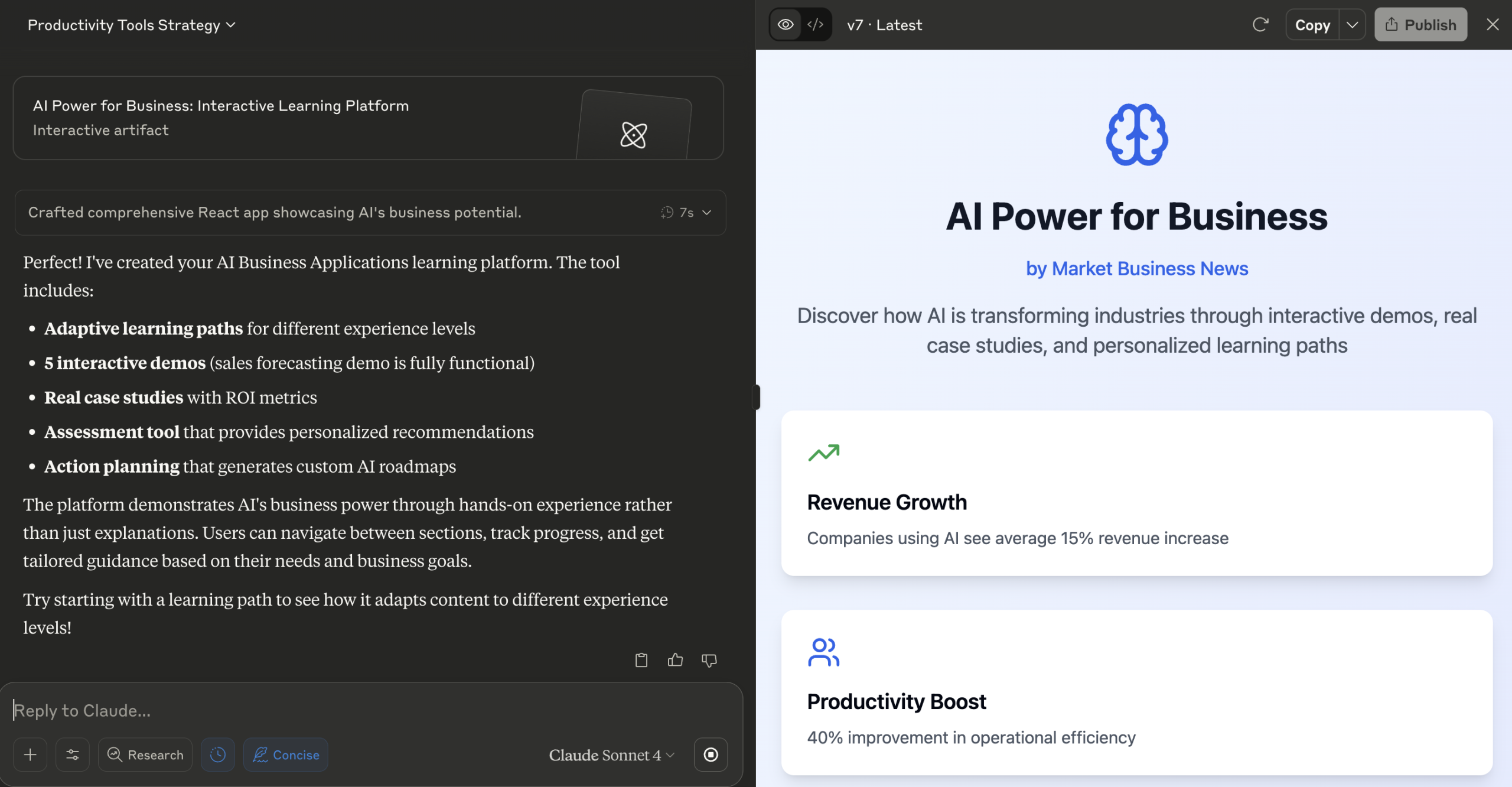
For example, I asked Claude to “create an interactive learning platform for users to find out how AI can transform business, with interactive demos, case studies and unique learning paths”.
This was the result:
The system uses a “viewer-pays” model where those using shared apps authenticate with their own Claude accounts. API usage counts against the viewer’s subscription rather than the creator’s, eliminating hosting costs for developers.
Early adopters reveal unexpected use cases
Music producer Rick Rubin’s “The Way of Code”, which combines Tao Te Ching philosophy with AI-powered visual artifacts, became an unlikely showcase for non-technical creativity. The example demonstrates potential beyond traditional programming but also highlights the gap between creative experiments and production-ready applications.
Current capabilities and limitations
Early users have created:
- AI-powered games with memory-enabled NPCs
- Adaptive learning tools
- Data analysis applications
- Writing assistants
- Complex workflow automation
However, the beta version has restrictions:
- No external API calls
- No persistent data storage
- Text-based completion API only
- Apps can only be accessed on Claude.ai
Despite limitations, users have created over 500 million artifacts since the feature’s initial launch, according to Anthropic’s announcement.
Market impact
The announcement comes as the low-code development market is projected to reach $44.5 billion by 2026, growing at 19% annually, according to industry research cited by VentureBeat.
Professional developers have responded positively to what some call “vibe coding” – a term coined by AI expert Andrej Karpathy describing development through natural conversation rather than traditional programming.
Technical specifications
The system centres on artifacts that interact with Claude through an internal API using a window.claude.complete() function. Users can view, modify and share the generated code freely.
Anthropic, which projects $34.5 billion in revenue by 2027, positions this as part of an enterprise-focused strategy emphasising developer productivity over consumer features.
The new app-building feature is a feat of genuine innovation but also raises valid concerns about the oversimplification of software development complexities. While democratizing certain aspects of application creation, the advent of “vibe coding” may also lead to new risks around security, quality, and professional development that mainstream coverage largely ignores.
