

Businesses that manage customer data with care may benefit from stronger customer relationships, but the effect depends partly on whether customers believe their motives are genuine, according to marketing research.
The finding matters to companies collecting information for services, advertising and customer support. A privacy notice is only one part of the experience: customers also encounter choices about what to share, what happens to their information and whether they can change their preferences.
Jordan W. Moffett, Natalie Chisam, Kelly D. Martin and Robert W. Palmatier examined what they call customer data privacy stewardship in research included in the Journal of Marketing’s November 2026 issue. The paper first appeared online in July 2025.
What privacy stewardship means
The researchers describe a customer-facing approach to managing personal information responsibly. In practical terms, a business can explain what information it collects and why, limit collection to a suitable purpose, protect it and give people clear ways to exercise the choices available to them.
For example, an online retailer asking for a delivery address needs to make it clear how that information will be used. Asking for additional information to support marketing is a separate decision that should be explained in context.
Privacy and security are related but distinct. Security protects information against unauthorized access or loss. Privacy also concerns whether collection and use are appropriate, expected and transparent.
What the research does and does not show
Across three studies using different methods, the authors found a positive relationship between privacy stewardship and performance measures at firm, brand and customer levels. The relationship was not equally strong in every setting.
It depended in part on customers’ perceptions of a company’s motives. The relationship was weaker when customers saw a business as highly dependent on data, and stronger when they felt an affinity for the brand. Perceptions of data risk also influenced the pattern.
These are research findings about the relationships measured, not a guarantee that a particular notice or privacy investment will increase profits. A company cannot assume that a claim about protecting data will be persuasive if its actual practices do not support it.
Turn a policy into a usable experience
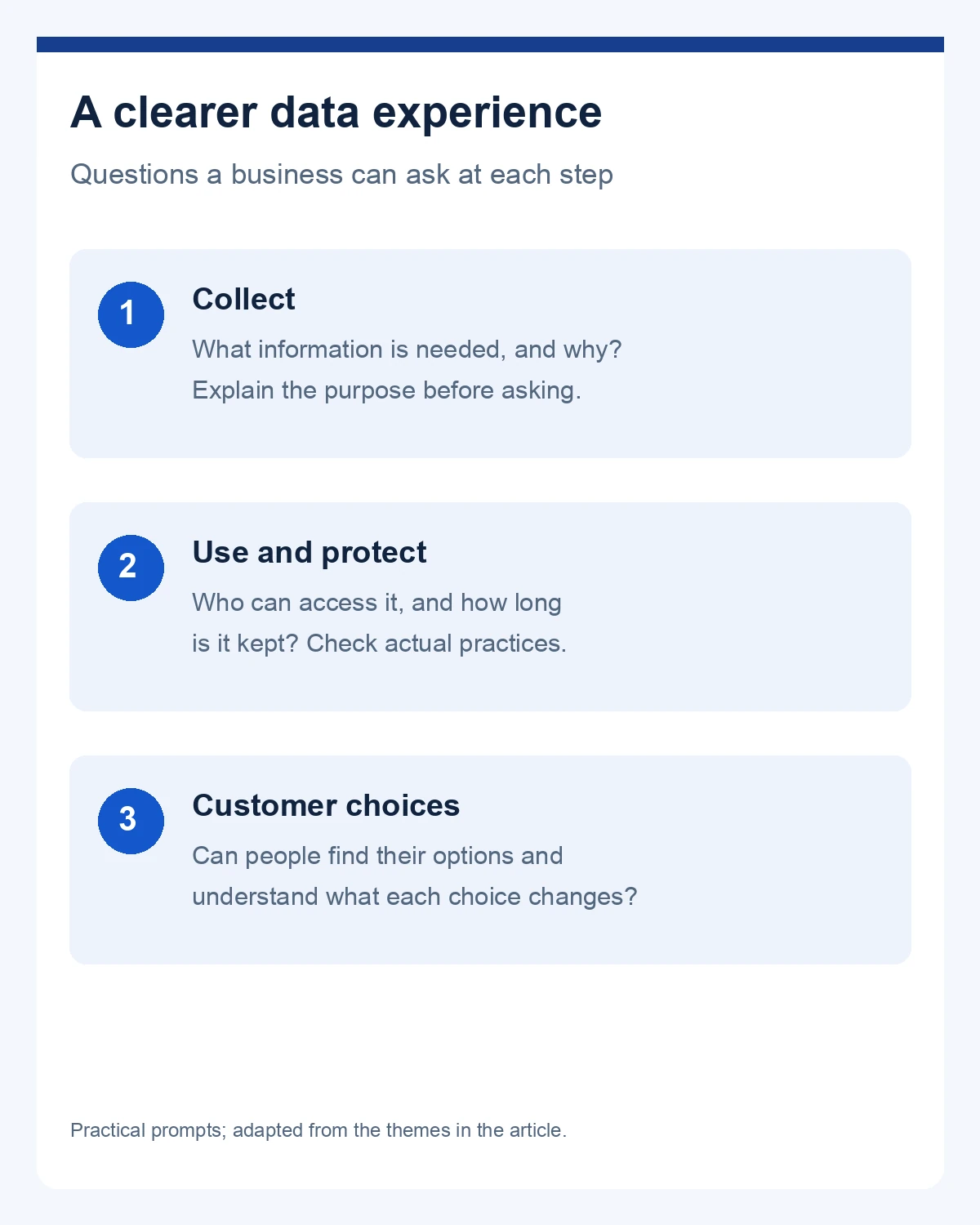
A practical starting point is to map the information collected at each stage of a customer’s journey, why it is needed, who receives it and how long it is retained. Staff can then check whether explanations match what actually happens.
For a customer, a useful choice is easy to find and understand. A preference page might explain what changes when someone opts out of a marketing message and provide a way to update that decision later. The details and legal requirements will depend on the service and jurisdiction.
Businesses can also ask customers whether they understand the choices, measure whether requests are handled promptly and review access to information. Those steps are practical applications, not tests of individual interventions in the paper.
The US National Institute of Standards and Technology provides a voluntary privacy framework to help organizations identify and manage privacy risks. It is a tool for planning, not a substitute for meeting applicable legal obligations.
The trade-off for marketers
Collecting less data or restricting its use can limit some types of targeting and measurement. Businesses also face costs when they build controls, train staff and maintain security. The research suggests that customer perceptions and relationships are relevant to that calculation, but it does not establish a universal return on privacy spending.
MBN’s reporting on customer data and pricing explores another situation in which data use can affect how customers judge a business.
For managers, the question is whether the value of a data practice justifies the information requested and the responsibilities that follow. For customers, clarity about those choices is useful even before any marketing benefit is measured.
