
Control of wastewater is a key part of managing the environmental impact of mining. Now, mineral engineers are exploring how to enlist microbes to help clean up mining industry wastewater.
Huge amounts of water are used by mining companies to extract copper, nickel, gold, and other valuable metals from rocks.
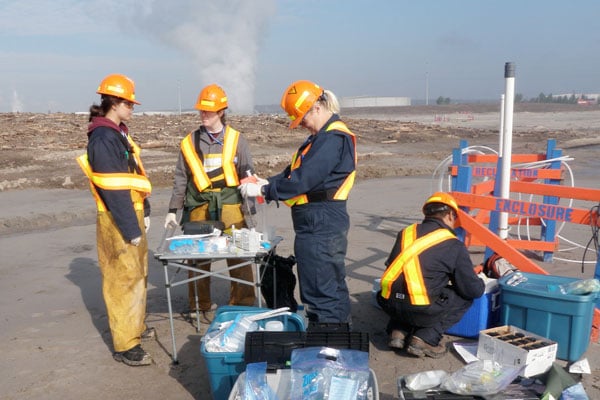
 By studying the genetics of bacteria in mining industry wastewater, University of Toronto mineral engineers hope to develop biotechnological tools that help mine managers further reduce mining’s environmental footprint. Image courtesy of Prof. Lesley Warren (standing, right).
In the United States and other countries, mining industry wastewater must be cleaned according to strict rules before it is discharged back into the environment.
However, wastewater is also an ideal habitat for untold numbers of microorganisms that thrive on a variety of compounds.
Project to study genetics of wastewater microbes
Mineral engineers at the University of Toronto have launched a multi-million dollar project – funded in part by Genome Canada – to study the genetics of these wastewater microbes. They hope to discover clues that will help the mining industry further reduce its environmental footprint.
Project leader Professor Lesley Warren says:
“These wastewaters contain a variety of sulphur compounds that certain bacteria can use for energy.”
She explains that the bacteria they are interested in evolved billions of years ago – long before humans came along. Imagine the time-span of evolution squashed into a single day, then these bacteria arrived one hour before midnight, and humans arrived 17 seconds before.
Currently, if wastewater contains too high a concentration of sulphur compounds, then mining companies have to pay for costly treatments to chemically remove them and make the water safe to discharge into the environment.
The project engineers will be using genomics – the study of the genetic code and related molecules that make up living things – to better understand how the bacteria thrive on them. They will also be analyzing and modelling the chemical reactions involved.
Warren explains that mining companies have known for some time that microorganisms interact with the sulphur compounds and drive much of their chemistry in the wastewater; but the technology to look inside the “black box” has not really been around until now.
‘Mining wastewater bacteria as a biotechnology resource’
The idea is that using the new tools the engineers will be able to discover how to use the bacteria in a number of ways. For example, perhaps they could serve as early warning signals for levels of toxicity in mining industry wastewater, or even as a form of biological treatment that breaks down toxic compounds or stops them forming in the first place.
Mining companies don’t know which levers to pull to control the system, says Warren. She says their task is to develop new tools that help mine managers make better decisions about controlling wastewater.
“Once we understand the microbes and how they affect wastewater geochemistry, we can pinpoint the drivers of their behaviour,” says Warren, “Which wastewater compounds are they using? Do they like it hot? Do they like it cold?”
“Essentially we are mining the bacteria that already exist in these wastewaters as a biotechnology resource,” she explains.
Warren says many of the organisms they are finding are new to science, and there is a high chance they will find organisms capable of doing creative things with mining industry wastewater.
