
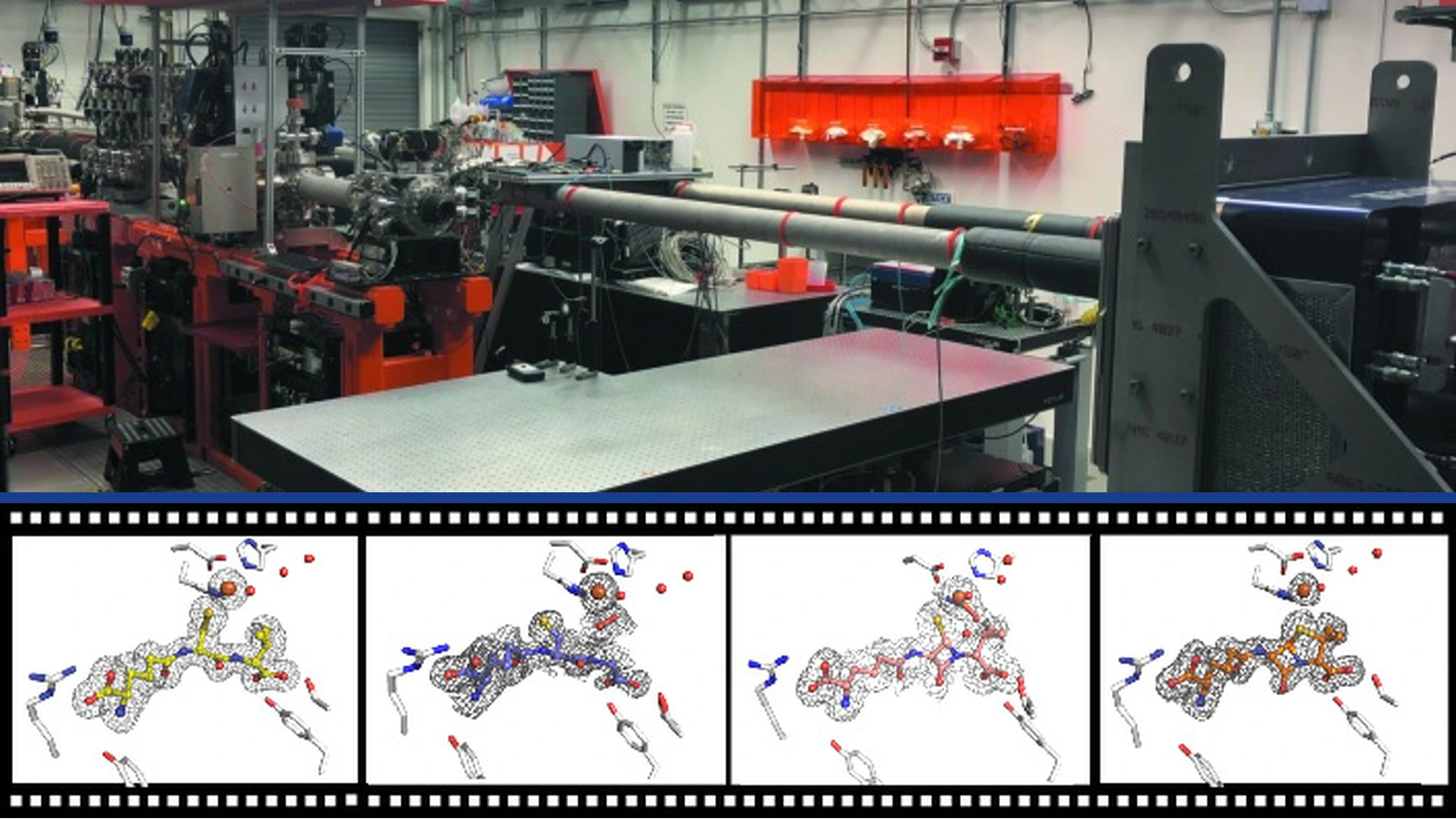
Researchers have captured previously unseen stages in the enzyme reaction that builds penicillin’s characteristic ring structure. The findings, published in Nature Catalysis on October 9, could help scientists investigate new ways of engineering antibiotic-producing enzymes.
The international team, led by researchers at the University of Oxford, used powerful X-ray lasers to reconstruct a sequence of molecular structures. These show how the enzyme isopenicillin N synthase, or IPNS, transforms its starting material into the two joined rings that form the penicillin scaffold.
The study provides a more detailed explanation of that chemistry. It does not report a new antibiotic, a clinical trial or an improvement in commercial manufacturing.
What is a molecular movie?
An enzyme is a biological catalyst, usually a protein, that helps a chemical reaction take place. Understanding its starting structure and finished product does not necessarily reveal what happens between them.
Some intermediate structures exist only briefly before the reaction continues. A molecular movie reconstructs those changing arrangements from measurements taken at different reaction times.
In this experiment, tiny droplets containing enzyme crystals travelled on a moving tape through an oxygen-filled chamber. Oxygen started the reaction. Changing the tape’s speed controlled how long the crystals reacted before an X-ray pulse measured them.
Combining many measurements produced a sequence of structural snapshots. These are reconstructed atomic models, rather than ordinary photographs of a molecule.
Oxford’s account of the research distinguishes the very short X-ray pulses from the reaction intervals, which ran from milliseconds to seconds. That distinction matters when interpreting how quickly the chemistry was observed.
Water helps guide the reaction
The team observed an intermediate before the first ring formed and another after one ring had formed, before the complete two-ring structure emerged.
One unexpected finding concerned the way an intermediate interacted with the enzyme’s iron center. Its sulfur atom was temporarily not attached to the iron, contrary to the expected arrangement. The connection was restored at a later stage.
The experiments also supported a role for water molecules within the enzyme in guiding the reaction. Researchers combined the structural measurements with spectroscopy, changes to the enzyme and computational analysis to examine the proposed mechanism.
For scientists trying to redesign an enzyme, knowing which interactions matter gives them more specific features to investigate. It does not establish that a modified enzyme will produce a useful medicine.
A related avenue in cancer research
In an October 9 research announcement, SLAC National Accelerator Laboratory also discussed an earlier study of the human enzyme AspH, a potential target in cancer research.
That Nature Communications paper, published in February, found that a water molecule bound to iron remained in place during the reaction. It helped explain how the enzyme functions, rather than demonstrating a cancer treatment.
Both projects used X-ray measurements to examine chemistry that is difficult to follow through static structures alone.
Better information still needs testing
The business opportunity lies in giving researchers firmer evidence about which experiments to attempt. That could be useful in enzyme engineering and drug discovery, but neither study measures a reduction in development costs.
As our coverage of new tools in pharmaceutical development explains, choosing promising ideas and proving that a treatment works are different stages.
These molecular movies provide a clearer view of the reaction. Turning that view into a better antibiotic or another treatment remains work for subsequent experiments.
Cover image: Historic MFX equipment photograph and molecular structures from the IPNS study, adapted from Sierra et al. (2019), Figure 4, and Rabe et al. (2026), graphical abstract, both licensed under CC BY 4.0. Cropped and composed by Market Business News. The equipment photograph does not show the 2026 experiment. No endorsement by the authors, SLAC, Stanford University or the US Department of Energy is implied.
