
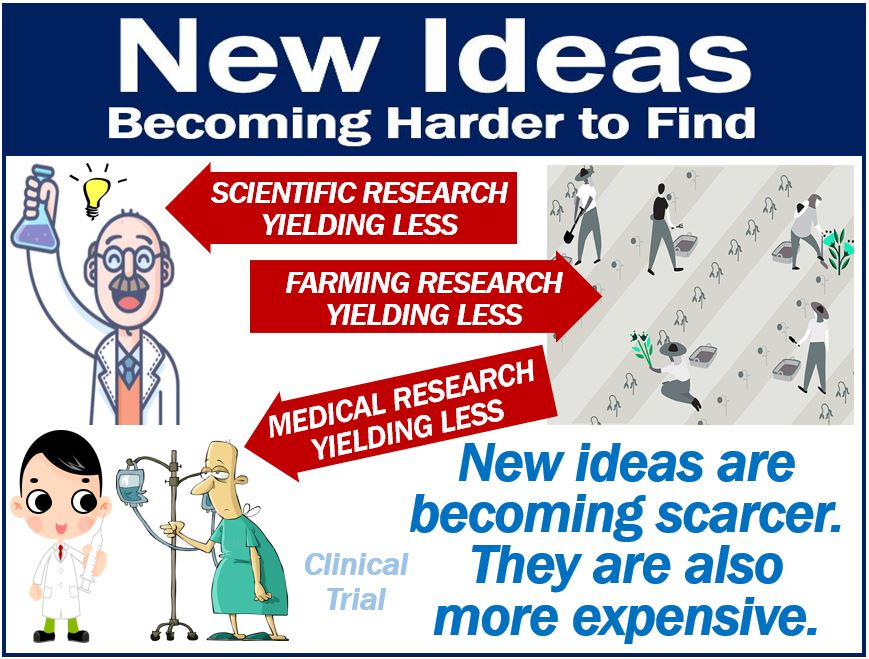
New ideas are becoming scarcer, especially in medicine, agriculture, and some other industries. New ideas are also becoming more expensive, a team of researchers from Stanford University and MIT Sloan found. As technology advances in leaps and bounds, we subsequently assume that new ideas are becoming increasingly abundant. However, this is not the case.
John Van Reenen, Michael Webb, Nicholas Bloom, and Charles I. Jones wrote about their study and findings in the National Bureau of Economic Research.
Webb is a Stanford University doctoral candidate. Bloom and Jones are Stanford University professors. Van Reenen works at MIT Economics and Sloan.
New ideas harder to find?
In this age of astonishing scientific and technological progress, are new ideas becoming scarcer?
Yes, the researchers say. The productivity of scientific research is declining steeply across the board.
It is declining, they argue, because researchers are putting increasingly more effort to sustain the pace of idea generation. Specifically, the rate of idea generation that we experienced fifty years ago.
In fact, even with that additional effort, we might not be keeping up with past rates of idea generation.
New ideas – GDP growth
Regarding GDP growth, the authors explain:
“Just to sustain the constant growth in GDP per person, the U.S. must double the amount of research effort put into searching for a new idea every 13 years to offset the increased difficulty in finding new ideas.”
GDP stands for Gross Domestic Product. It refers to all the products and services that an economy produces over a specific period, such as a year.
Moore’s Law
Moore’s Law stands as a prime example. It is named after Gordon Moore, the co-founder of Intel and Fairchild Semiconductor. He observed the doubling of the number of transistors we could pack into a new central processing unit every five years.
This doubling effect represents an annual growth rate of thirty-five percent. Ever-more-extensive research drives that growth.
Regarding Moore’s Law, the authors write:
“Many commentators note that Moore’s Law is not a law of nature, but instead results from intense research effort: Doubling the transistor density is often viewed as a goal or target for research programs.”
“The constant exponential growth implied by Moore’s Law has been achieved only by a massive increase in the amount of resources devoted to pushing the frontier forward.”
Semiconductor investment
Since the early 1970s, for example, semiconductor improvement research has increased by a factor of eighteen. Productivity, on the other hand, has declined by the same factor.
It means, therefore, that it is approximately eighteen times more difficult to push Moore’s Law forward. Specifically, to push it forward compared to fifty years ago, the authors explain.
New ideas – agriculture
The same also held true for crop yields in farming. Per-acre yields of cotton, wheat, corn, and soybean rose by approximately 1.5% every five years from 1960 to 2015.
However, during the same period, there have been between three and 25 times more researchers working on boosting yields. The number of researchers depends on the crop.
Regarding agricultural yields, the authors write:
“It is … evident … that research productivity has fallen sharply for agricultural yields.”
“Yield growth is relatively stable or even declining, while the effective research that has driven this yield growth has risen tremendously.”
New ideas – pharmaceutical industry
When they gathered and analyzed data on the pharmaceutical industry, the researchers discovered the same story.
Since the 1970s, we have been spending 6% more annually on new drug research. However, as in agriculture, the productivity of those efforts has also declined. In the pharmaceutical industry, it has declined by 3.5% annually.
FDA new drug approvals
The authors measured productivity by looking at how many new drugs the FDA had approved. FDA stands for Food and Drug Administration. In the USA, the FDA must approve a new drug before companies can start selling it.
Cancer treatment innovation
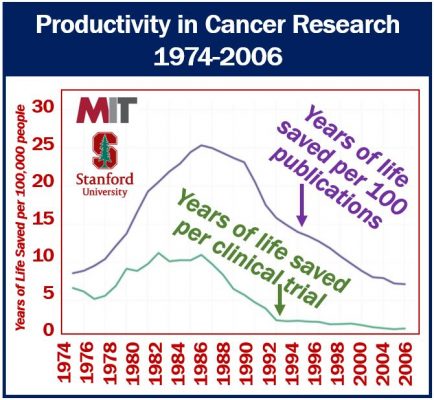
Productivity regarding new ideas for cancer treatments declined by a factor of 1.2 for all work and 4.8 for clinical trials. The researchers measured productivity by comparing years of life per hundred people saved by research.
Even though cancer research productivity declined over the 50 years, it increased from 1975 to the mid-1980s. The authors noted:
“These cases suggest that it may get easier to find new ideas at first before getting harder, at least in some areas.”
New ideas – revenue growth
It now takes approximately 15 times as many researchers versus 30 years ago to get the same rate of revenue growth. This figure is for the broader economy.
Perhaps it is taking longer for researchers to achieve a level of education required for a major breakthrough.
Ban Reenen said:
“As the total amount of knowledge becomes larger and larger and larger, it becomes increasingly difficult to get to its frontier of that knowledge. It was much easier a couple thousand years ago.”
More specialized studies
A common workaround to that problem is for people to narrow the focus of their studies. However, according to Van Reenen, that strategy also creates its own set of problems:
“In order to carry on innovating, you’re constantly working together, and it’s very complicated to get all of these people and ideas together.”
“That, itself, could be a reason why things start slowing down.”
Van Reenen does not believe that we are approaching any kind of hard limits to technological growth. Globalization, the growing ease of communication, and population growth present new opportunities for the creation of new ideas.
“As long as we keep increasing the amount of resources we put into research, we’ll keep doing that.”
Investment in research losing steam
However, continuous investment of national GDP is crucial. Van Reenen worries that investment in research has recently lost its impetus.
Regarding investments, Van Reenen said:
“The concern I have is that the investments are not being done. I think a lot of the time you hear we’ll just cut the top tax rates to generate lots of innovation – I’m pretty skeptical about that in terms of the incentives you’re going to give.”
Targeting investments and government funding
We should target our investments in new technologies and innovation more carefully. Additionally, the authors say, governments should directly allocate funds for worthwhile projects.
Better targeting and government funding could finance specific projects. They could also help expand science, engineering, technology, and mathematics opportunities for women and people of color, the authors write. People of color and women are underrepresented in those fields.
