
Researchers at NIST have developed a new method of choosing and evaluating optimal antenna designs for 5G devices. NIST stands for National Institute of Standards and Technology, a physical sciences laboratory in Gaithersburg, Maryland, USA. It is a non-regulatory agency of the US Department of Commerce.
The antenna designs are for 5G cell phones, base stations, and other wireless devices.
Researchers say that the NIST method could increase 5G network capacity. It could also reduce costs.
5G systems will use higher, millimeter-wave frequency bands. Thus, they will avoid crowded conventional wireless channels.
At these frequencies, transmissions lose a great deal of energy along the way. This subsequently weakens received signal strength.
The researchers wrote about their work in the IEEE Communications Magazine (citation below).
Smart antenna designs
One solution is to ‘smart’ antenna designs. These antennas can form unusually narrow beams. The antennas can steer the beams rapidly in different directions. The ‘beam,’ in this context, is the area in space where signals are received or transmitted.
The beamwidth of an antenna affects wireless performance and system design. NIST researchers say their new measurement-based method allows system designers to evaluate the most ideal antenna beamwidths for real environments.
Reducing cost with initial network design
Kate Remley, a NIST engineer 1999, said:
“Our new method could reduce costs by enabling greater success with initial network design, eliminating much of the trial and error that is now required.”
“The method also would foster the use of new base stations that transmit to several users either simultaneously or in rapid succession without one antenna beam interfering with another.”
“This, in turn, would increase network capacity and reduce costs with higher reliability.”
This is the first measurement-based study of how antenna orientation and beamwidth interact with the environment to affect millimeter-wave signal transmission.
In a press release, NIST explains:
“In the technique, NIST measurements covering a broad range of antenna beam angles are converted into an omnidirectional antenna pattern covering all angles equally. The omnidirectional pattern can then be segmented into narrower and narrower beamwidths.”
“Users can evaluate and model how antenna beam characteristics are expected to perform in specific types of wireless channels.”
Using method to select best antenna designs
Engineers could use NIST’s method to select the best antenna designs. Specifically, the antenna that best matches a specific application.
The engineer may, for example, select a beamwidth that is narrow enough to avoid reflections of certain types of surfaces. Alternatively, a beamwidth that allows several antennas to coexist in a specific environment without interference.
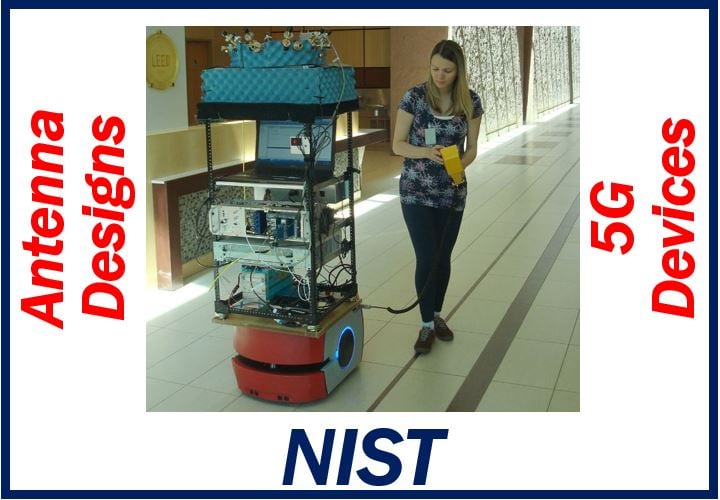
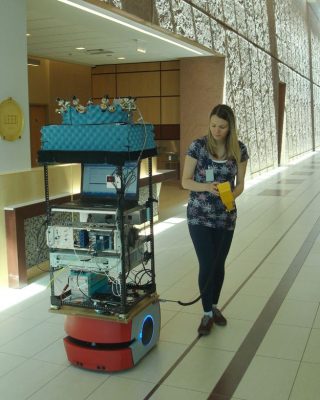
To create the new method, NIST engineers gathered experimental data in the lobby and hallway of a NIST research building. They used a special robot that they had loaded with a customized channel sounder and other equipment. Channel sounders gather data that capture the signals diffractions, reflections, and scattering that take place between a receiver and transmitter.
Engineers can use many such measurements to create a statistical representation of the radio channel to support reliable system design and standardization.
NIST engineers’ findings confirmed that narrow beams could reduce signal interference and delays considerably. They also confirmed that an optimized beam orientation reduced the loss of energy during transmissions.
The engineers say that future research will focus on extending the method to a range of environments. They also want to analyze other wireless channel characteristics.
Citation
“Millimeter-Wave Radio Channels vs. Synthetic Beamwidth,” Kate A. Remley, Ruoyu Sun, Camillo A. Gentile, Nada T. Golmie, Jelena Senic, Peter B. Papazian, and Peter Vouras. IEEE Communications Magazine, Volume: 56, Issue: 12, December 2018. DOI: 10.1109/MCOM.2018.1800177.
